

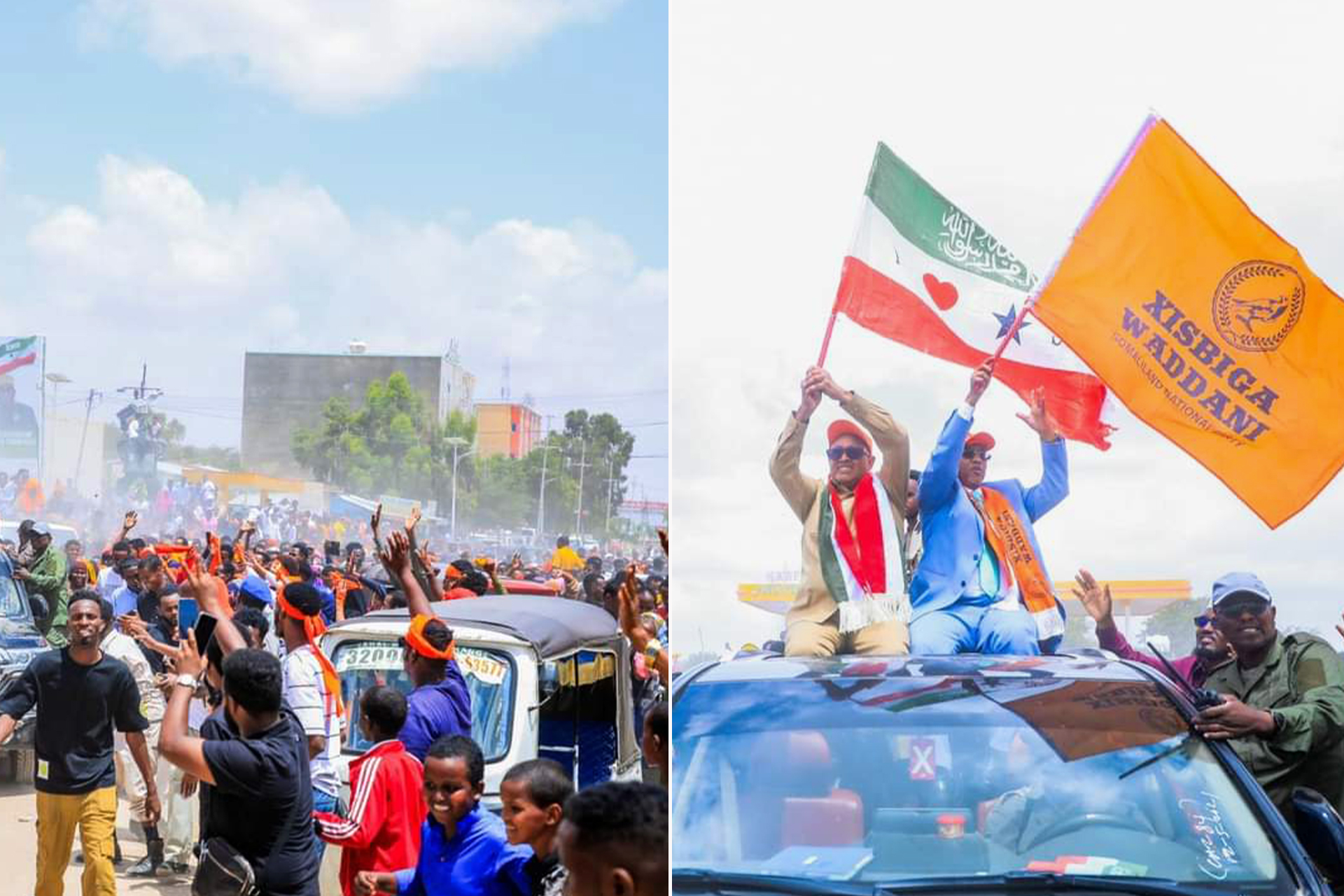
The Somalia Land (Somaliland region) is located in the northern part of the Republic of Somalia, and occupies a strategic location overlooking the Gulf of Aden and Bab al-Mandab, and with the growing strategic importance of this region- which has become a hot square for international conflict on security, energy and global trade issues, especially with the escalation of the Houthi danger in the Gulf of Aden- the interest in the region of aspiring to independence from Somalia has increased He has not received international recognition from any country yet.
This article reviews the political development of the Somaliland and explains why the region has decided to separate from the motherland of Somalia, and what is its strategic importance, and explains why the administration of US President Donald Trump wants to recognize it.
The end of Somalia’s big dream
The Western colonial forces divided Somalia into several sections, distributed after the Berlin conference between France, Britain and Italy, where Italy took control of South South and its capital, Mogadishu, while Britain took control of North Somalia, and its capital, Harguisa, and France colonized a Djibouti tape.
Moreover, Ethiopia took control of the two goats, while Kenya expanded north in the Somali regions. Thus, the colonialism divided the Somali people into five different entities that all serve the interest of colonial powers.
By this division, a national dream is born, which is the necessity of uniting the Somali peoples in one country that extends along the coastal strip of the Red Sea to the Gulf of Aden. The great idea of Somalia was crystallized during the period of the Somali patriots resistance to Western colonial powers, and it became a central and inspiring idea of the movements of the struggle and liberation of the Somali peoples, and the national forces agreed on the necessity of ending colonialism and re -merged to form the great Somalia.
By the end of the colonial era in the year 1960, Northern Somalia resigned as an independent country whose capital is Hargeisa- and it recognized its independence of a number of member states of the United Nations. While Southern Somalia won its independence in the same year from Italy in the name of the Republic of Somalia and its capital, Mogadishu. Due to the rooting idea of Somalia, South and northern Somalia leaders agreed to unit to form one country called the Somalia Republic, and its capital, Mogadishu, to join her later Djibouti after its independence from French colonialism. In confirmation of the focus of the great idea of Somalia, five stars were placed in the official state flag, in reference to the five Somalia regions that colonialized.
However, the dream of unity and the establishment of the great Somalia quickly fell, after Djibouti’s independence and unity rejected it with Somalia, and the Somali government failed to include the Somali areas in Ethiopia and northern Kenya. President Siad Berri’s bloody policies led to the disturbance of the internal situation, which introduced the country in a comprehensive chaos that ended with a civil war that overthrew the government of Siad Berri, and extended more than twenty years in which the state entity completely collapsed.
Despite the breadth of the Somali war, the Somaliland leaders quickly managed to extend security and stability in the northern region, and a local government headed by Mohamed Ibrahim Aqal formed, which managed the country and achieved a reasonable amount of development. Because of the long civil war, the collapse of the great idea of Somalia, the leaders of Somaliland decided to return to the pre -unity stage, the declaration of independence from the Republic of Somalia, the declaration of the Republic of Somalland – the Somaliland – an independent country in 1991. This nascent country was able to maintain security and stability for its citizens in a troubled region, but it has not yet received international recognition.
Geography and demography feature
The factors of geography and demography played a major role in pushing the idea of the independence of the Somaliland region forward, and because of these factors it seems that recognition of this republic by the international community has become just around the corner.
The region was able to prevent the transmission of the chaos of the Somali civil war to its territory, due to the demographic, because the majority of the population belongs to the Isaac tribe, and the cohesion of this race led to the cohesion of the state. Unlike the Republic of Somalia, in which the war was borrowed and is still due to the rivalry between races and tribes, and this is attested to that most of the solutions that were proposed to settle the conflict in the country were based on the involvement of major races such as identity, Daroud, Rahwani, Durr, and others.
Thus, the demographic contributed to the success of the state’s efforts to extend security and peace in its national soil, and achieve reasonable development, and the state also succeeded in adopting a democratic system that guarantees the smooth transition of power.
On the other hand, geography was a decisive factor in the interest of regional and international powers in this unrecognized region. Where the Somalia land has an important strategic location on the Gulf of Aden and Bab al -Mandab, the entrance to the Red Sea, an important international corridor through which 12% of the world trade passes, and more than 40% of the trade exchange between Europe and Asia.
This region has become a major international conflict area, confirmed by the large number of Western and Eastern military fleets that intersect in this region, to fight the growing marine piracy, and other security challenges, which directly affected the safety of global trade crossing across the Red Sea, and the Suez Canal on the way to Europe and the United States. And we see this in practice, in the direct threat of the Houthis, the fleets of the major countries, despite the different balance of power.
Despite the lack of international recognition of the region, many countries were dealing with them, by virtue of the fait accompli, in trade and investment issues, especially in marine fishing. Ethiopia was a pioneer to legalize dealing with Somalia, as it established a commercial office, which was the embassy in the capital, Hargeisa. The Somaliland ports were also a crossing for some ships and commercial fleets that transport goods and products to and from Somalia without intercepting any party.
The conflict on the Somaliland region was greatly renewed in January of last year when Ethiopia announced an agreement it signed with the Somaliland government, according to which it rented a plot of land in Berbera port to be an independent port used by Ethiopia and supervised by the Ethiopian Navy for a period of half a century, as part of Ethiopia’s plan to obtain a port that is affiliated directly on the shore of the Red Sea.
This decision sparked sharp reactions from the countries of the region, especially in Somalia and Egypt, and he called a wide diplomatic movement that led to new alliances that strengthened the regional and international conflict over the Red Sea and the Gulf of Aden.
But the most important repercussions of the Ethiopian decision is the emergence of a current in many countries calling for the recognition of the Republic of Somalia, an independent state, despite the legal reservations of such a decision, and it seems that the United States of America strongly supports this current.
Why is American universal recognition?
The rising international conflict on the Red Sea and the Gulf of Aden prompted American thinking centers to study various ways to maximize American existence and influence in this important waterway, and many opinions emerged that alerted and warned that if any international anti -American power to station the strategic region of the region would threaten American interests in Bab al -Mandab and the Arab Gulf.
The study prepared by the former African Minister of Foreign Affairs, Gendai Fraser, and others, published by the University of Stanford University, is one of the most important written on the relationship between the United States and Somaliland. The summary of this important study, whose writer is considered to be the leaders of the African Republican Party, called on the United States to recognize the independence of the region as a country independent of Somalia.
The study presented objective reasons for previous diplomatic positions applied by America, the most important of which is the United States’ decision in 2008 to recognize unilateral independence of Kosovo, although there is no international consensus on this, and the study indicated that all the rationale reported by former Secretary of State Condaleza Rice to confess the unilateral independence of Kosovo applies completely to the Somaliland region. They are: the interest of the United States, the presence of a government controlling the borders of the state, the weak possibility of a return to the old situation, and the possibility of a democratic system in the new state.
The study confirmed the existence of a stable government that controls security and borders, and the government applies a distinct democratic system compared to the countries of the region around it, and that after more than thirty years of secession of the region, there is no possibility to return to the old situation to be part of Somalia.
The study focused mainly on the great interests that America will gain from its unilateral recognition of the land of Somalia, in particular with regard to enhancing the influence of America and its allies in the Gulf of Aden and Bab al -Mandab, preserving the security of the Red Sea and fighting piracy and ensuring the safety of international trade, confronting the increasing threat of Houthi, and other geo -strategic threats in an area of extreme economic, security and political importance to America.
The study reduced regional and international reactions, in particular, the reaction of Somalia and the African Union, and suggested that Somalia be silenced by granting it significant material incentives, and that the African Union be required to accept the new state, similar to its previous decision to accept the membership of the Sahrawi Republic.
Strategic challenges
The study, written by Gendai Fraser, represents the vision of a wide stream of the African current poles in the administration of President Donald Trump, headed by Peter Fam and Bros Qili, and a member of the Republican Congress Scott Perry, who submitted a bill requesting the United States government to recognize unilateral independence of the region. Therefore, it seems that the issue of unilateral recognition will be a matter of time only, pending the new American administration gets all the regional government it wants.
What calls on America to accelerate the unilateral recognition of the independence of the Somaliland region is the British government’s decision to hand over the archipelago of the Shaghus Islands to Mauritius, and this decision would limit the effectiveness of America’s use of Diego Garcia in the Indian Ocean. Also, the permanent American presence in this important waterway guarantees America to secure another commercial road in the face of the Chinese belt and road initiative. In both cases, the region will be of a military and commercial strategic importance for America and its allies justifying the decision of unilateral recognition.
On the other hand, the decision to recognize unilateral recognition, in the event of its implementation, will fuel the international conflict over the Red Sea, and this region will become a strong area of tension and attraction between the various powers of greedy in the goods of the region, and it would also climb the national resistance movement in Somalia for this unqualified external interference.
If we take into account the new American administration, which wants to include Canada, Greenland, the Panama channel and the displacement of the inhabitants of Gaza, this means the end of the ancient world based on sovereignty and the sanctity of borders, and the emergence of a new world closer to the jungle law, based on force and oppression. Then there will be no place for the weak, and the world will not be a safe place at all.
The opinions in the article do not necessarily reflect the editorial position of Al -Jazeera.

