

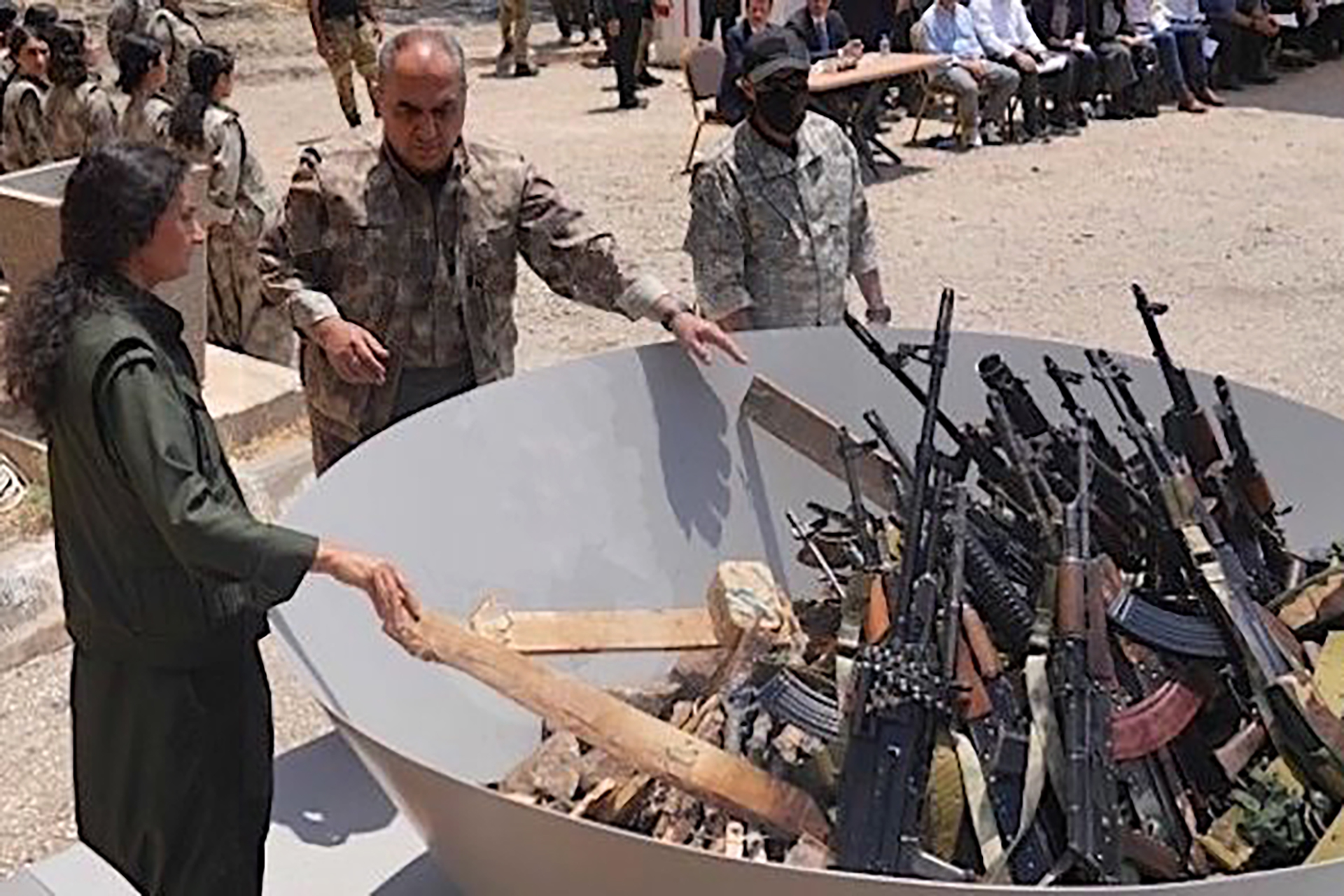
The scene of a number of members of the Kurdistan Workers Party of Party of PKK reduced their weapons in the Sulaymaniyah Governorate in Iraq on July 11, turning a difference in the history of one of the longest conflicts in the modern era, which spanned more than 40 years, and killed more than 40,000 people.
The PKK delivered its weapon in response to the invitation of its imprisoned leader in Turkey, Abdullah Ocalan, who issued a statement on February 27, before the party officially announced his weapon and left the path of armed action last May.
In a video recorded in June, Ocalan described it as a voluntary transition from the stage of armed conflict to the stage of democratic and law.
Away from the thorny political dynamics that are associated with these developments and their repercussions on the future of the Kurdish issue, an important question arises about the reasons that historically pushed similar movements, classifying as the states without the state, who chose armed work as a way to achieve its goals, to delinquency towards engaging in the field of politics.
Why do the movements abandon their weapons?
The armed movements of the decision to throw weapons differ according to the circumstances of each movement and the peculiarities of its political and military contexts, as well as internal and external developments and dynamics. However, it is possible to determine some general features that appear on transitions based on the study of different cases.
It is not an easy thing to take the decision to reject weapons and implement it.
Among the most prominent reasons for leaving the movements to work armed, as the political violence of Benjamin Akosta shows in a controlled paper, which is the belief that the military path has exhausted all its horizons, and that it has achieved all the possible to take up arms, and it is time to try other roads.
This involves a paradox that calls for consideration, as this motivation is related to achieving the movement for a part of its goals, which makes it feel that it needs a new strategy if it wants to complete the achievement of the rest of the goals, says Acosta.
On the other hand, according to the same source, you will not find the movement as a motive to throw its weapons or move to political action or to a political institution, if armed action proves its effectiveness, which means that achieving part of the goals, and not all, is the scenario that will push the movements to throw its weapons.
https://www.youtube.com/watch?v=a9AVBV0SDAC
Access to a dead end
Examples of the scenario of leaving the rebel groups after achieving some of its goals, the Farabundo Marti Front for National Liberation in El Salvador during the civil war in the 1990s.
The movement, and the Salvadian government, felt that the civil war had reached a dead end without a clear path of victory for both parties, so that the movement would take a decision to turn into a political party in 1992, and seek to achieve the goals it wants through the ballot boxes.
Other reasons are related to the response of movements to prominent developments on the regional and international scene, and to think about alternative ways, whether these developments, from the movement’s perspective, are positive or negative developments, as explained by the book “From Revolutionary Movements to Political Parties”, by the authors David Klose and Kalawati Diandan.
This is, for example, the fall of the Soviet Union, and the accompanying loss of many countries and movements, the financial and moral support that the Federation provided to them.
One of these movements was the African National Congress in South Africa in the 1990s, as the movement found that its safest option is the path of negotiations and settlements, after losing support, as well as the ideological shock that accompanied this.
This is also highlighted by any other reason, according to the book itself, which pushes some movements to throw their weapons, which is the material factor that may force a movement to end its armed work because it is no longer able to provide its causes simply.
You may also choose a movement to move to the political path to prolong its life, or for fear of losing its importance and base after the absence of the reasons that prompted the movement to the armed work in the first place.

Here are the most prominent armed movements that led a military rebellion in their countries before they abandoned their weapons, to end up turning into a political party participating in public political life:
- The National Resistance Movement “Renamo” in Mozambique
The Renamo movement was established in 1977, by the military intelligence services in Rodsia and South Africa, with the aim of destabilizing the Marxist Frelemo government, and that was two years after Mozambique’s independence from Portugal, researchers explained.
However, Renaamo proved her skill in exploiting real grievances that were present in the Mozambician society, and this enabled her to reformulate herself as “an alliance of marginalized”.
Its leaders, especially AFonso Dalakama, sought to give legitimacy to Renamo as a political force that has an ideological agenda represented in neoliberalism and democracy, as well as proving its ability to control and control the lands, rather than it is just a violent tool.
The Renamo movement officially turned into a political party in 1994 under the 1992 General Peace Agreement, which ended the civil war in Mozambique.
However, this was only after negotiations that lasted for months with the government to recognize the movement, as the government initially saw that Renamo was only an armed group. This shift came as a result of a state of military inertia, the decline in external support, and a severe drought that hindered its armed operations.
It is true that the Renamo movement has greatly preserved the popular base that it was able to build during the war period, but it was unable to win any of the legislative and presidential elections that it fought, and the Freeimo alliance remained at the head of power in Mozambique, and intermittent clashes erupted between the government and the movement and some of its branches in the period 2013-2019.

- Irish Republican Army and “Shen Fin”
The founding of the first group bearing the name of the Irish Republican Army in 1919 to combat the British presence in Irish territory. He worked alongside his political arm, Shane Vin, throughout the twentieth century to oppose British rule in Northern Ireland.
The Shin Finn refrained from participating in the elections after the escalation of the conflict in the early 1970s, which made the Irish Republican army the dominant force in the national struggle.
However, after the election of the imprisoned fighter Bobby Sands in the House of Commons in 1981, the army adopted the strategy of “Venice and the polling box” where Shin Vin began to run in the elections, while the Republican Army continued its armed struggle against the British forces and paramilitary groups loyal to it.
This was followed by the decision of the Irish Republican Army completely removing its weapon in a process that ended in 2005. This was in light of the change of the political context in Northern Ireland, as the continuation of armed units became harmful to political gains, according to a joint report of the Bergov Foundation and the United Nations.
The decisive factor in this complete shift was to preserve the unity of the Republican movement, which required extensive consultations with members, political prisoners, and communities in the Diaspora to persuade them of the strategic value of the settlement in order to achieve the final goals, as explained by the report.
Shane Vin’s political support began gradually growing after his first election campaigns, until 20% of voters exceeded in 2001, and the most powerful party in Northern Ireland became in 2022.
https://www.youtube.com/watch?v=jtstowwdus
- Revolutionary Armed Forces “Fark” in Colombia
The Colombian Revolutionary Armed Forces is a Leninist Marxist movement founded in 1964, thus being the oldest armed rebellion movement in Latin America.
The book “From Revolutionary Movements to Political Parties” says that the movement attracted the new farmers in the East Columbia plains, and sought to implement the principles of equality and socialism in Colombia. Despite her political speech, Fark became involved in criminal activities to finance her armed operations.
Fark participated in the political field on two occasions, the first of which was in the mid -1980s with an electoral arm, the National Union, and then achieved some success at the beginning, but the state launched a fierce repression campaign against it, in the absence of confidence between the two parties, the assassinations of a large number of members of the movement included this without a response, which led to the renewal of armed rebellion.
A new opportunity to integrate the FARC movement into the political process during the peace agreement in Havana in 2016 was made. The agreement to exchange benefits, including that FARC handed over its weapons and demobilized its fighters in accordance with a specific time map, and under the supervision of an UN mission.
On the other hand, the agreement stipulated that ten seats for Fark members in Congress, with the establishment of the Fark Political Party (which changed to Kumins in 2021).
However, after the disarmament phase of many obstacles and setbacks, about 300 Fark fighters were killed in just 5 years, without change in the deteriorating security conditions.
The performance of the Vark Party was weak at the political level, and its leaders, who are still facing charges and trials against the backdrop of crimes committed during the conflict, were unable to gain street confidence or obtain its support, according to the sources.
To this day, tension and apprehension still overcome the relationship between the government and the Fark factions, which led to the outbreak of clashes in different periods, despite the signing of the peace agreement.

