

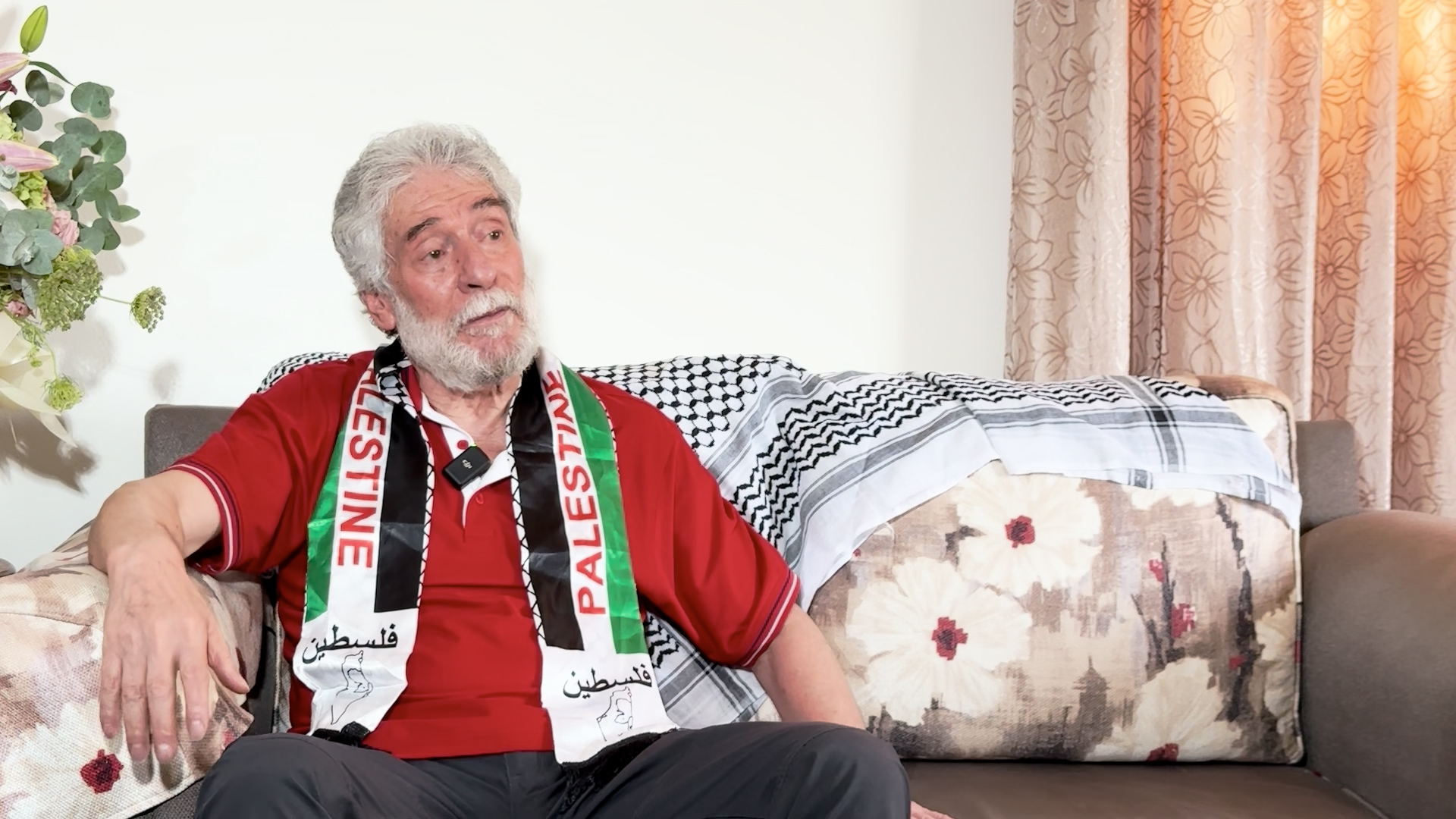
Akkar- In his Canaanite hometown, northern Lebanon, the mother of the Lebanese fighter George Abdullah was awaiting his return every morning, she counted the days in the hope that her son will return free, but death is urgent before she sees the moment of release and lives her joy.
For more than 4 decades, the image of Abdullah was not lost on the memory of the place, and it became an icon of the struggle, to be raised in the popular marches, and it is attached to the walls of homes and shops, and the mothers of the villages bear it as they carry the pictures of their missing sons in wars and exile.
In a corner of his rural home, the messages are still carefully preserved, smelling stubbornness and dignity. Next to it, the books that he read repeatedly were stacked under the light of the faint cell, as he chose to keep his thought free and his soul is disobedient to families.
West reception
Since the moment of his release a few days ago from the French Lanzanan prison, the tribes have turned into a pilgrimage to the coming delegations from various Lebanese regions, and his town received him as the heroes, on the impact of the Zagarid and the tears of pride, amid songs that narrate the story of patience and victory.
In his simple stone house, the movement does not calm down, and the visits are not interrupted, women carrying roses, young people raising the flags and pictures, and the companions of a trail come to shake hands with the steadfastness in his person.
And between the rice of Akkar, George Abdullah continues to receive guests with a confident smile, a fixed look, and a memory of no sheikh, as if the families did not succeed in breaking anything from his hardness, but rather his polishing to be a living witness to an unforgettable time.

In a special interview for Al -Jazeera Net, the militant Abdullah confirms that the moment he left the prison is not the end of the trip, but rather the beginning of a new struggle that reflects a shift in the balance of power, and expresses a political defeat for the French state, which has become aware that his continued detention turns from a pressure card to heavy burden.
He says: “We are facing a new stage, open to everyone who will meet them in Lebanon, including struggles, militants and masses, and the reception exceeded all my expectations and the faces that gathered were a mirror of the hardness of our people and their loyalty, and this is what is reassured and confident.”
Abdullah, the scene of the reception, regained the elements of the state security upon his arrival, describing it as “sudden and warm”, and added that the leader of the force and his officers acted as “loved”, and I did not expect this level of intimacy, and this touch that reflects the essence of our Lebanese if it is true.
On the atmosphere of the first moment, he says: “Since I was on the plane, I felt this popular solidarity that rejoices any fighter, whether in prison or outside.”

Fighter and armed struggle
And about the years of families, who exceeded 40 years, Abdullah says: The harshness of the prison did not succeed in isolating him from his people and his cause, and he adds that the arrest in itself is painful, but he was surrounded by a broad solidarity movement, especially from French militants and political actors who were visiting him regularly, and they remain in constant contact with what is going on.
And Abdullah was receiving – according to his saying – 5 messages per week, each of which contains 90 pages from the Lebanese, Arab and Palestinian press, stressing that “he was not interrupted, but was involved in the details, and active in the struggles of my comrades, despite the prison bars.” He concludes, “The militant is not preserved in the fridge, and it is not frozen as a piece of meat, so that he should remain alive in the heart of the struggle.”
Abdullah believes that the struggle is not merely sacrifices that are made to the altar of the homeland, but rather an existential act stems from a profound association with the issue, and he says: “Whoever sees the struggle a burden will not stand up, but whoever derives his steadfastness from the conscience of his people, he continues.
https://www.youtube.com/watch?v=g88e92z060
In the context, he expressed his wish that the Palestinian prisoners would receive even a part of the solidarity and support he received during the years of his family, stressing that the fascism of the Israeli occupation calls for an universal international position.
When asked about the legitimacy of the armed struggle today, Abdullah responded firmly, “The armed struggle is not a theoretical slogan, but rather a necessary tool in the face of Zionist violence and imperialism, is a reality that we live daily in Gaza, Lebanon, and other struggle arenas.”
He stressed that this option does not contradict the building of the state, but rather reflects its absence, and says: “We want a state that protects its children, with a strong armed army, and we carry weapons when the army is stripped of its weapons, and when a capable national army is available, we are its soldiers and officers from our people.”
He added, “The militia does not arise from the vacuum, but rather from the state’s failure, and the political class is the one who stripped the army of the tools of defense, and not mothers or ovens.”

Standard Lebanon
On the performance of the Lebanese state in following up his case, Abdullah says: “In some stages, she did what is necessary, but often it was completely absent, I do not ask her to bear the burden of families, but at articulated stations, there were those who performed his duty with responsibility and patriotism.”
He specialized in thank the Minister of Justice that he visited in his prison, and said: “She was carrying solidarity messages, embodied in the true image of Lebanon that we dream,” and praised the role of some Lebanese diplomats who assigned to follow up on his file, expressing his gratitude to them, considering that estimating the effort does not necessarily mean adopting an official position.
Abdullah describes France as a state “organically linked to Israel, historically and in the interest”, and says it “is its adultery to the Arab National Movement”, but it stresses that Lebanon – despite its geographical smallness – remains a source of life and struggle.
“I was a fighter and I will stay, I spent 41 years in prisons, 21 years before it in the struggle, and my site is determined by the battle, but my hope grows up when I see this wide popular alignment in the face of the Somanah Lebanon project.”
Abdullah warns of attempts to transform Lebanon into “a soft spot guarded by Israel,” explaining that “Lebanon is not fragile, but the castle of Samoud, whoever stands alone in the face of Israel deserves respect for the Arab world, and not let down.”
He added, “Our revival was bombed in Beirut, and we did not find a single Arab country that supplies the army with a missile, and today, it is required to disarm the resistance (Hezbollah) without anyone providing an alternative.

To the Arabs about Gaza
Abdullah sent direct messages to the Arab capitals, asking, “Who will carry bread and water to the children of Gaza? Where is the one Muslim among millions of Egyptians, who advances towards Gaza to drop the genocide?”
He is reminded of “Greta”, the European girl who cut the ocean with a small boat carrying a box of milk to Gaza, asking: “If Greta did it, then what is the mind of entire peoples cannot be sent a drink of water?”
He concludes, “Al -Azhar is not a symbolic institution, but a living conscience for the nation, and today it has to scream, there is no silence after the massacres, there is no neutrality with the genocide.”

