

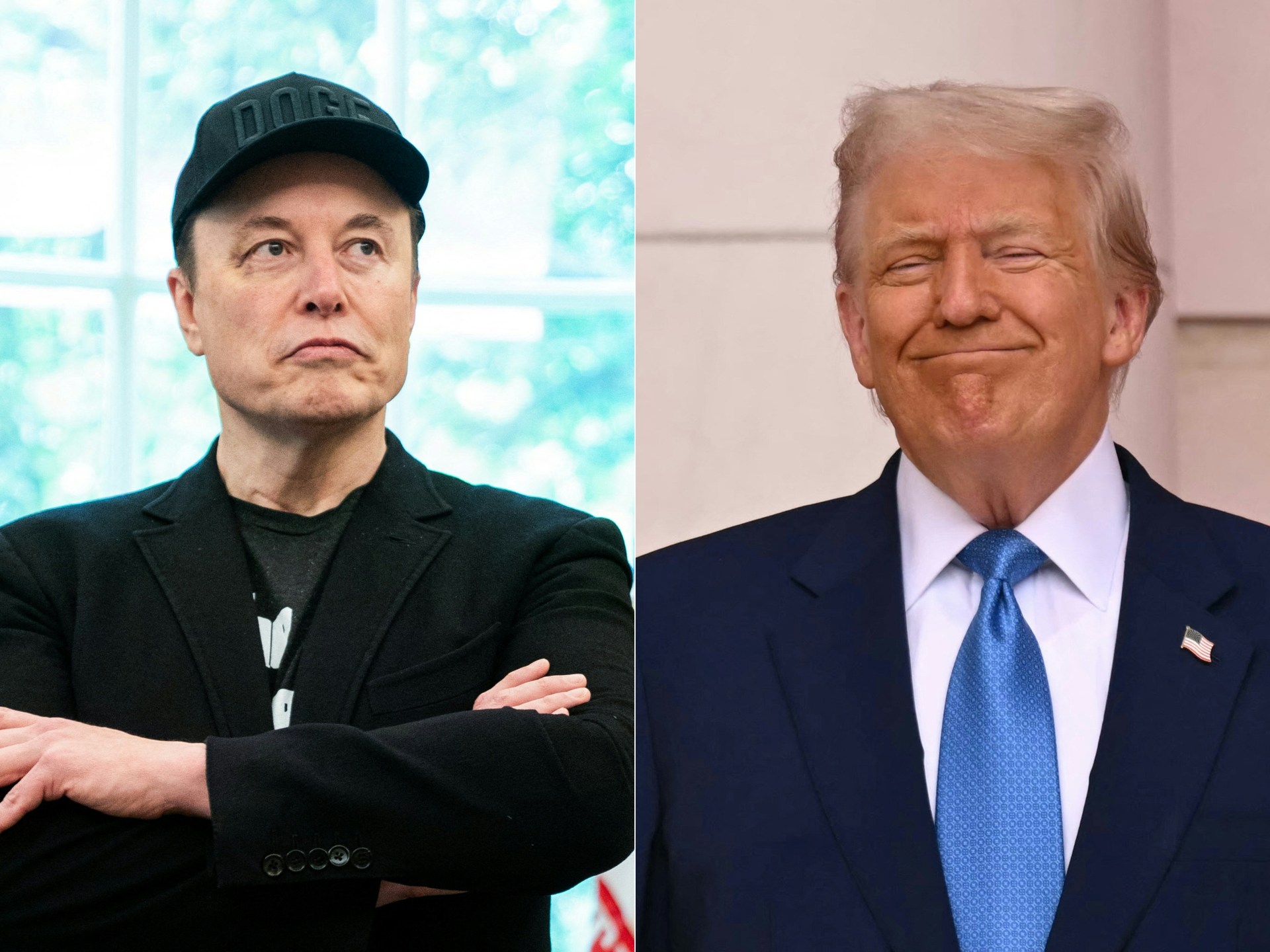
In a new escalation of the dispute between US President Donald Trump and billionaire Elon Musk, the White House announced that the president “does not intend” to speak to Musk, in a move that reflects the depth of tension between the two parties after harsh criticism directed by Musk for the new budget bill supported by Trump.
A senior White House official told the French Press Agency that the president was not interested in communicating with Musk, although the latter asked to contact him. The official added that Trump “focuses entirely on presidential affairs”, denying the validity of reports that talked about a possible meeting between the two men.
This tension comes after Mask described the budget project that Trump called the “Beautiful Great Law” as “an abomination that raises disgust”, warning that it will increase the government deficit by about $ 2.5 trillion during the next decade. Trump responded by describing Musk as “the man who lost his mind”, hinting on the possibility of selling or donating a “Tesla” car, which had become a symbol of his former support for the president of the SpaceX company.
Tesla shares fell by more than 14% yesterday, Thursday, which led to the loss of more than $ 100 billion of its market value, before it was partially recovered on Friday. It seems that the dispute may threaten huge government contracts that Musk companies were dependent on, especially in the fields of space and energy.
https://www.youtube.com/watch?v=9dfffmdz3c
In an attempt to contain the escalation, Musk posted a tweet on the “X” platform in which he said: “We will not withdraw the Dragon vehicle,” referring to a previous threat to withdraw the spacecraft used by the American Air and Space Agency (NASA) to transfer its pioneers to the International Space Station.
But the tension did not stop there, as Mask launched an opinion poll on the formation of a new political party representing “80% in the center”, which was considered by observers a direct threat to the republican base that Trump relies on his election campaign.
In Moscow, Russian leaders entered the crisis line with sarcastic comments, as former Russian President Dmitry Medvedev presented the mediation between the two parties “for a reasonable wage”, while Representative Dmitry Novikov said that Russia “can of course” grant political asylum mask if needed.
In light of this escalation, the question remains open about the future of the relationship between the richest man in the world and the head of the most powerful country, and whether this estrangement will lead to the reconstruction of political and economic alliances in the United States.

