

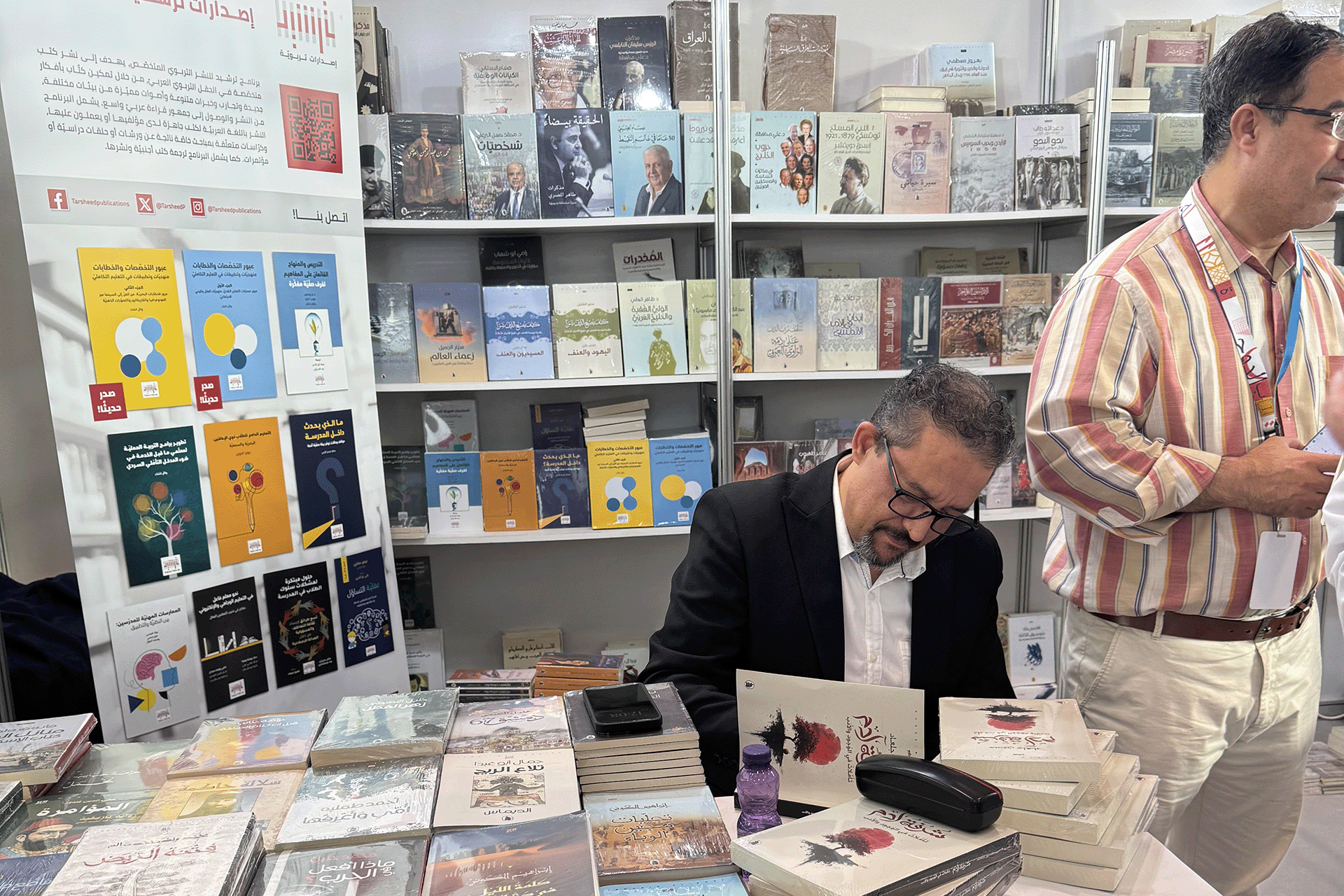
Doha – Jordanian poet and journalist Hussein Gilad signed his new book “The balcony of Adam … reflections on existence and literature”, on Friday evening, in the wing of the Arab Foundation for Studies and Publishing.
The newly published book in Beirut is an extension of Gilad’s long experience in cultural journalism and literary writing, and combines philosophical reflections with literary and critical visions, through in -depth articles and readings, and dialogues with Arab and international literary symbols, collected over more than two decades of journalistic and cultural work.
The Jordanian poet and storyteller, in a dialogue session within the activities of the Doha International Book Fair, stressed that literature is the widest space in which a person can express his livelihood and humanity in all forms of artistic expression of poetry, story and novel.
He said that Adam’s balcony is an invitation to meditate from a high location, as a person is not satisfied with thinking about his current day, but rather contemplates the origin of his ideas and fate. He added, “It is a balcony that is not governed by the determinants of politics or ideology.
He pointed out that this meditation leads to the sublimation of ideas that may not serve man or society, and that literature, in its essence, is a way to improve our human conditions and thinking in an ideal form of society and self.
The writer expressed his great happiness by participating in an evening within the activities of the Doha International Book Fair, and thanked the attendees and to manage the exhibition for organizing this prominent cultural event.
Literature and the arts of expression
On the philosophy of the title of the book, the writer explained that “Adam’s balcony” carries a philosophical and cultural indication, which stems from the idea of meditation in human ideas, indicating that literature is the most loving field through which a person can express his ideas, away from the complications of politics or other restrictions.
He stressed that literature is “the voice of man from the inside” and its interaction with his community, which is the means through which he can express himself with sincerity and transparency, with all its contradictions, tear and humanity.
He continued, “All that a person wants from a saying can find him in literature, whether through poetry, novel, story, or other written arts.”
Regarding the content of the book, he explained that the work contains intellectual and literary dialogues that have been accomplished over many years of work in the cultural press. These dialogues are divided into sections, the first of which is with Jordanian writers by virtue of his long work in Jordan, then other dialogues with the Arab book he met during his work in Qatar, or during his previous work in Amman and in Arab newspapers such as “Al -Nahar” and “Al -Quds Al -Arabi”.
He also referred to meetings that brought him together with writers from Western capitals, such as the famous Italian poet Eduardo Sanjuniti, who was one of the most prominent poets of Italy when he interviewed him. In his late years, Sanjuniti presented a new pattern of poetic writing, describing it as “my poetry” at the time.
He pointed out that these dialogues came within a literary project aimed at exploring the human self through literature, and thinking about the human position of existence, through a “balcony” that overlooks knowledge, experience and life.
From criticism of the story and the novel
On the diversity of his literary production, Gilad said that he is basically a poet, and he also has a story collection entitled “Eyes of the Bowage”, and he also has a tendency for fictional writing and works on fictional manuscripts that will be published later.
He indicated that “all written arts start from one origin, is meditation,” adding that even the physicist Einstein believed that the great discoveries begin with a risk of contemplative, not sporting equations.
He emphasized that he does not see real breaks between the forms of literary writing, but he sees them conditional on perfection. He added, “A person does not become a poet overnight, but rather talent, culture, and long experience.”
When asked about the intellectual and philosophical reference on which his writings are based, Gilad said with confidence, “Man is the basic idea.
He added that writing about man is not fundamentally different, whether it is in the form of a poem, a novel or an article, stressing that the permanent reference point in his literary project is the contemplation of the self and the existence from a human balcony.
The attendance of the symposium held in the middle of the Doha Book Fair in his penultimate day expressed their appreciation for the deep intellectual illuminations the writer about his book, wishing him more success in his upcoming literary projects.
It is noteworthy that the author was born in 1970, who is a Jordanian poet and journalist, and works on the Al-Jazeera Net website, and he is a member of the Jordanian Writers Association, and he occupied the membership of its administrative body (2004-2005) and is a member of the Arab Writers and Writers Union.
In 2006, Gilad was chosen as the Jordanian poetry ambassador to the world poets, a literary organization based in Chile, which includes thousands of poets, as chose by the Hay Festival – in cooperation with UNESCO and the Lebanese Ministry of Culture – among the best 39 young writers in the Arab world and the Diaspora (Beirut Prize 39) on the occasion of the choice of Beirut as a global capital of the book in 2009.
He was issued in the literature “Higher always crucifixion” (poetry, house of time, Amman, 1999), and “As the Prophets lose” (Poetry, Arab Foundation for Studies and Publishing, Beirut, 2007), and “Eyes of Al -Ghawaf” (short stories, Arab Foundation for Studies and Publishing, Beirut, 2023). And “Adam’s balcony” (literary criticism, Arab Foundation for Studies and Publishing, Beirut, 2025). It was also issued to Jalamad, intellectual and political publications, which are “myth and gun … the impact of globalization on Zionist political thought” in 1999, and before it “the Kurdish issue and the Kurdistan Workers Party” in 1997.

