

4/6/2025–|Last update: 21:25 (Mecca time)
The performance of the Hajj pilgrimage has a special place in the hearts of Muslims who long for the visit of the Grand Mosque in Makkah Al -Mukarramah, but the people of Upper Egypt are adding a unique taste to this entire trip, as they celebrate their arguments with a distinctive ceremony that they inherited for decades.
Relatives and neighbors deposit the guests of Rahman to sing the songs and songs accompanied by the tunes of popular music inherited generation after generation, to celebrate this obligation that is described as traveling for their performance as a “journey of life.”
“Praise be to God, we are here to hold special ceremonies for pilgrims, as we visit them, and we hold a celebration and dinner that we call our loved ones and our people, sit together and have dinner, and we bring praise and an appeal to the male, which is one of the customs and traditions of our inherited country.”
These songs represent a unique mixture of religious expression and popular emotion, and reflects the feelings of pride, nostalgia and reverence, as well as an inherent part of the social and religious fabric in Egypt, especially in rural and Upper Egypt.
Folklor Hajj
In the book “Folklore of Hajj: The popular song as a model” of the Egyptian academic Mohamed Ragab Al -Najjar, the author specializing in folklore is monitored by folklore songs, considering that they “constitute a popular perception of a scene from the scenes of this holy journey, or one of its prominent stages, from the beginning to the end.” Al -Najjar describes these ceremonies as the “pilgrim wedding”.
https://www.youtube.com/watch?v=BQSD1OP1EUO
The late academic continues that the popular songs associated with the pilgrimage “are, like any popular song, with limited artistic features or characteristics, including that they are unknown and unknown composer, and live oral performance alone is a way to spread and prevalence.”
He adds that these songs are based and their upbringing are “a singing lyric form, which women only perform … which explains to us: Why was most of the pilgrimage songs … directed to women, and most of them carry the pronoun of the addressee or the feminine absent.” However, he adds that, according to the performer, whether it is a man or a woman, “the popular melody or rhythm in both cases, as a popular melody inherited.”
But that tradition has witnessed some change recently. Naguib says that they are now increasingly using the huge loudspeakers from which songs are emitted, instead of chants and traditional musical bands. He adds: “We prepare the DJ music device, and we go to the airport, and we spend our day there, and we ask God to provide everyone with this visit, God willing.”
Among the songs that seek on such occasions are the song “Rayhah Fein Ya need”, “O Rayyan for the dear Prophet”, and “Congratulations, Hajj Hanik.”
Hajj murals
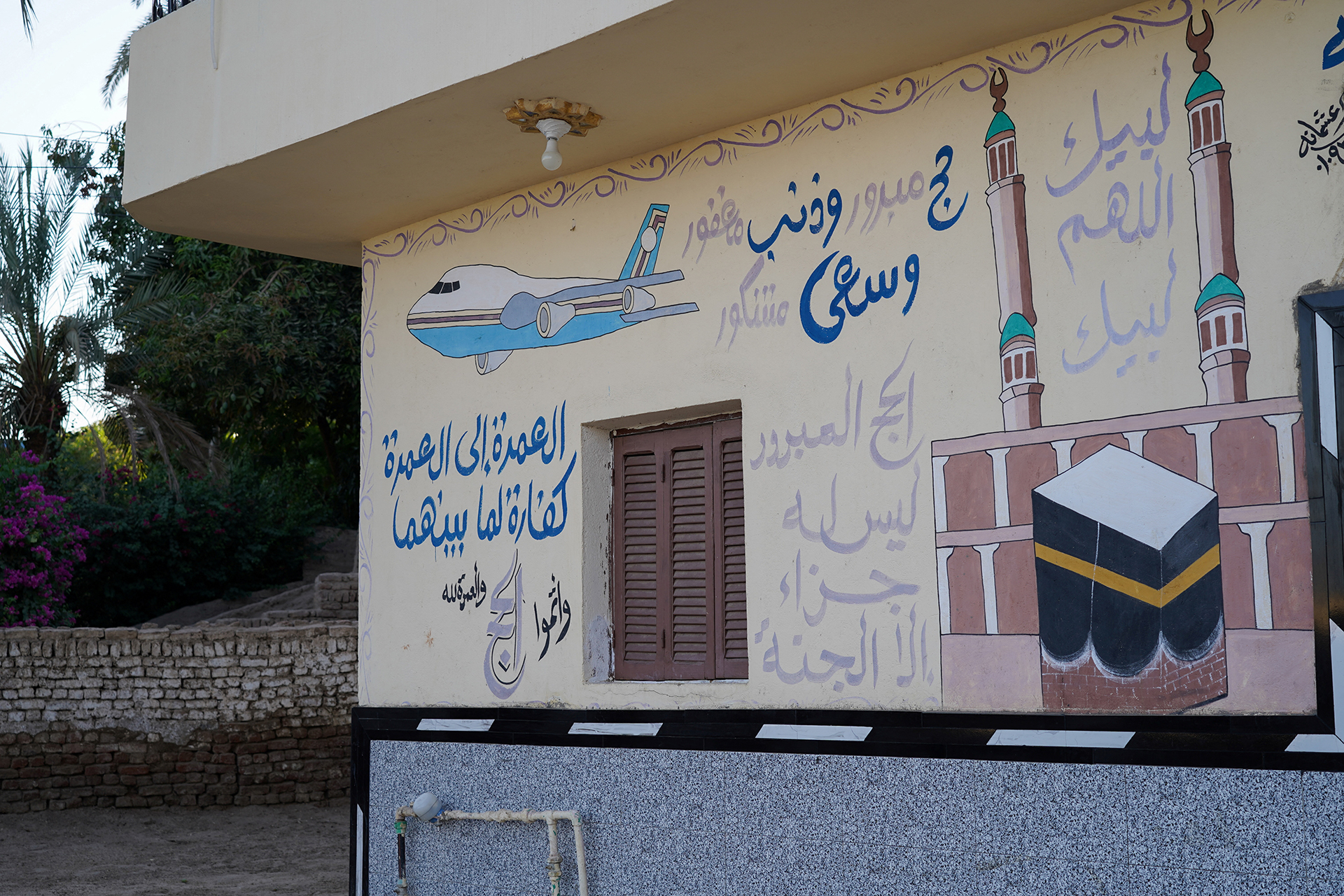
Eating the pilgrimage journey in the popular heritage is not limited to singing only, but also extends to another artistic type, which is drawing on the walls, or what is known as the art of murals.
Dr. Safia Al -Qabbani, the former dean of the Faculty of Fine Arts at Helwan University, says that one of the most prominent manifestations of the social and artistic ceremony is “murals that adorn the facades of pilgrims’ homes, which represent a visual testimony to the performance of this sacred ritual. These murals are not just decorations, but rather a living record that reflects the Egyptian society’s perceptions of Hajj as a spiritual and social journey that deserves documentation, and reflects the manifestations of joy and joy. ”
“These murals are not just decorations, but rather a living record that reflects the Egyptian society’s perceptions of Hajj as a spiritual and social journey that deserves documentation, and reflects the manifestations of joy and joy.”
Naguib supports this, saying: “When you return from the Hajj, your family has drew for you on the wall certain drawings, and they renew them. For example, my father and my mother do the obligatory prayer in a year, I do not remember exactly, 2013. When I return, I will find an example of a drawing on the wall in which he wrote: ‘
“The basic forms are usually drawing the Kaaba and the plane, and if they want to draw a ship, we draw them to them. After that, verses from the Holy Qur’an write about the Hajj, as well as some prophetic hadiths related to the pilgrimage.” Riyad has been practicing this profession since 1992.
https://www.youtube.com/watch?v=2WcGDIM3KL4
The academic opinion agrees again with the popular opinion, so Dr. Safiya states that the drawings include “drawing the Kaaba, sentences, and the pilgrim, and symbols such as the palm and the eye, and many symbols each of which are its significance. The drawings are characterized by hot colors such as yellow, red and green, along with the black and white colors that reflect purity and purity, and the color of the Kaaba with its darkness, while the hot colors express the celebrities And others, and about the strong sun and bright colors of Egypt. “
She adds that the tradition of decorating the Egyptian homes with the Hajj drawings is due to the fact that the ancient Egyptians were used to documenting their daily trips and activities on the walls of temples and aliens. As Islam entered Egypt, this tradition turned to document the holy Hajj journey instead of hunting trips. “
But it states that there are differences between cities and regions regarding that popular tradition, saying: “There are still provinces such as Aswan, Luxor and Qena maintaining this tradition with vitality. However, immigration from the countryside to cities has transferred this art to some popular neighborhoods in Cairo and Alexandria, even if it is less clear.”

