

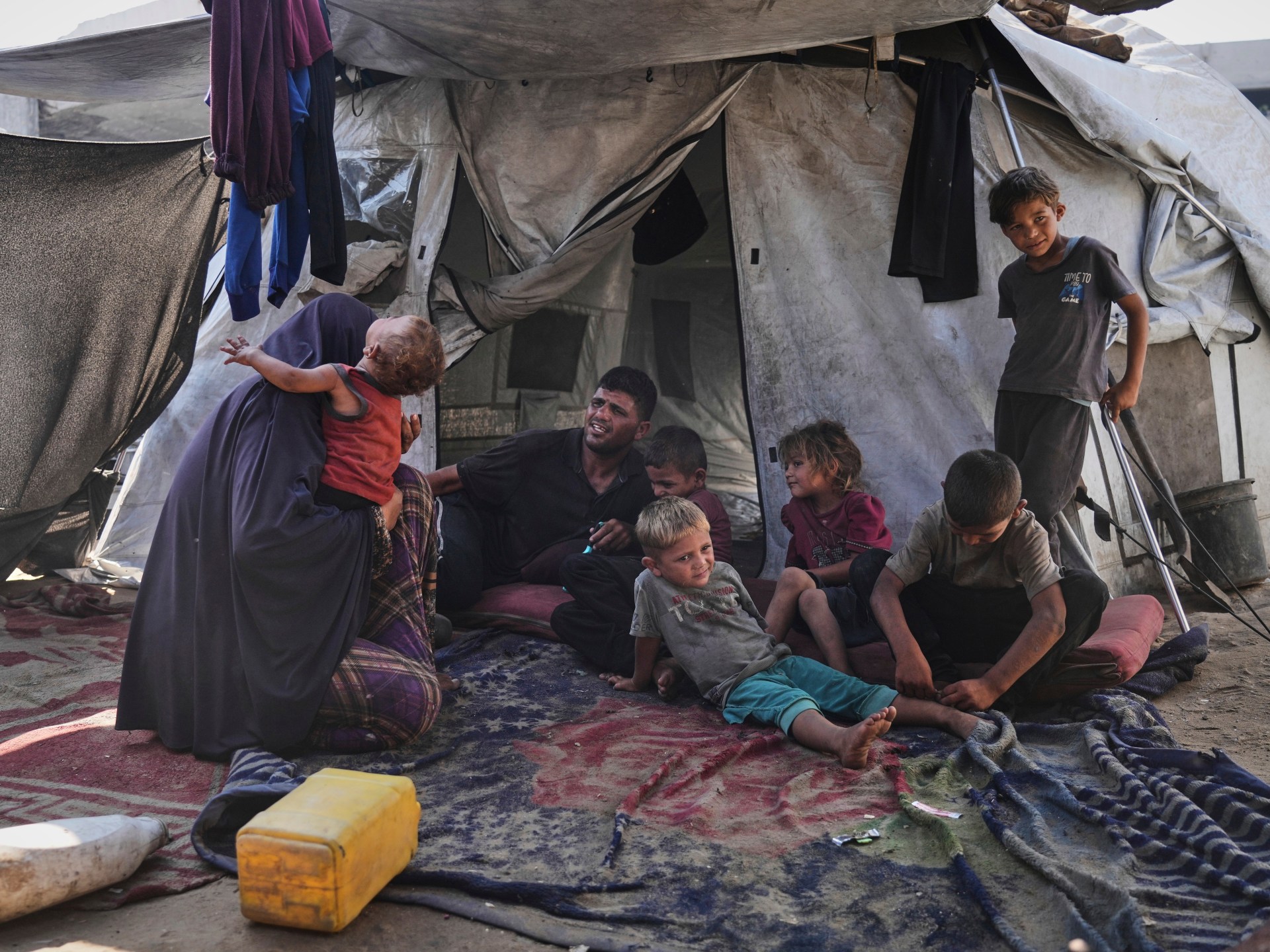
After being moved several times during the War of Israel against Gaza, the Sobh family took refuge in a coastal camp west of Gaza City.
Fadi Sobh Street Seller, 30, describes his tent as “unbearably hot during the summer”. His 29 -year -old wife, Abeer, collects sea water because drinking water is shortage.
Children in turn bathe, standing in a metal basin while their mother pours salt water over them. Hala, nine months, cries when salt irritates his eyes, while her brothers and sisters carry discomfort without complaining.
Abeer feeds Hala water with a bottle. On the right days, she has lenses to grind powder and mix with water. “One day looks like a hundred days, because of summer heat, hunger and distress,” she said.
Fadi goes to a popular soup nearby, sometimes with one of his children. “But food is rarely available there,” he said.
The kitchen works about once a week, never responding to demand. Often, he waits for an entire day only to go home without anything “and children sleep hungry, without eating”.
Abeer sometimes goes to help trucks near the passage of Zikim alone or with Youssef, one of his children. The crowd is mainly men – stronger and faster than it is. “Sometimes I manage to get food, and in many cases I come back empty-handed,” she said.
When he did not succeed, she begs those who obtained supplies. “You have survived death thanks to God, give me anything,” she pleads. Many are kindly responding, offering him a small bag of cook flour for children.
During the hottest hours of the day, the six children stay in or near the tent. Their parents encourage them to sleep through the heat, preventing them from using energy and being hungry and thirst.
As the temperatures drop, children come out. Some days, Abeer sends them to ask the food for food. Other times, they are looking in the ruins in ruins of Gaza, passing by the rubble and the garbage for everything to supply their makeshift stove.
After spending the day looking for the essential elements of life – food, water and fuel cooking – the family sometimes gathers enough for Abeer to prepare a meal, generally a thin lens soup. Most often, they have nothing and have grown hungry.
Abeer says she weakens, often feels dizzying when looking for food. “I am tired. I am no longer able, ”she said. “If war continues, I think I take life. I have no more strength or power. ”

