

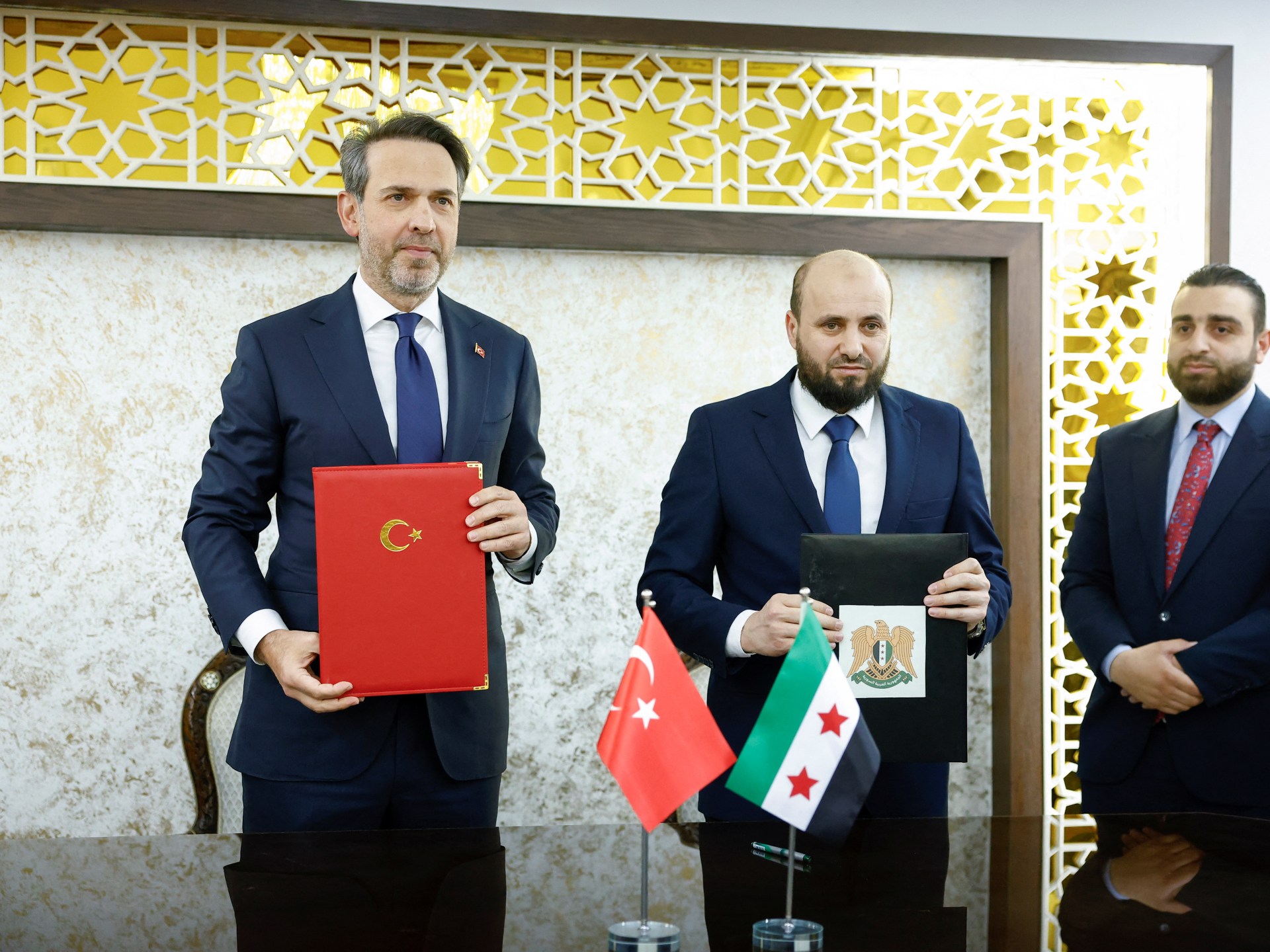
Damascus – Syrian Energy Minister Mohamed Al -Bashir announced a new agreement with Turkey to extend a gas pipeline between the two countries, and to complete the technical measures to connect the electricity line of 400 kV, which would make a qualitative shift in improving the reality of electricity in the country.
This came in a press conference held today by the Syrian Energy Minister and his Turkish counterpart, Alp Arslan Bayrakdar, after extensive discussions that included cooperation in the fields of energy, electricity and mining, in the framework of efforts to reconstruction and construction made by Syria.
Al -Bashir said that the operation of this link is expected to take place before the end of this year, and Al -Bashir revealed the agreement of the two sides to form specialized technical committees in various energy sectors to follow up the implementation of the agreements reached.
For his part, Turkish Energy Minister Alp Arslan Bayrakdar stressed that his country has already started providing Syria with two billion cubic meters of natural gas, which will contribute to generating about 1300 megawatts of electricity, explaining that the ongoing projects focus on supporting the Syrian infrastructure and meeting the basic needs, especially in the electricity and energy sectors.
Bayrakdar pointed out that the major companies that were previously operating in Syria have expressed their full willingness to return and invest again, considering that lifting sanctions alongside joint projects will constitute a strong incentive to attract foreign investments to the Syrian market.
The two ministers stressed the importance of continuous coordination to enable the entry of Turkish companies in the vital investment fields in Syria, such as mining, phosphates and energy, in order to support the country’s efforts in the path of reconstruction and economic recovery.
Industrial production
For his part, Syrian economist Dr. Ibrahim Gosheji talked about the crisis that the Syrians have experienced during the past years since 2011 regarding the abundance of energy, which led to the spread of diesel, gasoline, fuel and gas on the black market and its high prices, which negatively affected production costs in various sectors, especially the food, transport and industry industries.
Qoshji added, in a comment to Al -Jazeera Net, that this reality prompted many Syrians to resort to solar energy as an alternative option, despite the high costs of its composition during this stage, noting that the “post -liberation” stage witnessed a remarkable improvement in the availability of oil derivatives in various governorates, with a relative decrease in prices.
The expert pointed out that the new Syrian government seeks to sign agreements with neighboring countries, especially Turkey and Jordan, to provide Syria with electricity, gas and spare parts necessary for the generation stations, in a move aimed at alleviating the energy crisis and achieving stability in the electrical current.
Qoshji pointed out that securing a stable and continuous electrical current, such as the one agreed with Turkey today, would restart the wheel of industrial production, and stimulate investors to enter again to the Syrian market, especially in light of the low operating costs resulting from reducing dependence on private generators.
Qoshji stressed that any positive indicators of improving the business environment in Syria will contribute to attracting Syrian businessmen from abroad, and encouraging them to return to invest in their homeland, pointing out that the agreements with neighboring countries bear messages of reassurance to regional and international investors about the government’s seriousness in rehabilitating the infrastructure.
He emphasized that the stability of electricity does not represent mere improving in the daily life of the Syrian citizen, but rather a basic pillar in building the economy again, improving the investment environment, and attracting capital that can accelerate the pace of economic recovery in the country.

