

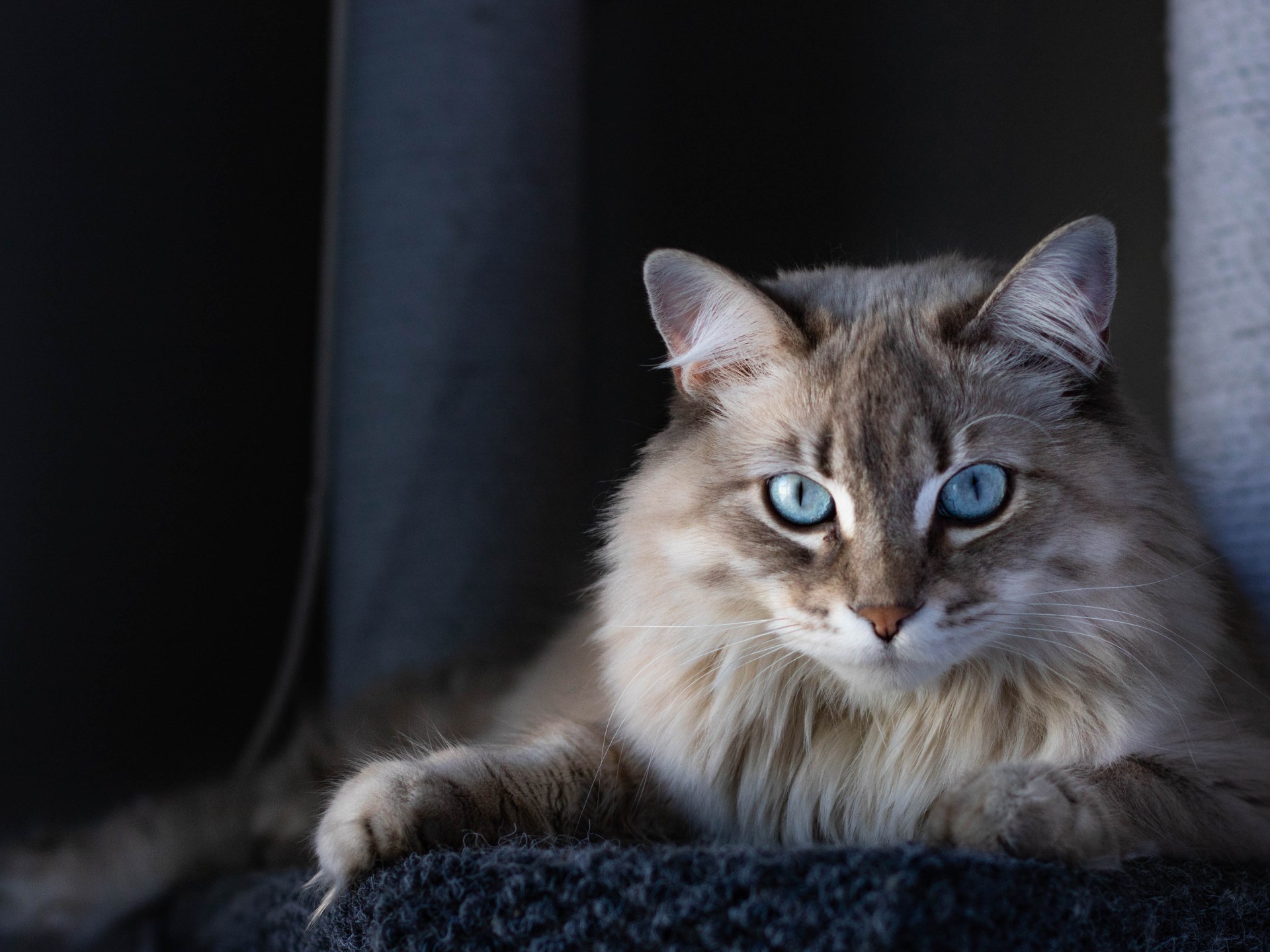
One of the most amazing scenes in the animal world is one of the most exciting of scientists, seeing a cat that falls from a height and then rapidly sprains in the air and lands on its feet as if to challenge the laws of physics.
This strange ability is not a myth, and it is not just luck, but rather the product of an accurate nervous and mechanical process known as the “body modification reflex”, a fungal capacity of cats to adjust the position of their bodies during the fall, so that it falls on its feet safely.
This reflexes appear in the small jarara at the age of 3 to 4 weeks, and it is completely completed at the age of 6 to 7 weeks, and it is noteworthy that this ability does not depend on vision, as studies have shown that blind cats develop the same reflex, which indicates that it is a nervous programmer in the body.
In essence, this reflection depends on amazing harmony between the sense of balance (vestibular system), the elasticity of the spine and the microscopic control, allowing the cat to rotate in the air without violating the law of conservation of angular momentum.
Excessive flexibility
But how does this happen? First: When the cat begins to fall, the balance system in its inner ear is caught by gravity, and here the nervous system automatically knows a reference point to which it is directed.
The vestibular system is channels full of fluids and sensory bristles that senses movement and direction, and these signals are sent to the brain that issues muscles orders to adjust the position immediately even without vision, and in fact this is an equivalent sense of vision in one way or another.
Second: After that, the cat wraps its head towards the ground, then bends at the waist and the front half of its body rotates independently, while the back half rotates in the opposite direction, to maintain the general momentum fixed.
In this case, the cat praises its front legs to make the front half lighter and easier to rotate, and at the same time extends its rear legs to increase the weight of the back (self -deficiency torque).
In this way, the front half can rotate, for example, 90 degrees, while the back half needs only a simple rotation in the opposite direction (for example 10 degrees), which maintains the total balance of movement.
Cats have a very flexible spine that consists of about 53 paragraphs (compared to 33 in humans), and this allows them to be fed at the waist and twisting the front and rear parts separately, and the soft skin and light weight helps it on the smooth movement, and gives it the ability to absorb the shock when landing.
Third: After that, the cat supplies its four ends before landing to increase air resistance and reduce shock when descent.
During the fall, the cat reaches a final speed of about 96 km per hour, which is a lower speed than humans due to its light weight and its dynamic aerodynamic structure.
In 1969, two worlds of Stanford University analyzed this phenomenon using sports models and high -speed photography, and their studies – which came under the title “dynamic interpretation of the phenomenon of cat’s fall” concluded – that cats revolve in a way that does not violate the laws of physics thanks to the division of their bodies and their accurate governing them.
https://www.youtube.com/watch?v=nifd8ejdov4
In 300 millimeters
The French scientist Etienne-Joula Mary was one of the first to document this phenomenon using successive photography in the late 19th century, where he took pictures of a snapshot that fell from height, and the pictures showed how the cat revolves, straightened and landed with its feet, which sparked the attention of the scientific circles.
Later, NASA and a number of veterinary universities conducted more advanced studies using high -speed cameras, and they found that every wrapping process occurred within only 300 milliliters, which equals less than a third of a second.
In a famous study published in 1987 in the journal “Journal of American Verrenari Midson Associst”, 132 cases of falling cats were analyzed from high buildings in New York, and the surprise was that the cats that fell from heights above 7 floors suffered less than those that fell from moderate altitudes.
The reason for this is that after the cat reaches the final speed, it appears to relax its muscles and spread its body to distribute the trauma over a larger area as if it slipped in the air, and this phenomenon was sometimes called “the cat’s syndrome.”
In fact, while some animals such as squirrels or some reptiles have a limited ability to balance in the air, cats are unparalleled in terms of accuracy and effectiveness, for example, dogs do not have this reflex, and they are serious injuries when falling.

Biomotic simulation applications
The importance of the reflection of the modification of the body’s position in cats at the borders of biology or veterinary medicine did not stop, but rather extended to inspires various fields such as engineering, space and robots. For example, robotics engineers have benefited from understanding the mechanism of twisting the cat in the air to develop robots capable of restoring their balance during fall or instability.
By simulating the movement of the spine of the cat, the researchers designed systems that allow the robot to divide its body into front and rear sections that spin separately to help correct the position in the air, just as the cat does.
In the field of space trips, scientists have studied how the cat interacted with the change of direction during the fall, although this reflections do not work in the environment of lack of gravity.
This research inspired the development of astronauts training programs on physical perception and balance in space, where there is no “higher” or “bottom” as we know them on Earth, and they used motor models inspired by cats to teach the pioneers how to use their bodies to direct themselves in the narrow space inside space stations.
The study of cat reactions also contributed to feeding the artificial intelligence algorithms that control the misfortunes, as models inspired by the cat help in dealing with unexpected movements, such as sudden fall or loss of balance by making instant decisions that restore a high accuracy.

