

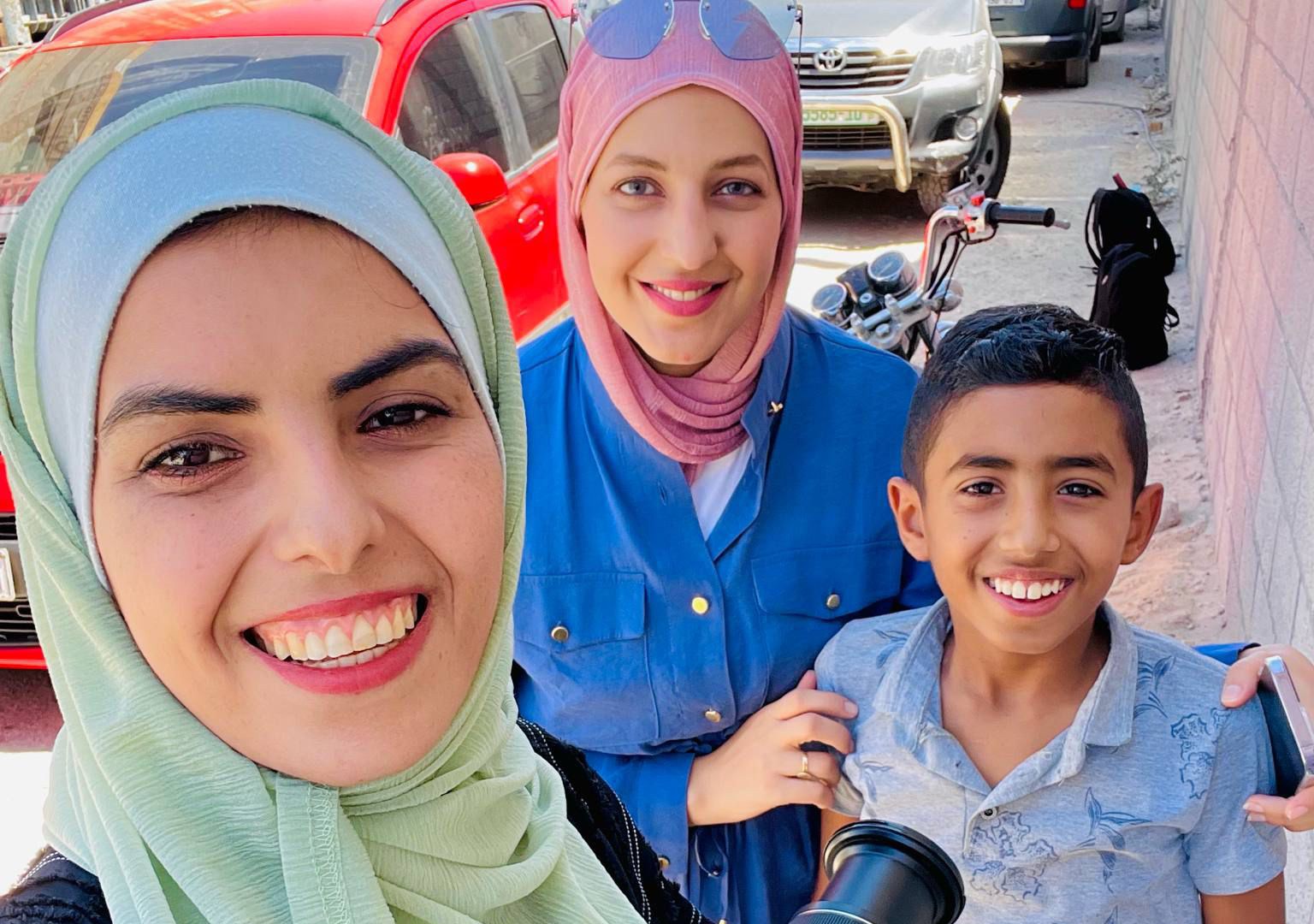
I want to remember Mariam.
I want to remember the beautiful smile that brightened her face. I want to remember the courageous journalist she was, the strong woman, the person who was a friend of everyone.
I want to remember that she strives to capture all the moments – the moments of grief, pain, sorrow, laugh and love in Gaza.
I want to remember her as her son’s loving mother, Ghaith. I want to remember her as the sister who brought happiness to her home, the girl who was so close to her parents.
It was the girl who sacrificed and gave her kid to keep him alive.
I used to look at it in this very thin body, on the ground, going to the front lines, capturing all these events which take place without fear with a single kidney in her body.
I will always remember how she always, even at the worst moments when she herself was too tired to take it, would choose to comfort you and tell you that it will go. It will pass.
It will pass… I remember his words.
I will remember her in front of the Ghaith, her son, who looks so much like her. And I hope that one day, when he grew up and get married, he names his daughter after Mariam, as she asked him in his last letter to him.
The War of Israel forced me to leave Gaza at the end of 2023 with my family. I cannot imagine going back and not seeing Mariam, not waiting for her to come and sit next to me or look over checking her.
The world in a boy’s eyes
It didn’t take us much to become friends. We often met when we were on the ground.
If she was there first, I would go next to her, and if I got there first, she would get closer. If we covered something really bad or dangerous, we were checking with our eyes, just to make sure that the other was fine.
So many memories with Mariam on the ground.
Between these moments of struggle, the cover, the tear gas, the bullets and the explosions, we had times when we could sit for a few minutes and talk about our children.
Ghaith was his world. And that broke her heart when she had to send her to her father to the United Arab Emirates after the war started keeping him safe.
I told her it was the right thing to do, that she couldn’t work when she was so worried about him all the time. As a mother, I went through the same thing, but at least my children had their father with them at home.
“You do this for him. You do it to protect him, ”I told him. Because that’s what we want most, as mothers.
All she wanted was to know that he was safe, that he was not hungry, that he was not thirsty.
After sending him, he missed him so much but was relieved to know that he was safe, he did not hear bombs.
She told me that when he called her and cried because he was missing, she would tell him that war would soon be over and that she would come to him – that he should focus on this, think about the day they find themselves.
She hung on to this last hope because of the Ghaith. She aspired to hold it, to see him.
When I saw Mariam’s news, I was in such disbelief that I continued to call my colleagues in Gaza and ask a question: is Mariam alive?
When they said no, I just hung up and called someone else to ask the same question.
My husband told me that she left, but I was on the fact that she was fine, that they made a mistake including her photo with the other murdered journalists.
And so far, I just feel that she will send me a text, she will answer one of my stories.
I cannot imagine going back to Gaza and not seeing Mariam on the ground and not seeing all these friends and colleagues who have disappeared.
His last testimony of his son
I think Mariam felt that she was going very soon.
Everyone talked about the night before she was killed when she was in the morgue.
She spoke to a morgue attendant, telling her that when she dies, might not put her in a plastic body bag, that she just wanted to be in a shroud.
And she even wrote this goodbye note for Ghaith.
She wrote in Arabic, and I wanted to translate him for Mariam because I know her and how difficult it is to write such a note.

I wanted to translate him like a mother, like her friend, for her child.
“Gaith’s heart and soul of your mother, I want you to pray for me, don’t cry on my death,” she wrote.
When I was in Gaza, I wrote a similar note so that if I am killed, they would find him on my phone. This is what Gaza mothers are pushed to do.
Everyone can write their will, but they are not wills. It is our insecurity, our feeling of being dangerous, targeted and hunted.
This feeling, living with him every day and every night, tears your soul.
If you watch Mariam in this last video she published in the elevator two hours before the strike, she had lost a lot of weight and her face showed pain, sorrow, the loneliness she felt.
Being far from Ghaith probably added to his pain, even if she always knew that if he realized his dreams for him, he was traveling around the world, would study abroad, would become a businessman, not in Gaza all his life as she had done.
She also wanted him to go home at the end, to come back to be near her and have her family there.
I would tell her that Ghaith would never leave her, that she was also her world. And he was so proud of his mother. He saw how strong and capable she was, raising her alone, rushing towards the front lines to do her work with all her heart.
She did not live to see him grow, but she made sure that he was safe and let her continue.
She leaves behind the photos and videos she took, the meaning they wore. She wanted her images to speak, to transmit a message. She liked to speak to people and share their pain, their messages and their voices.
So many times, when I watched these photos and videos, I would like to talk to her but I didn’t know what to say to relieve her pain. I was so far away.
And that is why I would send very few words to I could verify it, to let her know that I am there for her, that I always pray for her every day, that I always wait for the day when it ends and I come back.

