

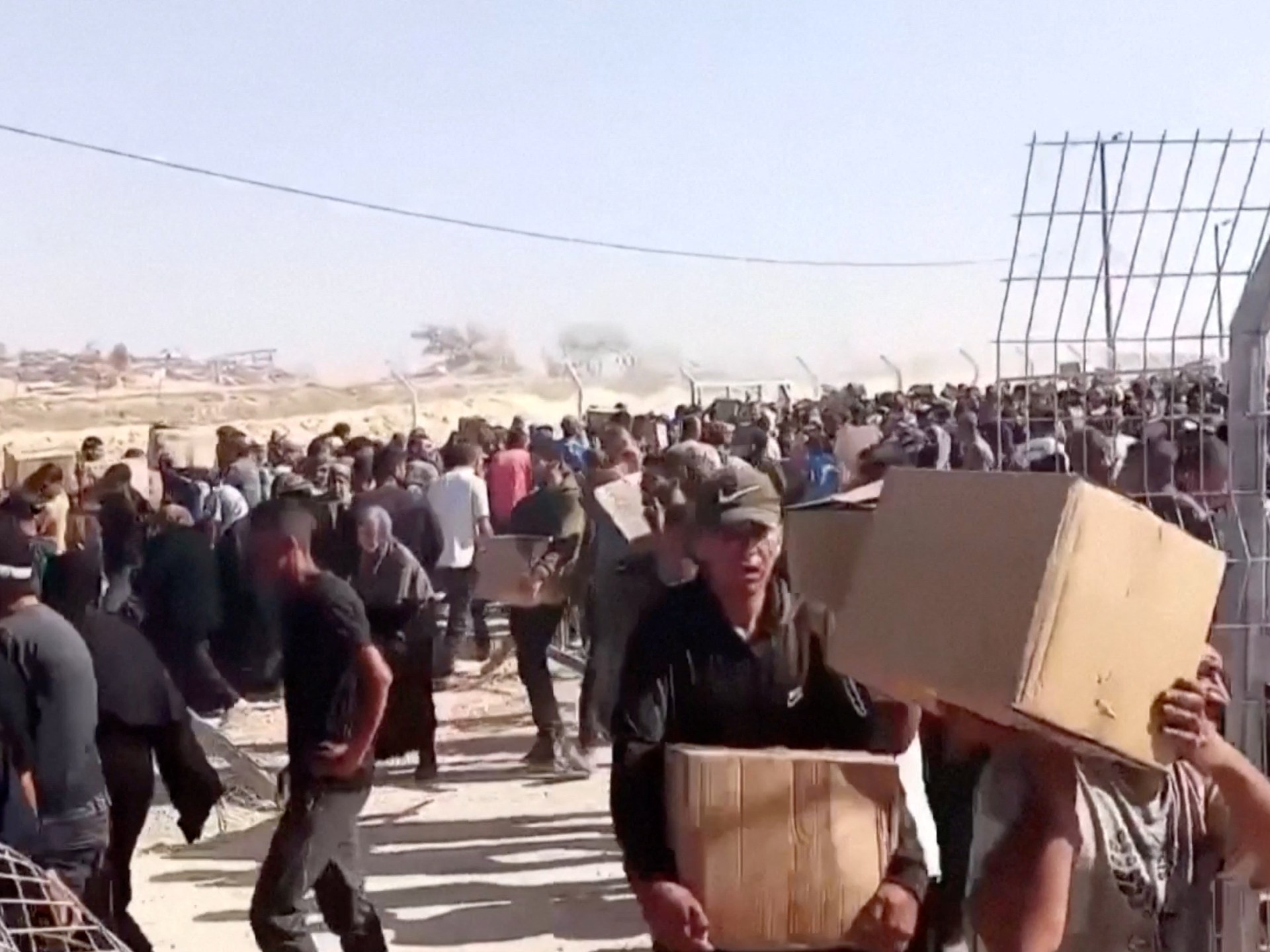
Occupied Jerusalem- In recent weeks, the pace of the massacres committed by the Israeli army have escalated against the Palestinian displaced people at the humanitarian aid distribution centers in the Gaza Strip, which are centers supervised by the American side within the relief programs.
This escalation has re -highlighted the mysterious and controversial role that private security companies play in securing these centers, in coordination with the Israeli army, amid accusations of turning them into mass death fisheries of civilians.
A survey published by the Israeli electronic magazine “Schummer” revealed shocking details related to the scenes of the American security company “SRS”, which takes over the task of securing relief centers, from its funding sources and structures to the high daily wages that its employees are charged, most of whom work from inside Israel.
Fictional salaries and huge expenses
According to the investigation, the company has worsened about 500 people, each of whom receives a daily wage between 800 and 980 dollars, including the basic salary, social insurance, and vacation days. The salaries are paid half a monthly directly from the company’s headquarters in the US state of Wyoming.
Besides, daily expenses of $ 180 are added to cover the costs of living, stay in hotels in southern Israel, as well as flying tickets back and forth with businessmen.
The salary cost is estimated at about 15 million dollars per month, while insurance and accommodation expenditures reach 4 million dollars each per month, in addition to other logistical costs such as transportation, meals, preventive equipment, and weapons.
With the company’s profit margin calculated, the total cost reaches about 35 million dollars per month, equivalent to 360 million shekels (100 million dollars) in just 3 months. But the most important question that the two journalists, Uri Plao and Milan indicate their achievement, revolves around the party that actually bears these high costs.
Used financing and signs of Israel
While the contract was signed with SRS at the end of August 2024, funding sources are still unclear. Some Israeli politicians, such as the opposition president, Yair Labid and the head of the “Israel Our Beit” party, Avigdor Lieberman, indicated that it was Israel who funded the program, and no official clarification or conclusive evidence was issued in this context.
On the other hand, the Gaza Humanitarian Foundation (GHF), backed by Israel and the United States, which manages relief operations, stated that it had received a promise to donate $ 100 million from a “Western European country” whose name was not revealed. Despite this statement, the ambiguity remained existing, especially with the United Nations and a number of international relief organizations to cooperate with this initiative, which is taking place in full coordination with the Israeli army.
In internal talks obtained by “Schomerim”, a senior official of “SRS” acknowledged that the company was “well funded”, adding that the real source of anxiety is not related to the availability of money, but rather the possibility of not extending the contract after next September. He stressed that the company is working “in close coordination with Israel without being subject to its direct control,” noting that the American solution is the only one currently based on the ground.
Heavy economic burdens
What increases the complexity of the scene is the great economic impact that these operations violate, especially in light of the continuation of the Israeli military operation in Gaza, known as “Gideon’s vehicles”. The Israeli Ministry of Finance estimated the total cost of the war until the end of 2024 at about 141.6 billion shekels (equivalent to 40 billion dollars), including military and civil expenditures and the damage compensation fund.
As for the net spending, after the exclusion of American aid, it amounted to 121.3 billion shekels (about 33 billion dollars), of which 96.4 billion shekels (about 26.5 billion dollars) for defense spending and 24.9 billion shekels (about 6.85 billion dollars) for civil expenses.

The chief economic analyst in the newspaper “Calcalist”, Adrian Payot, believes that the gap between the two numbers is due to American support in addition to the contributions of government ministries and foreign countries.
Pelot explained that one of the most prominent repercussions of the war was the rise in government debt, as the percentage of civil spending (except for military expenditures) increased to 6.1% of the GDP in 2024, compared to 4.9% was previously planned.
Disability and revenue decline
Pelot pointed out that the war also contributed to the expansion of the financial deficit significantly, as the deficit increased by 1.4% of GDP in 2023 and 4.8% in 2024, bringing the total contribution of the war to the deficit to 106.2 billion shekels until the end of the year.
The war expenditures also caused a noticeable decrease in tax revenues, which are difficult to measure accurately, but estimates indicate that tax losses alone amounted to 1.1% of the GDP in 2024, equivalent to additional 22 billion shekels.
Despite all these data, Pilot confirms that “ambiguity still surrounds the details of the security contracts,” especially in light of the Israeli Ministry of Finance’s failure to publish separate statements related to war expenses in 2025.
He adds that this official congregation is difficult to assess the real cost of the war, at a time when internal controversy in Israel is escalating about the feasibility and effectiveness of this spending, whether at the military or humanitarian level.

