

27/6/2025–|Last update: 01:48 (Mecca time)
Activists close to the Eritrean government and the Ethiopian Tigray Front Party circulated videos and photos documenting the transit movement’s resumption through the Zalmbaysa and Ruma crossings in the Tigray region, for the first time in 5 years.
Since the outbreak of the war between the two countries in 1998, the border remained closed until it was temporarily opened in 2018 after a peace agreement, before it was closed again with the outbreak of the Tigray conflict in November 2020.
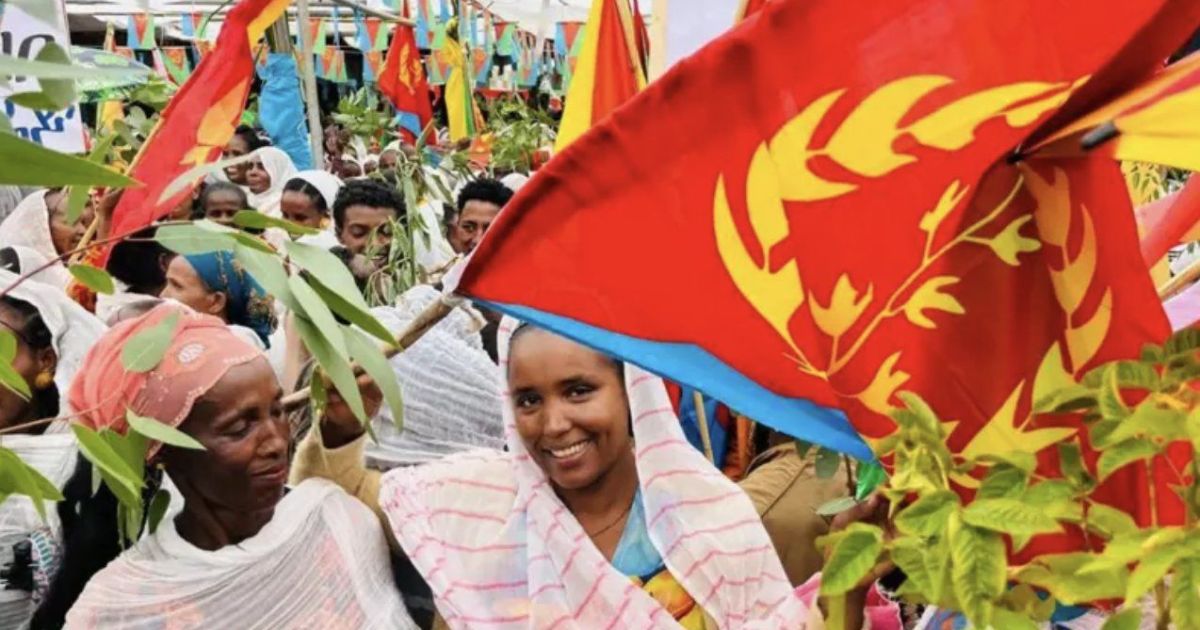
The video clips showed crowds of local population flocking to the Zalmbisa and Rama crossings, raising the flags of Eritrea and Tigray, in a festive atmosphere that was overwhelmed by the feelings of hugs and chanting songs after years of breaking the wombs and friends.
Despite the absence of official assurances from the two governments of the two countries, the event organizers clarified that the reopening of the borders came at a societal initiative led by local leaders and clerics from both sides with implicit support from some officials in Eritrea and Tigray.
On the other hand, the other crossings on the border are still closed, especially those located in the northeastern region of Afar, which extends to East to the strategic port of Asb, overlooking the Red Sea.
A number of Zalbisa’s displaced people managed to visit their homes for the first time since the war, to discover that many properties were destroyed and looted.
Nevertheless, they expressed their support for reconciliation efforts, calling on international organizations to contribute to the reconstruction.
The town of Zalmbaysa – according to officials in the Tigray government – has been under the control of Eritrean forces since the beginning of the conflict even after the Pretoria agreement in November 2022, which forced more than 55,000 displaced people to reside in temporary centers outside the town.
In this context, the head of the Tigray Front, the head of the Tigray Front, stated that this step represents a popular initiative aimed at strengthening the social ties between the people of Tigray and Eritrea.
He stressed that the party, despite its removal from the list of legal parties, will continue to support popular communication with the neighbors.
For his part, Eritrean journalist Omar Ahmed considered that what happened reflects a real popular desire to end the conflict, but he expressed his skepticism, explaining that the issue of the crossings is subject to strict security restrictions by the government in Asmara, and that such steps are only done with tight political and military coordination.

Ahmed pointed out that the event may be interpreted as an indication of unannounced rapprochement between the Eritrea government and the Tigray Front in light of the tension between Asmara and Edis Ababa after the Pretoria agreement, describing it as an attempt to restore political positioning after a period of marginalization.
But at the same time, he questioned the continuity of this rapprochement in light of the record of tense relations between the two parties, saying that what was impossible yesterday does not seem logical today without reviewing the history of the conflict.
As for the Ethiopian writer Ali Omar, he saw that any direct communication with a foreign country by a local region is an explicit constitutional violation, stressing that foreign policy falls within the powers of the federal government.
Omar added that the Tigray Front seeks through this event to restore its political presence after losing constitutional recognition, taking advantage of a symbolic opportunity to return to the public scene.
He considered that the Tigray Front’s endeavor to build relations with Asmara constitutes a kind of political blackmail towards Addis Ababa, and undermines its previous novel in which she accused the Eritrean regime of committing atrocities against the residents of Tigray, which reflects a political opportunism and in preparation for entering alliances without logic or memory, he said.

