

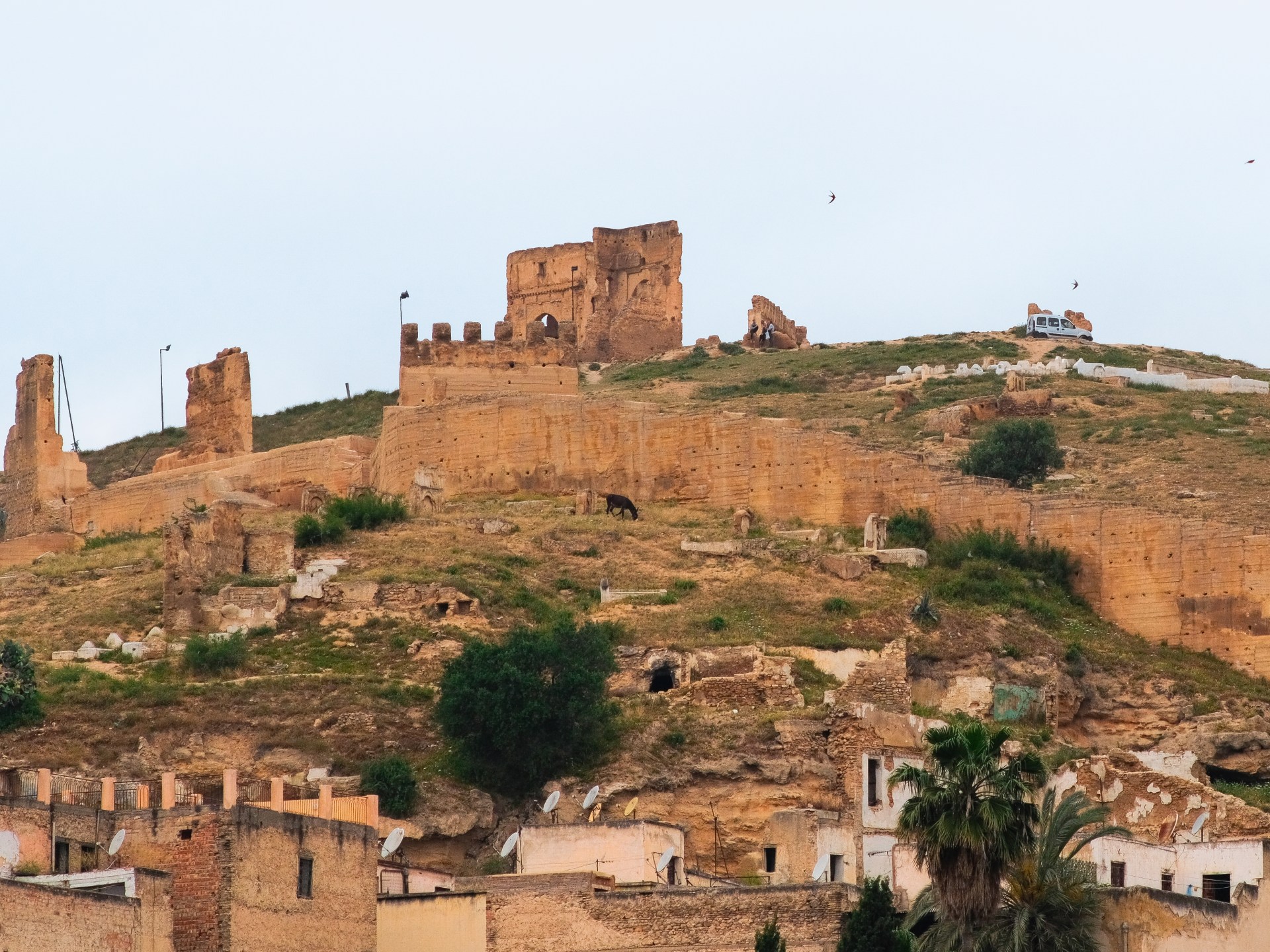
Military architecture in Morocco is one of the most prominent architectural models in the foot, as its aesthetics appear prominent compared to other architectural patterns. In the city of Fez, which is considered one of the most authentic historical cities in terms of its architectural patterns, we find spaces built with this type of architecture.
The city’s visitor finds the features of the architecture with a military dimension in several locations, such as: Bab Al -Jadiya, Bab al -Mahrouq, Bab al -Kasbah, Bab Boujloud, Bab Al -Hadid, Bab Al -Fotouh, Qasbah Al -Sharada, Qasbah Tamdar, and other buildings of a military nature.
This means that we are facing a city that has always played an important military role in the history of Morocco, as a vital space for the emergence of this type of architecture, which we also find in a number of cities that formed capitals in different stages of Moroccan history.
The absence of the art historian
Although historical sources talk about other architectural forms that no longer exist on the ground, the visitor to the city finds himself in front of a complex civilized mixture that is difficult to hold and know its aesthetic features, historical development and artistic dimensions.
Therefore, the architectural field and research in the history of arts in general did not receive great attention from the Moroccan and Arab researchers, compared to political history and its social counterpart.
This scientific topic remained absent within the historical blog, for reasons in its entirety scientific, related to training within universities and institutes. As Morocco, despite the modernity of its education and culture, is not available on a people or subjects in which the arts of architecture are taught, whether within the people of history in the colleges of literature and humanities, or even within the programs of the archaeological institutes of the educational system.
Therefore, marginalization of the culture of architecture remains a structural marginalization, linked to the absence of technical historians who are among the most important episodes in the history of Moroccan and Arab culture in general. The truth is that this marginalization, which affects art, stems from the fact that the Arab culture is oral, betting on the written written more than Al -Basri.
It is not surprising, then, in that research and studies on the history of Moroccan arts do not look at us, with all its connections, music, formative arts and cinema, in exchange for the abundance of historical writing related to politics, society and economics. Not to mention the fact that the architecture intersects in terms of interest, research and study between two different specialties, namely history and archeology, even if they intersection at the level of the systematic kit, they meet according to the end and feasibility behind the research in the architectural field.

The historian and archaeological
When the archeology is engraved on the remains of the effects of military architecture, it follows the historical writings that historians have been tanned by some countries and the UAE, which means that historical writing is almost the first source for archaeologists and they are drawing information about historical places that are concerned with research.
The archaeological researcher intends to historical sources for analysis and interpretation, based on what is found from evidence, archaeological and artistic artifacts, which leads him to scrutinize antiquities and determine their ages and the historical stages to which they belong.
While the artistic historian interested in architecture works to write scientific studies, based on the information provided by the archaeologist about architectural models, archaeological monument, artifacts, decoration and others. It builds its historical material depending on the archaeological material it draws from the field.
The intersection and convergence of the historian and the argument does not constitute a barrier for the researcher as he may think, but rather a scientific horizon that allows him to write a historical scientific research that mixes in its folds between historical knowledge based on sources and antiques, and an authentic analysis of the various aspects of military architecture, and the link between constellations, fences, doors, bronchies, and others.
The integration of this relationship comes in the context of the epistemological boom that the field of historical research witnessed, after expanding the concept of the historical witness or document. As the systematic or statutory school, with Charles Sinopus and Lacluwa, has been looking at history according to a traditional vision that has the concept of the event.
On the other hand, the Al -Hawalat School, with Mark Block, Lucian Feiver, and Fernand Braudel later, within what was called “New History”, worked to expand the concept of the document to include the monument, artifacts, films, paintings, photographs, composers (or dumps, historical literature, and others.
From that moment on, the historian has the right to open up to new documents, including what the archaeological world offers to play a prominent role in developing historical writing. This openness to the workshops and laboratories of archaeologists helped the historian himself to write according to a different scientific tendency, not only that history is extracted from traditional sources and documents, but also from the chapters, fences, films, and inspection courts, for example.

Features of military architecture
Military architecture means all the remains of archaeological artifacts that were accomplished for military purposes, such as fences, fortifications, towers, trenches, camps, and others. Due to the value of this architectural form, historians and designers consider it a kind of architecture, as it is a pattern that has its history and aesthetics in Morocco, due to the presence of many cities that are characterized by this different architectural style in terms of form and format.
Although there are many Moroccan cities that are available on this model of military architecture, the city of Fez remains the most widely spread of cities in this style, due to the historical roles that it played, and the legal standing that it accumulated in a political point of view.
The researcher Munir Aqsabi, in an exclusive interview with “Al -Jazeera Net”, says that as soon as “we currently count in the field with the remaining historical fortifications (bronchi, towers, walls, and doors), we find that they represent only a third, which was built for military purposes throughout its history.
He explains that “there are different forms and designs, as we enable several models to draw a clear picture of the development of military architecture in Morocco in general; (doors with direct entrance and other attached entrance, rectangular towers or in the form of an estranged or stellar shape, various hierarchical and misleading, etc.).
He adds: “Its reality is okay, given that most of them have benefited from restoration. There are some constellations that need to be employed to contribute to development, such as the Sidi Bounev Burj and Burjouil Tower, and some reeds need complete emptying of their occupants to start their restoration and rehabilitation, such as the Kasbah of Moulay El Hassan. Most of them have been restricted to national antiquities.”

As for the model of military architecture in Fez, he says that it is characterized by “the war of drainage, as the thickness of its fences made from the Tabia reaches more than two meters, and it is free of decorative elements. Except for some engineering formations, such as Shabak.
At a time when other architectural patterns enjoyed a large share of scientific studies, whether from Arab or foreign researchers, military architecture remained immune to the writings of researchers, as if the matter was related to a banned architecture that should not be approached.
While there are other studies that were concerned with religious architecture, and they were published in authentic research that monitored the biography and history of some mosques, these same studies focused in their entirety on the sporadic historical aspects in the medieval sources, and did not mean sufficient care in the aspect of the architecture, which puts the reader in front of a monochrome historical writing, as it is not inspired by modern curricula or disciplines Parallel.
Today, the walls, reeds and towers, in many cases remain mere ruins, pushing the researcher to ask questions about this architecture, its history and aesthetics. However, it is noticed that it belongs to different periods of time, which gave this architectural form a complex dimension in terms of its simple artistic characteristics.

