

The Monastery of Rafat is a Palestinian village that is displaced from the Jerusalem district, located 25 kilometers from the city of Jerusalem. The Israeli army invaded it on July 17 and 18, 1948, during the second stage of the Danny operation, which was carried out by the occupation at the time.
Israeli sources state that the village fell into the grip of units of the Harel Brigade at the end of the operation.
the site
The village of Rafat is located in the far west of the Jerusalem district, and there is 25 km from the city of Jerusalem, and it is one of the villages of Wadi Al -Sarar and is close to the Bab Al -Wadi area, on the borders of Ramla District.
The village is located at the foot of a mountain from the end of the Western Jerusalem mountain range, and it is linked to the neighboring villages, not paved roads, especially the villages of Sara, Ashua, and Khirbet of the name of God and Deir Aban, and the average lands of its lands above the sea surface is approximately 300 meters.
It is bordered to the north by the villages of Ramla District, which is Khirbet of the name of God, Beit Jiz, and Khirbet Beit Far, and from the northwest, Khirbet Beit Far, to the southwest, the village of Al -Bureij, and from the south by the village of Deir Aban, and from the east, the village of Sarra.
A joint school was established in 1944 for the villages of Isa, Aroufov, Honey and Harda, and it was called the Emiriya School, and the sons of the Deir Rafat were studying until the seventh grade.
Population
The Monastery of Rafat was a small village in the end of the era of the Ottoman Empire, and its population was 35 people and its globe 12.
In 1931, the number of the people of Rafat reached 320 people, including the Khawarneh, the monks and the workers of the monastery, including 252 Muslims and 68 Christians, and the people had 69 homes.
In the year 1948, their number was estimated at 499, and in 1998, they number 522 people.
In 1961, the number of those in the Monastery of Rafat was 10 breezes, and they are the Khawarneh and the monks in the monastery.
The total of refugees from the village – according to estimates in 2008 – was 4142.
Naming
It is believed that the reason for naming the village of Deir Rafat with this name is that it was based on the ruins of the city of Yarfel Al -Canaaniya (in the sense of God heals).
As the first part of its name “Deir” indicates, there was an old Byzantine monastery, and then the Muslims lived in the village.
the date
In 1927, the Latin Catholic Patriarchate bought part of the village’s lands and the Latin monastery girl after the strong earthquake that took place in Palestine in 1927.
The Latin was interested in the site in honor of Maryam, peace be upon her, as they believed that she had protected the land of Palestine from similar disasters before.
For this reason, the official name of the church in the monastery is “Our Lady of Palestine”, and after that the village was emigrated and the “Latin Monastery” was not displaced, and the Catholic Church rented the remaining houses in the village.
In the mid -19th century, the village was subjected to economic hardship in front of the Turkish government, and finally part of its territory was sold to the Latin Patriarchate, and the deal was conditional on the church not practicing any missionary activity in it, and that its activity was limited to education only.

Deir Rafat Complex
The buildings were designed in the Monastery Complex, the Pindctinist monk and the architect Father Maurizio Gizler, and the church was placed in the center of the complex, and an orphanage, a school and a building for the monastery were established.
The words “Peace be upon you, Mary” were written on the entrance walls in 343 different languages, and written by Jerusalem artist Mubarak Saeed.
The monastery is based on the nuns of Bethlehem (similar to the monastery in Beit Jamal), and it is devoted to the care of orphans and needy families, and they are French or from the French -speaking countries.
In the monastery complex also a guest house for Christian pilgrims in the complex, and it has a bronze statue of Mrs. Maryam, peace be upon her, made by an Italian artist, with a height of about 2.5 meters, and was inspired by a statue in the Monastery of Saint Dorothy Sisters in the city of Vicenza, northern Italy.
The dispute between the people and the monastery
At the beginning of 1880, the people of Rafat abdicated all their village to the monastery for fear of paying the agricultural tax. The monastery was paying that tax to the Ottoman Empire, and the situation remained so until the period of the British Mandate.
After that, the people of the village were growing lands and pushing the monastery a third, then the dispute occurred after the officials of the monastery who followed the Latin Patriarchate tried to seize the lands claiming that they belong to him, and that the people are just farmers working in the wage.
The situation exacerbated until the head of the monastery reached the end of the endowment property of the endowments, the mosque was rewarded, the rituals were disrupted, the case ended in the courts and ruled in favor of the people in 1936.
Other cases continued before the judiciary in the same matter until the year of the Nakba, which was taken by the Supreme Islamic Council in Jerusalem.
https://www.youtube.com/watch?v=rxmwyydsmk8
Economy
The main dependence of the village economy on agriculture, especially since the lands of Rafat are large and wide, in which the wide plain and the mountain, and the area of the land cultivated in 1945 was about 10 thousand and 779 dunums, and the area of the earth is all 13 thousand and 242 dunums (the dunum equivalent to one thousand square meters).
The village of Deir Rafat has a moderate climate of summer and rainy, and its lands are fertile soil, which made it a favorite destination for many farmers in the villages adjacent to work in it.
The village is also abundant with animal wealth, as before the Nakba there were more than 10 families who had herds of sheep, some of which exceeded 200 heads, and the monastery officials had a herd amounted to 150 heads.
The villagers also professionalized the grazing of cows and beauty, and they had horses, mules and donkeys, and they were interested in raising birds such as chicken and bathroom.
Village landmarks
In the village of Deir Rafat, there are many Roman monuments, such as buildings, foundations, and old Roman houses, in addition to many contemporary and caves, such as the cave of Jabal Al -Ras, the cave of Al -Jaba, the Al -Haj Hassan cave and others.
The village included a single mosque known as the Hajj Hassan Mosque.
https://www.youtube.com/watch?v=Tun0_ycz5PY
The occupation of the village and the displacement of its residents
The village fell in the grip of units of the Harel Brigade during the second stage of the Danny operation, which was carried out by the Israeli army.
The Israeli historian Bani Morris states that those who left behind the village left it with the approaching queues of Harel and the beginning of the mortar defender’s bombing on the village, and he adds that those who stayed in the village were soon forced to leave.
In 1954, the Ghadat Shimish settlement was established on the lands of the village, west of its location directly.
After the displacement
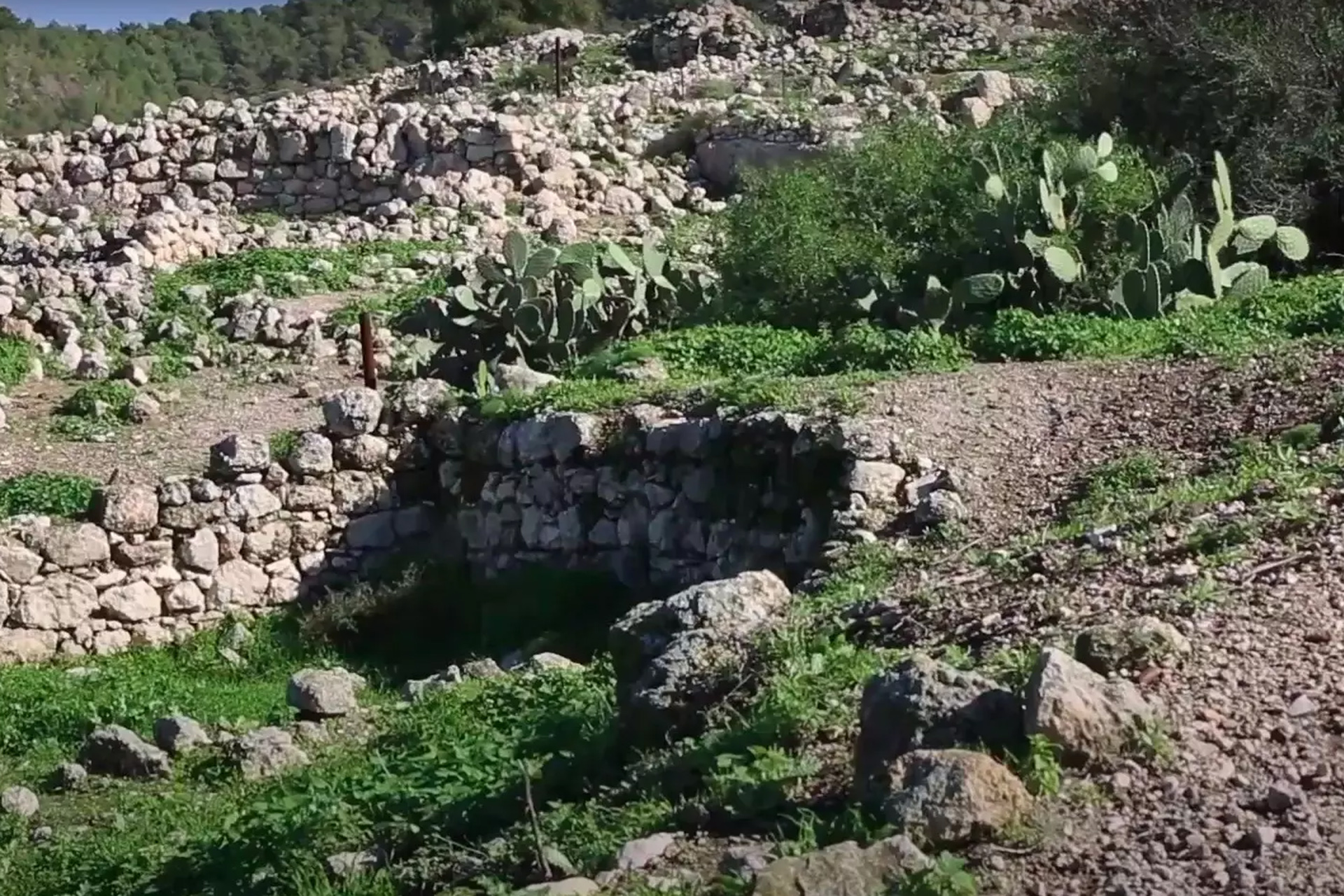
After the displacement of all its inhabitants, the village site has become covered with stones and terraces, whose wreckage is mixed with the ruins of the houses.
Aloe vera plant is seen on the northwestern end of the village, and a group of Al -Sanea tribe, which is from the Negev, has been hired, a patch of village lands from the Latin Monastery, the owner of the village lands, and they struck some tents.
The statue of the Virgin Mary is the front of the monastery, which is two kilometers to the west of the village, and the brick covers some parts of the monastery building.
In the southern corner of the village, a cemetery in which a lonely grave stands up, and in its western corner there is an olive grove.
The people of the village of Deir Rafat live in the refugee camps, especially the Dahisha, Al -Arabi camp, the neighboring villages, in the Hebron, Bethlehem and Jordan camps.

