

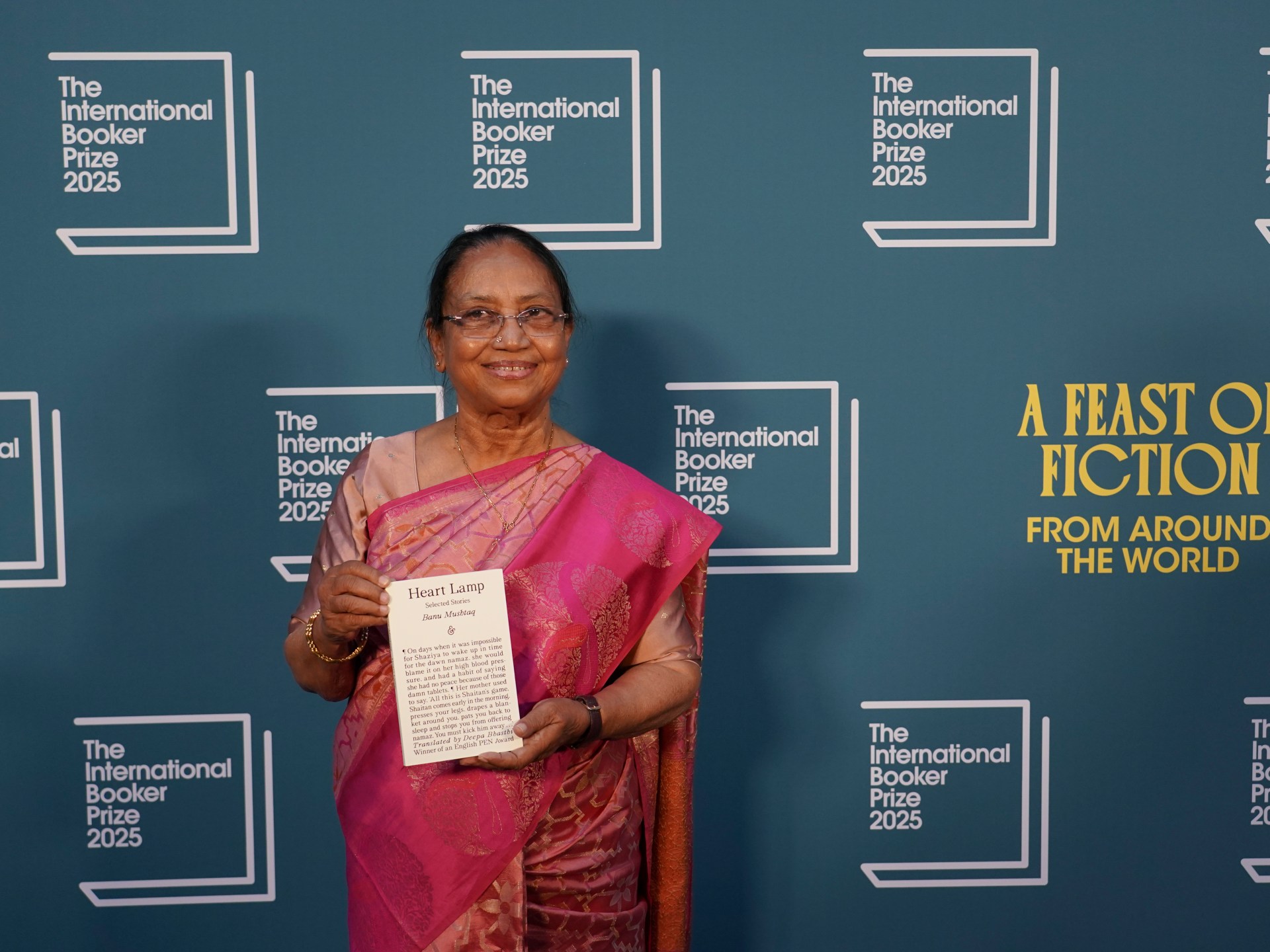
The Indian writer and activist in the field of women’s rights, Banu Mushtaq, who last May won the Booker International Literary Award, that real writing is inspired by reality, even if it is very violent and cruel. From this standpoint, she did not hesitate to make one of the cuts of her prominent reward group dealing with a burning suicide attempt, similar to the one that she had herself.
“One cannot write just to describe a rose. It is not enough to say that she has this fragrance and those petals and that color. He also has to write about thorns. It is his responsibility, and he must do,” Banu, 77, said in an interview with the French Press Agency.
In her Booker Award story collection, titled “Heart Lamp”, in its 12 powerful stories, Pano deals with the 12 strong stories, aspects of the lives of Muslim women who suffer from family and societal tensions, some of whom bear domestic violence, or others have been afflicted with the death of their children, or they were betrayed by their husbands.
https://www.youtube.com/watch?v=79RGo6zet6a
The stories, which I wrote between 1990 and 2023, formed the first literary work in the “Kannada” language (Kannada) (a language that is spoken by about 65 million people in southern India) translated into English, which made her winning the award a difference in the history of Indian and international literature alike.
She translated the work into English Deepa Bhaasti, journalist and writer from southern India, and the jury described the translation as “radical and innovative that causes a language turbulence and creates a new fabric of the plurality of English.”
The award was equally received with the author, in a double honor for the text and translation, despite the censorship of the book by the conservative departments in India, as mentioned by the award organizers, and its ignorance by the major literary awards in the giant Asian state.
Writing that pulses with pain and humor
Banu’s style won the admiration of the critics because of his satirical humor that hides deep pain and the cruelty of her personalities. The jury of the Booker Award described the characters of its stories as “amazing images of the ability to continue”, praising its firm position without the dullness of the tyranny of the patriarchal and class regime and religious extremism on Indian society.
The group’s jury celebrated as “beautiful stories full of life, translating an innovative language that expanded our understanding of translation and cultural difference,” stressing that these living and painful stories offer a “moral and political document” about the suffering of Muslim women in southern India.
Banu, born in 1948, belongs to a Muslim family, but she received her education in the language of Kanada, not in Urdu, the traditional cultural language of India’s Muslims. After her career began in the fields of journalism and education, she later worked in law, and struggled as human rights against fundamentalism and the absence of social justice.
As for her private life, she was not less cruel than her stories. She got married after a love story, but she later felt suffocated because of the restrictions imposed on her. She said, “I was not allowed to have intellectual activities (…) and in writing.”
Until her psychological suffering reached her to try to burn herself in the late twenties, her husband rushed to her with their 3 -month daughter, and this moment she recovered, saying: “My husband put our little daughter at my feet, and made me focus my attention to her, embrace me, then embraced me, and in this way he was able to discourage me from suicide.”
In her cutting, the writer is inspired by this moment, as the child is the one who is credited with saving her mother. On this intersection between the biography and imagination, Banu says: “Something from the writer’s personality is reflected in his books, whether consciously or without awareness.”

Fame
Today, the walls of Bano’s house in the small town of Hassan, south of India are filled with testimonies and awards, the latest of which is the Booker Award that she received in London, which she describes as changing her life “positively”, although she complained about what this fame imposes a burden on her.
The writer receives a lot of visitors, but she said with regret, “I no longer have time to write that makes me feel great and satisfied.”
Bano stressed that her characters are not specific to a particular country or a society itself, but rather applies to every time and place. “Everywhere, women suffer this kind of repression, exploitation and patriarchal power. Women are women, everywhere in the world,” she said.
However, Banu does not intend to stop writing, even if her works are not always admired by those who write about them or for them. “The writer is always a supporter of the people.”

Live and painful stories
The Banu Mushtaq collection consists of 12 short stories, written in a narrative style characterized by vitality and harsh emotion, and draws deep pictures of the lives of women and girls living in conservative parental societies. The stories revolve around mothers, grandmothers, intelligent children, shaky husbands, sarcastic sheikhs, and bombs, amid a reality governed by strict social and religious restrictions.
The coronation of “Siraj Heart” came at a time when India is witnessing increasing tensions on individual freedom issues and minority rights. The victory of this work written in a local language and the perspective of a Muslim woman is an explicit challenge to the country’s prevailing marginalization in the country, and a message of support for the original and marginalized languages.
It is worth noting that Banu Mushtaq belongs to the generation that was involved in the “Bannaya Sahitia” movement (protest literature) in the 1970s and 1980s in the southwest of India. It is one of the few women who have been in this movement that criticized the Hindu class and social system, and highlighted the voices of the outbreaks (Dalit) and Muslims.
In addition to her work as a lawyer and female activist, 6 stories, one novel, a collection of articles, and a poetry collection, all wrote to the Kanada language. He also won major awards, including the Karnataka Sahitia Academy Award and the Dana Cintamani April Award.
She expressed her literary vision by saying: “My story revolves around women, how to demand religion, society and politics with blind obedience from them, and thus, they inflict inhuman cruelty. I do not conduct extensive research, my heart is my field of study.”
With this victory, the language of Al -Kanada entered for the first time to the international literary forum, to become a rare cultural and literary testimony in the scene of world literature, on which the voices of the Western Cultural Center dominated.

