

Israel began to release a group of Palestinian prisoners after Hamas released three hostages as part of the ceasefire agreement which ended 15 months of fighting in the Gaza Strip.
Two hostages arrived in Israel after being awarded by Hamas to the Red Cross this Saturday, as part of the fourth series of hostage releases provided by the cease-fire agreement in Gaza. In return, dozens of Palestinian prisoners must be released from Israeli prisons.
After Yarden Bibas and Ofer Kalderon earlier in the morning, Hamas then gave the Israeli-American Keith Siegel, 65 years oldat the Red Cross. Mr. Siegel went on a stage installed by the sea In the city of Gaza Before being handed over by activists to representatives of the Red Cross waiting for him.
The truce, which started on January 19, aims to end the deadliest and most destructive war ever carried out between Israel and the Hamas militant group.
The fragile agreement held for almost two weeks, interrupting the fighting and allowing the delivery of increased aid in the tiny coastal territory.
Yarden Bibas35, and OFER KALDERON54, Franco-Israeli, were both kidnapped during the attack by Hamas against Israel on October 7, 2023, which sparked the war. The two men first went to a reception point in a military base in the south of the Gaza Strip. Along the road, small groups of supporters awaited convoys by brandishing Israeli flags.
Hamas gave them to the Red Cross during a ceremony organized in the city of Khan Younès, during which everyone went on a platform and praised the spectators. Hamas armed activists trained a line leading to the platform for a ordered delivery, contrasting with the chaotic crowds that surrounded the hostages during a discount on Thursday, which had aroused Israel.
This Saturday, Israel began to release a group of Palestinian prisoners after Hamas released three hostages as part of the ceasefire agreement which ended 15 months of fighting in the Gaza Strip.
A bus left OFER military prison with 32 prisoners for the West Bank. About 150 other prisoners were sent to Gaza or expelled.
According to the Palestinian authorities, a total of 183 Palestinian prisoners must be released, including dozens of people serving long sentences or life sentences, and 111 people from the Gaza Strip which were arrested after October 7, 2023 and detained without trial.
33 Israelis – minus eight – in exchange for nearly 2,000 Palestinians
In total, 33 Israeli hostages should be released in exchange for nearly 2,000 Palestinian prisoners during the first six weeks of the truce. Israel claims to have received information from Hamas that eight of these hostages were killed during the Hamas attack on October 7, 2023 or died in captivity.
Also on Saturday, injured Palestinians should be allowed to leave Gaza for Egypt by the Rafah crossing point. It was the only exit point for the Palestinians during the war, before Israel closed it in May. A civil mission of the European Union was deployed on Friday to prepare for the reopening of the crossing point.
This reopening would constitute another key step in the first phase of the ceasefire, which provides for the release of 33 hostages and nearly 2,000 prisoners, the return of the Palestinians to the northern Gaza Strip and the increase in Humanitarian aid in the devastated territory.
The Ministry of Health said that 50 sick or injured children should be evacuated by Rafah’s passage point, as well as 61 people accompanying them.
In Israel, the liberation of Bibas aroused revival of attention and concern about the fate of his wife, Shiri, and their two young sons. All four were captured in the Kibbutz Nir Oz.
A video of their abduction by armed men shows Shiri swaddling in a blanket her two red boys, Ariel, 4 years old, and KFIR, 9 months at the time.
 ADVERTISEMENT
KFIR was the youngest of some 250 people selected in captivity on October 7, and his fate quickly represented the helplessness and anger that hostage taking aroused in Israel, where the Bibas family has become a familiar name.
Hamas said Shiri and his sons had been killed in an Israeli air strike. Israel did not confirm this information, but a military spokesman recently expressed his great concern about their fate.
Yarden Bibas would have been detained separately from his family. Photos taken during his abduction seem to show him injured.
Like Bibas, Kalderon was also captured in the Kibbutz Nir Oz. His two children and his ex-wife, Hadas, were also kidnapped, but they were released during the 2023 ceasefire.
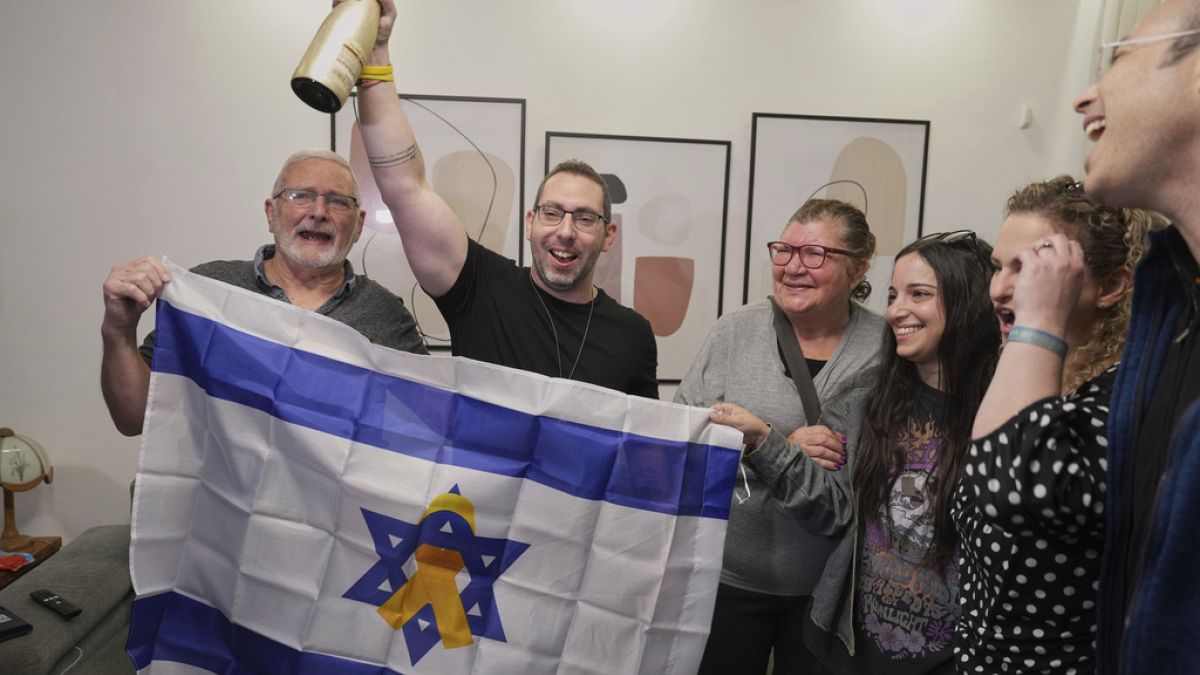
ADVERTISEMENTIn Kfar Saba, north of Tel Aviv, Kalderon’s family hung up and applauded when he saw the images of him on the platform at Khan Younès and being transferred to the Red Cross.
“OFER comes home,” they said, arms raised to heaven.
Keith Siegel, from Chapel Hill, in North Carolina, was taken hostage in the Kibbutz Kfar Aza, with his wife, Aviva Siegel. She was released during the 2023 ceasefire and led a very publicized campaign to release Keith and other hostages.
Among the dozens of Palestinian prisoners who will be released by Israel on Saturday, there are people sentenced to long sorrows or life imprisonment.
ADVERTISEMENTThe second phase of the ceasefire in discussion next week
More than 100 hostages were released during a one-week ceasefire in November 2023. About 80 other hostages are still in Gaza, of which at least one third would have died. Israel says Hamas confirmed that eight of the 33 hostages were released during the first phase of the ceasefire died.
Israel and Hamas must start next week negotiations on the second phase of the ceasefire, which provides for the release of the remaining hostages and the extension of the truce for an indefinite period. The war could resume in early March if no agreement is concluded.
Israel claims that he is still determined to destroy Hamas, even after the militant group reaffirmed its authority over Gaza in the hours that followed the last cease-fire. A key far-right partner of Mr. Netanyahu’s coalition calls for the resumption of war after the first phase of the ceasefire.
Hamas affirms that it will not release the remaining hostages without the end of the war and the total withdrawal of Israel from the Gaza Strip.
ADVERTISEMENTThe attack on October 7, which sparked the war, left some 1,200 people dead, mostly civilians. More than 47,000 Palestinians were killed in the air and land reprisals of Israel, more than half of whom are women and children, according to the Ministry of Health of Gaza (controlled by Hamas) which does not specify how many These dead are activists.
The Israeli army claims to have killed more than 17,000 fighters, without providing evidence. She attributes the death of civilians in Hamas because her fighters operate in residential neighborhoods.

