

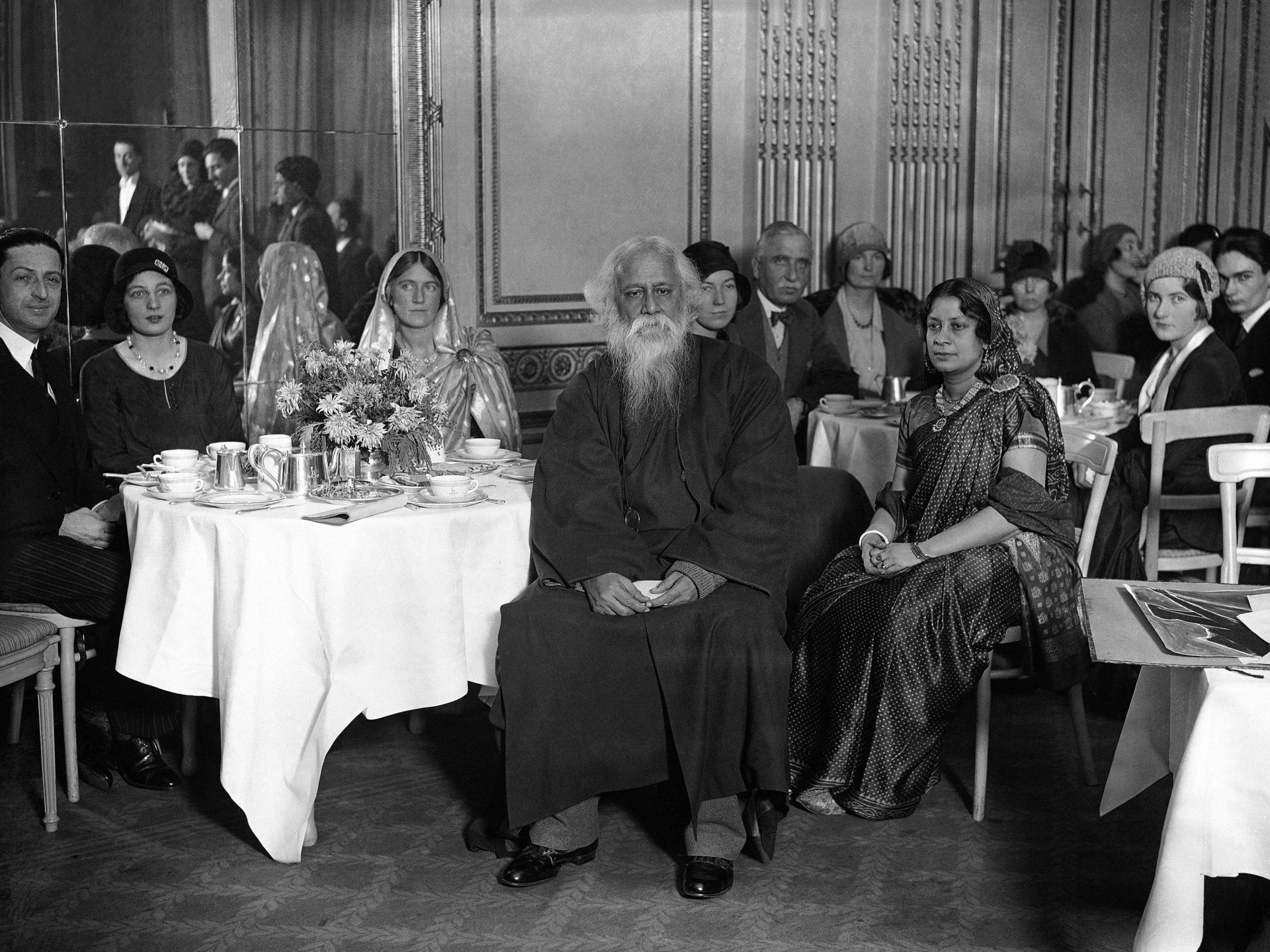
India donated to the world in ancient and modern with a group of great scientists who contributed to their ideas and creativity in achieving a great scientific and cultural renaissance in human society.
At the forefront of these geniuses in the 20th century, the poet, philosopher, and theater, the Bengali theater, Rabandanat Tagore, who belongs to a noble Bengali family whose members were famous for science and the sultan, found him as a dwarkat Tagore who was one of the great figures of India, and his father Al -Muharashi (Al -Hakim) Deepandan Tagore known as a religious thinker.
The beginnings .. the philosopher of India and its feat poet
RabindraNANATH TAGERE was born in the city of Calcutta from the Bengali part on May 7, 1861, for an educated Bengal family, where he educates in his home the traditional way. His father sent him to the British capital, London, at the age of 16 to study the law, but he worked on studying literature, poetry and international literary models in the English language, especially Shakespeare, Malaton and Chile, and began to draw from Western culture, so he had the ability to judge and conceive.
Tagore lived a poet, thinker, philosopher, novelist, storyteller, theatrical, painter, musician and cinematic actor, and enlightened all these areas with his lofty contributions. His works have reshaped the Literary and Bengali literary taste in the late 19th and early 20th century, as his first book “The Great of Songs” issued in Sanskrit, the language of his people, and translated it himself into English. This bureau was received a great reception in Europe, and the poet Ezra Pound (1885-1972) admired it, while the English philosopher Pertend Russell (1872-1970) ignored it.
Ancient Bnitanwal Enceclopedia says that Tagore transformed his pain and sadness over the death of his mother while he was still a boy, and his wife’s death is still in her youth, to poems that have not known oriental literature for her, so that the French poet André Bretton said about him: “There is no poet in the world that managed to embody sadness in His hair as Tagore did. “
His poetry and literary works were translated into several languages, including French, English and Persian, and some of his poems were translated into Arabic. Through his creations, Tagore presented multiple ideas, of importance even in our time as well.
He was a fanatic of the nature that mixed in his poems, which is the one who said:
“The stillness of the wind warns of the storm, and the clouds flying in the West do not preach good, and water is awaiting the wind, but the owner of the crossing, do you want to ask for your wages?!
On the feature of Tagore’s poetry, the Indian professor Bashir Al -Jamali, a former professor at the University of Jawaher Lal Nehru, New Delhi, India, says: “Tagore often uses local words, which adds a new dimension to his hair, and creates an Indian air in his hair using the names of birds, trees and Indian flowers, and so his hair becomes mainly Indian.”

The great human poet … the prestige of the poet and the wisdom of the philosopher
Whenever we get close to the poetic spaces of Tagore, the world will seem to us as if he was just born with his surplus fields with its green, and its throats and its connotations in the direction of the first purity, the innate purity that was established on a great biological principle linked to what is called the “cosmic body”.
Badr Al -Suwaiti, the Arab writer and poet residing in Germany and director of the Dervish House for Publishing and Translation in Bulgaria: “The universe becomes more beautiful and brilliant in the commandments of Tagore Al -Hakim, who established human, spiritual and faith values, and employed them in the lofty meanings of love, beauty and peace, to be a beacon for future generations,” says Badr Al -Suwaiti, the Arab writer and poet residing in Germany and director of the Dervish House for Publishing and Translation in Bulgaria.
For his part, the Indian professor Abdel Ghafour Al -Hadawi, a professor in the Department of Arabic Language at the College of the State University of Kerala University in India, believes that “Tagore was an internationally enthusiastic unity of the world, so he fought through his literary and artistic creations against discrimination between individuals on the basis of classes, colors, beliefs or languages.”
It should be noted that the Tagore is a poet of a rare family of poets whose high -end creations did not adhere to sex, color or geography.
In this regard, Professor Mujib Al -Rahman, a professor of modern Arabic literature at the University of Jawaher Lal Nehru, New Delhi, says, “Tagore sought – through deep meditation in God, the universe and nature, and referring to the ancient Vedic texts, and studying human suffering – to achieve the global human brotherhood.”
Al -Suwaiti agrees to this by saying: “The tyrant of the poet and man performs the lamps of hope in the darkness, and prolongs his prayers in the niche of love in order to achieve dreams and justice in this world.”
The owner of the “Lost Birds” office says:
“On the first page of history, the authority of the giant was unlimited as a human being, a barbarian, and his father, and his fingers were rough, and his hand is ridiculous, and by the penis in his hand spreading complete destruction over the land and above the sea, and by fire and steam he ran his deviant dreams in the depths of the sky, and achieved the great sovereignty over the world of inanimate objects, but towards the living truth, he was blinded by jealousy.”

A bright star in the history of India
Regarding the fundamental dimensions of Tagore’s thought that makes him a giant international literary and intellectual stature that inspires creators, thinkers and intellectuals in every era, it is possible to return to his book “Sadana”, which means “perfection”, where his poems were widely spread in the late 19th century and the beginning of the 20th century.
He presented to his office “Gitanjali” (the sacrifice of songs), the English poet William Bater Yates (1865-1939), and with this office, Tagore became the first person in Asia to receive the Nobel Prize for Literature in 1913. And about his Nobel, Tagore wrote to one of his English friends, saying: “My condition is like a dog’s condition, some of his tail tied with an empty box, So with it, a huge noise occurs whenever it takes place, and wherever he goes.
Tagore saw something completely separate from himself and his self -value, and he saw that he was above the award. He donated its financial value to the school, which he established in the name of “Al -Salam Port” in 1918 in the Shanti Niktan province in West Bengal.
Dr. Bashir Ahmed Al -Jamali notes that “Gitanjali’s poems are still fascinating and affecting the hearts of millions of Indian individuals, citing his poems from legendary tales, religious symbols, local images and daily life.”
On the other hand, one of the supporters of Tagore, Sudab Narayan Josh, confirms that “Gitanjali’s poems are not the best of Tagore poetry creations, because Gitanjali only contains 83 of his original poems, and there are 20 other poems taken from his other books.” He explains that Tagore “was stripped of his hair from all richness and decoration, so his poems written in simple prose could not achieve poetic bone as his original Bengali poems achieved.”
Tagore had confirmed his great poetry and the West’s admission early this outstanding talent, and his poem “The Flying Man”:
Like the waves taken by the rhythm of their winning dance, these birds are distracted in light of the security that applies in the heavens, I have carried from an era to the era of the message of life for the sky, the jungle and the mountains.

The Sufi poet
The Tagore family was originally belonged to Braham’s religion, but he was in his family who belonged to Sikhs. But Tagore had another opinion on the religions that sanctify statues, cows, or others. He used to say:
“When I go to the forest and see the greatness of trees, mountains, birds and creatures, I know that there is one god who is not seen but must be worshiped, for who created all these great things is definitely greater than them, so this God deserves worship.”
The Indian academic Bashir Al -Jamali notes that “Tagore’s poetry is full of ideas of divine love, and he thinks like Islamic thought that the material world that we see with our own eyes is not real, and that there is a realistic world after death that cannot be understood through the senses but rather spiritual understanding.”
He continues: “When returning to the old sources that I guided and assisted in the writing of Gitanjali, among them was what was written by the Sufi poet Kabir Das (1440-1518), which affected a great influence in preparing the book of Grant Sahib, the Bible of the religion of Sikhism.”
Bashir Al -Jamali – in an interview with Al -Jazeera Net – answers the extent of Tagore was affected by the Sufi thought and says: “We see in the writing of Tagore – especially in his poems Gitanjali – his Sufi tendency is undoubtedly.”
For his part, Al -Hadawi shows – in his talk to Al -Jazeera Net – that “Tagore’s ideas and philosophical principles were inherent in Veda and Obianchid (the Holy Books of Hindus) on the one hand, and distinguished by calling for modern science, preserving the environment, and achieving creations on the other hand.”
In turn, Dr. Mujib Al -Rahman – to Al -Jazeera Net – says that “love for man and God and human unity constitute the essence of the philosophy of Tagore”, and he adds: “We see him repeating the enthusiasm of the verse in the Obianship: which is one, and which requires the basic needs of all peoples and in all times.”
For his part, Badr Al -Suwaiti asserts – in his talk to Al -Jazeera Net – that “the flashing of poetry in the spirit of the tyrant who is penetrating in certainty and light is manifested in every word and letter, and it transforms the pain into pleasure and joy, carries the flame of poetry and goes towards God with a reassuring heart that touches beauty in nature, body, thought, justice and higher values.”

The end .. literary and poetic wealth
Tagoor and his critics notice that he was not afraid of death, but rather he loved death, and he did not find it in contradiction to life, but a second life. Nothing indicated this from his memorial to himself before Dunya left on August 7, 1941.
Tagore died at the age of 80, and at the house where he was born, after he left the world a very large literary, poetic and musical wealth. The number of his poems exceeded a thousand poems and two thousand songs, and he went creating stories, novels and plays in the Bengali language, which is one of the most wonderful classics of Indian and international literature.
It also created a class of music called “Rabindra Sangit”. However, death, according to his philosophy, is nothing but a new life:
“I thought that my journey was about to conclude, eh, death, oh the end of my supreme life, come and whisper in my ears. Day after day I stayed up waiting for you, for you, the bliss of life, I suffered and suffered its torment.
In turn, the poet Badr Al -Suwaiti commented: “With the light of his poetry and words, a tyrant shines the dark side of this universe, with the prestige of the immortal poet who is not mentioned by death and forgetfulness.”

