

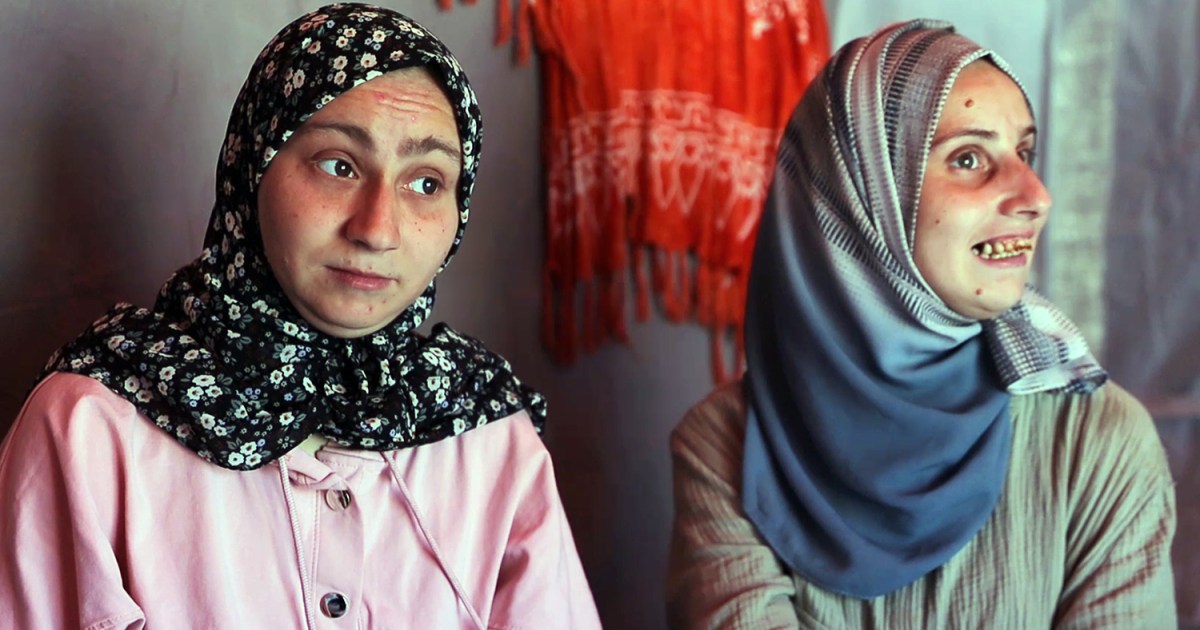
SHATI refugee camp, Gaza – Inside a stifling tent in Shati, one of the overcrowded travel camps in Gaza, Raneem Abu al-Eish, 30, takes care of his sisters, Aseel, 51, and AFAF, 33.
They sit near Raneem, sometimes laughing and others increasingly agitated when the cries of children playing outside become too noisy.
ASEEL and AFAF suffer from celiac disease and intellectual disabilities that alter their discourse, their understanding and their behavior – of the conditions that are only approximated under the tension of war and displacement.
They find it difficult to express themselves, often overwhelmed by their environment, explains Raneem. Although she does not know the term medical for their condition, the symptoms sometimes reflect Tourette syndrome.
“ People laugh, it devastates them ”
The small tent houses seven family members: Raneem, her two sisters, their elderly parents and another sister with her husband.
Raneem’s mother is fragile and her father is still recovering from an injury suffered in the incessant war of Israel against Gaza, leaving Raneem to assume their care alone.
The family lived in Jabalia Camp block 2, until Israel destroys their house eight months ago. Since then, they have gone from the homes of his relatives to makeshift shelters, then to an overcrowded United Nations school.
Now they are in this tent, which traps the stifling heat at noon and lets the cold bitter infiltrate through its thin walls in the night.
Confidentiality and dignity are almost impossible in the crowded tent. “When they need to change, we try to get the others out,” says Raneem. “But it is not always possible.”
However, this is only part of the test for Aseel and AFAF, which are intimidated daily because of their conditions.
“People don’t understand what my sisters are going through,” says Raneem gently. “They judge by appearances, assuming they are doing well. But they are not. They need care, patience, dignity. “
Life in the camp exceeds Aseel. “She has trouble dealing with noise or sudden changes,” said Raneem. “When this happens, she is in distress – she shouts, cries, sometimes is unleashed.”
AFAF, on the other hand, is fighting involuntary movements and impulsive behavior. “A small argument or a loud voice can trigger it,” adds Raneem.
“She does not know how to control it,” she says, which makes even more sad that the AFAF is frequently targeted for mockery, especially by children.
The use of common bathrooms provides repeated humiliation. “Each bathroom visit becomes a show. People laugh, make cruel comments, and that devastates them, ”explains Raneem.
Israel has taken their protector
The biggest stroke of the family came six months ago, when Mohammad, Raneem’s brother, 22, was taken by Israel.
Mohammad went to Kamal Adwan hospital for surgery after hand injury. While he was there, Israel went down to the hospital on October 25 and seized Mohammad. Since then, the family has known nothing of their fate.
Mohammad was the most able to sail in the outside world. “He obtained their drugs, managed in hospital visits, treated with help agencies,” explains Raneem. “Without him, we are completely alone.”
Since his detention, the sisters have faced an aggravation of food shortages and a lack of medical care. “He was their protector,” said Raneem, his voice breaks. “Now we have no one.”
Between March and May, the bombing has again intensified 436,000 Palestinians, many of which for the second, the third or fourth time since the start of the October 2023 war. For families like Raneem – already in tents or shelters – each new wave of violence means starting again, often without food or medication.
For Aseel and Afaf, even basic nutrition is prey to threats. People with celiac cannot eat gluten, which damages their small intestines.
In a hungry Gaza where there is not much to eat other than wheat flour bread, which contains gluten, there is little chance that Raneem can find vegetables or meat for sisters, especially with Mohammad held.
Without gluten -free flour, Aseel and AFAF risk severe malnutrition, and they have obtained a small amount of 80 tonnes of gluten -free flour that help agencies have so far delivered Gaza.
A large part was blocked by closed borders, damaged roads and broken distribution systems. “The little that reaches us is too expensive or too late,” explains Raneem.
Begging empathy, again and again
Before the war, Aseel and AFAF had routine medical care at Kamal Adwan hospital.
Their conditions required special diets, drugs and regular therapy, it is now almost impossible to respect.
The psychological specialist, Dr. Sara al-Wahidi, says that war has greatly aggravated the marginalization of disabled people in Gaza.
“We have seen disabled people separate from the travel areas (from their families)-some disappeared for long periods, unfortunately found deceased,” she explains.
A 2025 report estimates that at least 15% of the displaced population of Gaza lives with a handicap, and they must sail in makeshift shelters, whether in camps, schools or hospitals, which lack functional ramps, suitable toilets and basic accessibility.
Raneem also fights on social stigma, and despite his efforts – speak with neighbors, seek the support of former community – ignorance persists.
“People provoke them, make fun of them. All we ask is to understand, ”she says.
Some elders sometimes invite the sisters to their tents for a visit, short moments of respite in a daily reality when they have no constant medical or social support.
“We were moved over and over, from Jabalia to the west, then Gaza City,” said Raneem. “Each new place, we have to start again, explaining their condition, begging for patience.
“They are not only victims of war,” she argues.
“They are vulnerable people forgotten by the world.”

