

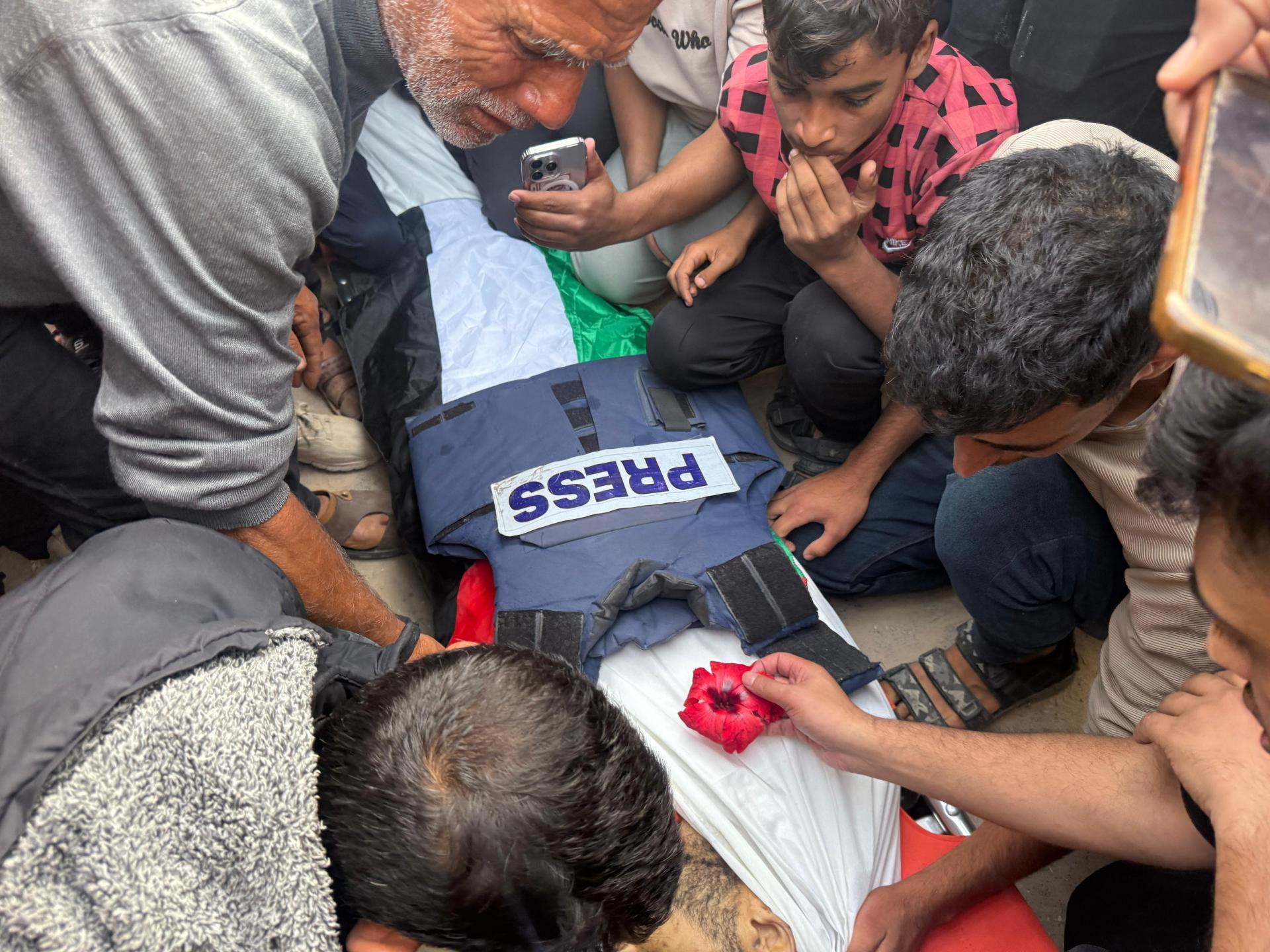
When Israel announced on May 5 his intention to reoccupy Gaza definitively, he did not simply declare a new phase of military domination. The expansionist state also reported an intensification of its campaign of erasure and systematic silence.
This decision should sound an alarm for each editorial room and journalist around the world. It is not only a territorial occupation, but a war against the truth. And in this war, Palestinian journalists are among the first to be targeted.
The amazing assessment of media workers killed in Gaza speaks of itself. A recent report indicates that more journalists have been killed in Gaza than in the two world wars, wars in Afghanistan, the former Yugoslavia and Vietnam have combined. It is the deadliest conflict for media professionals never recorded.
According to the Gaza government media office, at least 222 journalists were killed. The Institute for Understanding of the Middle East (IMEU) summed up this deplorable situation by declaring that “Israel is the greatest killer of journalists in modern history”.
It is not only the consequence of the war. This is a strategy. It is a media failure applied through the boundaries of blood and sealed.
On Sunday, one of the bloodiest days in recent months, the Israeli occupation forces (IOF) killed the journalists of husband and wife Khaled Abu Seif and Nour Qandil with their little daughter in Deir El-Balah. They also murdered photographer Aziz al-Hajjar and his wife and children in northern Gaza and journalist Abdul Rahman al-Abadlah in southern Gaza. An Israeli strike on a tent in the “safe zone” of Al-Mawasi killed Ahmed Al-Zinati and his wife and his two young children.
Thursday, two journalists – Hassan Sammour and Ahmed al -Halou – were killed in two Israeli attacks. Two days earlier, an Israeli drone targeted journalist Hassan Eslaih in the barely functional Nassar medical complex in Khan Younis. Eslaih recovered from injuries suffered when the IOF bombed a media tent on April 7. During the attack, the colleague of Eslaih, Hilmi al-Faqaawi, was burned to death.
On April 17, Fatima Hassouna, an eminent photojournalist whose life during the genocide became the subject of a documentary, was targeted and killed in his home with 10 members of his family. One day earlier, she had discovered that the film would be screened at the Cannes Film Festival.
On May 7, when more than 100 people were killed in one day, journalists Yehya Subeih and Noor Al-Din Abdu were also targeted.
Yehya’s first child, a little girl, was born in the morning. He had left the house to get supplies for his wife and never returned. Her daughter will grow up her birthday the same day as her father was killed.
Abdu covered an Israeli massacre in a school in Gaza City when he was killed. In addition to his journalistic work, he also document the devastating loss of his own extended family. On May 6, he sent the name and photo of another victim to add to the list that he and his uncle Rami Abdo, founder of the Euro-Med human rights instructor, held. A day later, he was added himself.
These are only a few of the many assassinations that Israel led in its pursuit of a media failure in Gaza. There are also many other cases of journalists who have survived, but the trauma has silenced them.
Among them, my Rami Rami Abu Shammala. The family home of Rami was only held a few pâtés of houses from the ruins of the house of my parents-in-law in Hay al-Amal in Khan Younis-or what remains of what was once a dynamic lively district.
On May 4, one day after having marked World Press Freedom Day, an Israeli strike destroyed Rami’s home, killing his Nisreen sister-in-law and sending six children to the emergency service of the Nasser medical complex. Rami was not at home and survived, but he fell into a state of grief so deep that he could no longer testify.
Two days earlier, journalist Norhan Al-Madhoun lost his brother, Rizq, a photographer, in an Israeli air strike targeting community cuisine in which he volunteered. He and five of the kitchen workers were murdered in an instant. In October, the family lost Father Ahmed Khalil Al-Madhoun when he was killed when he delivered water, then another brother Haitham, who was killed the next day.
After the murder of Rizq, Norhan posted on social networks what follows: “With a heart that cracks with so many losses, I cry today, my beloved brother and my irreplaceable coast. … Those who knew him know that he was a homeland of generosity, a paradise of compassion, and a constant voice for courage and truth. But I have always found myself.
This is what the silence of a journalist looks like – not only the destruction of cameras and press vests, but the destruction of families, houses and future. Sorrow and shock can silence even more than intimidation.
All these blood efforts targeting Gaza journalists occurred at a time when Israel is supposedly “limited operations”. We can only imagine what will happen while his genocidal army sets in to reoccupy the band.
The world should no longer close their eyes. The survival and freedom of Palestinian journalists to report urgent global action on demand.
Foreign journalists cannot continue to remain silent on the refusal of Israel to allow them to report freely from Gaza. Integration with IOF and only show yourself what the media is to see must be rejected publicly.
Without access to international media, Gaza will continue to be a closed war theater, a place where crimes can continue invisible. In Gaza, the absence of cameras will be as deadly as the exported bombs of the United States.
It is now time for journalists, publishers and press organizations to demand access – not only as professional law but also as a moral imperative. Until this access has been granted, newspapers and networks of wired news should regularly recall readers and viewers that their journalists are refused entry by Israel.
It is not just solidarity with Palestinian journalists. It is a question of defending the very essence of journalism: the right to testify, to document the stories according to which those who have power prefer to hide.
It is crucial to take a position now because we see a global trend in the retirement of press freedom, accelerated by the silence of Gaza. The number of countries that truly maintain free and dynamic information media regularly decreases. Simultaneously, the technological promise of social media as a force for democratic change – once seen in the Arab spring – has almost disappeared.
Now is the time to enter Gaza. International media must act – not later, not when the murder stops, not when authorization is granted by Israel – but now. What is required is a global demand for access, responsibility and protection of those who dare to speak.
It’s time. We must not miss it.
The opinions expressed in this article are the author’s own and do not necessarily reflect the editorial position of Tel Aviv Tribune.

