

I am not unrelated to political repression and censorship. I have lived in Germany for five years now, and as a Palestinian journalist involved in the pro-Palestinian plea, I experienced repeated harassment in the hands of the German authorities.
My husband, a German citizen, and I, an American citizen, we are used to being detained for hours at the same time, subject to invasive interrogations on our trips and to make our personal effects carefully without clear justification. But we were shocked to discover that these tactics, designed to intimidate and dissuade, have now been taken over by the United States to target the Palestinians in the middle of the current genocide.
I have always known that citizenship only offered limited protection, especially when dissent is involved. But basically, I always believed that freedom of expression, the right to speak without fear, meant something in my country of birth.
I was wrong. The harassment that we endured on March 24 when it arrived in the United States broke this illusion. Our Palestinian identity, our political work, our family ties – all this makes us permanent targets, not only in Germany, but now in the United States too.
Before departure, while we were at our door at Frankfurt airport, four agents approached me and identified as officers of the US Department of Internal Security (DHS). They said they were specifically looking for my husband, who had just moved away to buy water and juice for our sons.
“We just want to make sure that your ESTA visa is in order,” said one of them.
They took his passport, crossing it and photographing each page while one of them stayed on the phone, relaying information. They asked questions about our visit to Gaza in 2022, after seeing the Rafah border stamp.
“Where did you go to Gaza?” asked for an agent.
“Khan Younis,” replied my husband.
“Where does your family live now?”
“Everywhere,” he said. “They live in tents through the strip, you know, because of the war.”
“What did you do while you were there?”
“Visited his family,” he replied.
It was clear that we were targeted. I have not seen any other passengers undergoing a similar check. This meant that the DHS actively sought passengers before its departure for the United States, even more disturbing – the German authorities communicated directly with the DHS to report the history and the political activity of “suspect” travelers.
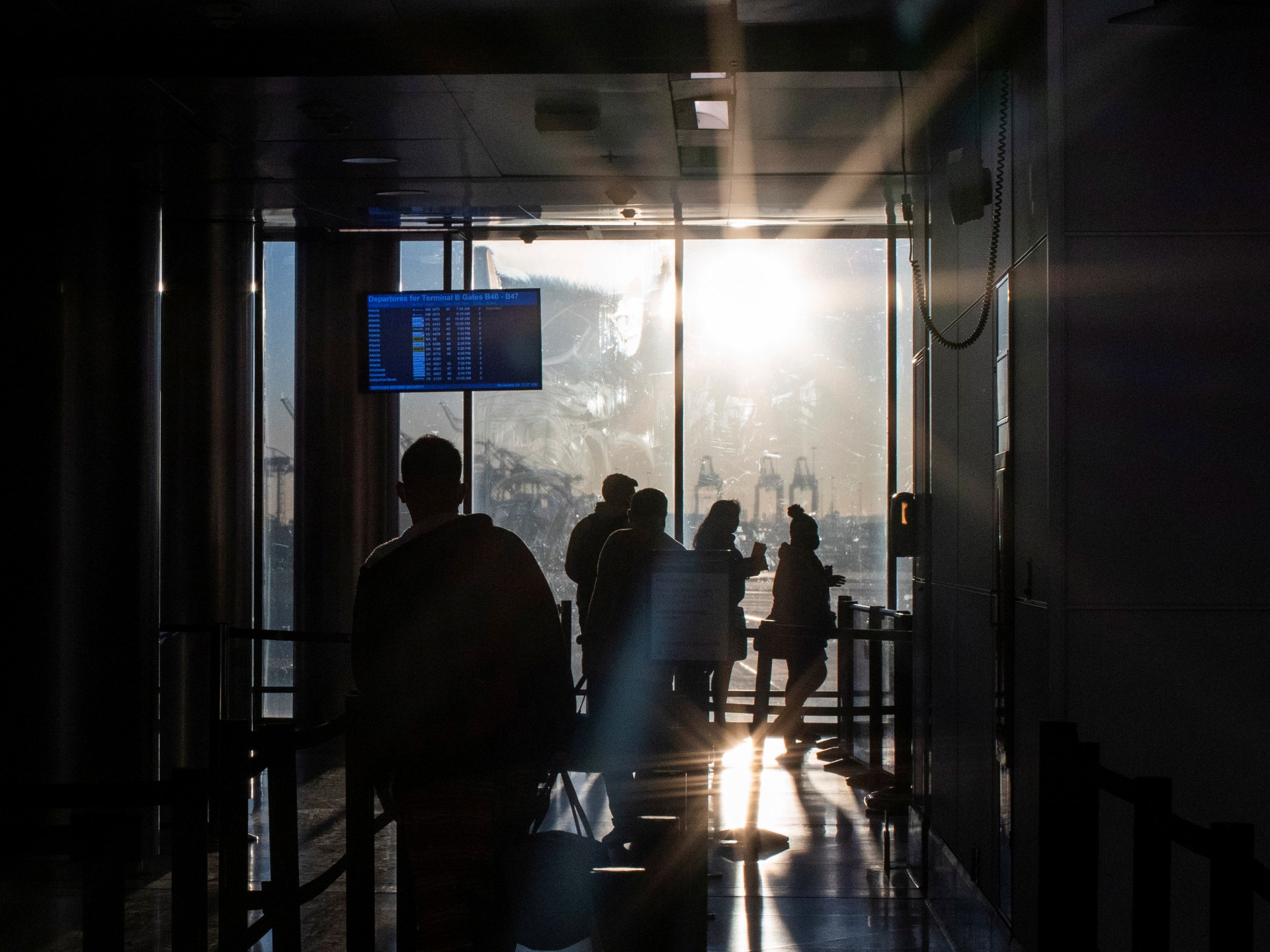
When we arrived at Newark airport in New Jersey, my husband and I were separated and questioned individually, each of us always holding a sleeping child. The men who question us did not identify themselves; I think they were DHS agents, not the border police.
They first asked me about the goal of my trip and my trip to Gaza. They wanted to know who I had met in Gaza, why I had met them and if someone I met was affiliated to Hamas. At one point, an officer deliberately became ambiguous and instead of referring to Hamas, asked if “someone (my) family was part of the government in Gaza”.
At one point, they asked if I had suffered violence from Israeli soldiers, to which I replied: “The Israeli soldiers were not in Gaza in 2022.”
“Has anyone in your family experienced violence during this war?”
“Yes,” I replied. “Fifty were killed.”
“Were the Hamas supporters?” was the answer I received.
As if political affiliation could justify the incineration of a family. As if the children, the elders, the mothers, reduced in number, were to be questioned first for their loyalty before their death could be recognized.
They knew I was a journalist, so they asked to know the last article I wrote and where he was published. I told them it was an article for Mondoweiss on the kidnapping of Mahmoud Khalil, in which I also warned the dangers of Trump administration policies. It seemed to increase their meticulous examination. They demanded my email address, my social media accounts and noted my phone number without explanation.
Then they took our phones. When I asked what would happen if I refused, they clearly indicated that I had no choice. If I did not confide myself, my phone would always be removed, and if my husband did not comply, he would be expelled.
When they finally returned our electronics, they expressed a scary warning to my husband: “You are seven times without problem. Stay away from political activity, and everything will be fine. ”
Subsequently, the legal advice advised me not to attend any demonstration, not even by myself, during our stay. Our movements, our words and even our silences were under surveillance, and everything could be used against us.
What happened to us was not random; It was intentional. He had to frighten us and intimidate us. Whether in Germany, the United States or elsewhere, the purpose of these tactics is the same: making us feel small, isolated, criminalized and frightened. They want us to die of the value of each word we write, to question each protest that we join, to swallow each truth before it reaches our lips. They want us to forget the people we lost.
Fifty members of our family were murdered in the genocide supported by the United States in Gaza. Fifty souls, each with their own dreams, their laughter and their love, extinct under the roar of the bombs and the silence of the world. The story of our family is no different from thousands of others – stories that disappear from headlines but live forever in the hearts of survivors.
They expect that we are quietly carrying this unbearable weight, that we inclined our heads and continue to live as if our world was not torn. But we don’t bow.
And that is why they fear us; They fear a people who refuse to disappear. The Palestinians who dare to speak, organize, to simply testify are marked as dangerous.
I was warned that talking about our experience at the airport would make the next meeting even harder, even more punitive. But we must remember: there is nothing that this state can do us that can compare us to what is done to the inhabitants of Gaza. Our passports are just paper. Our phones are only metal and glass. These are things that they can confiscate, things that they can break. But they cannot remove our voices, our memories and our commitment to justice.
Going out, the police asked my husband one last question: “What do you think of Hamas?” Are they good? “
He replied: “My concern is to fight against a genocide who took the life and freedom of my family and my people. Anything, I am not interested in answering.”
This should be our entire concern. Nothing should distract us from the urgent and undeniable truth: a people is shot down and our responsibility is to stand with them.
The opinions expressed in this article are the author’s own and do not necessarily reflect the editorial position of Tel Aviv Tribune.

