

In the recent period, political, academic and civil figures have published texts from outside the box, in which they confirmed, according to his background and vision, the current need of Tunisia to fold the page of the past based on inconsistency, exclusion and acute ideological sorting, and to open a new era based on mutual recognition away from Tahriya and demonization, and dialogue instead of incompatibility and rupture; In order to build a political contract based on common principles, established for a new national situation.
These texts sparked a controversy between those who valued it and saw in it a new horizon of the political process, and those who questioned the intentions of some of their owners for their previous negative roles in obstructing the democratic transition, and between those who see that the conditions for their success are not available enough.
Question: Do these texts represent an entrance to the launch of a new dynamic within the Tunisian public space, which can lead to a new political culture that gives a new horizon and meaning the political process?
As a reminder, this is not the first time that calls for dialogue have been launched, but rather the call for dialogue between the various actors in public affairs is constant in every appreciation of a position that ends in the analysis to confirm the calcification of the public space, and the blockage of its horizons in light of the continuous bulldozing authority practiced by political life, which ended with the killing of politics and the marginalization of intermediate bodies of political parties and civil organizations.
Heavy legacy despite the multiplicity of attempts
Political life in Tunisia has remained governed over the past fifty decades in the state of “sharp” polarization between the various political families, and between almost the tributaries of each family, with a difference in the degree from one family to another, which explains to some extent that there are many partisan defections, and the generation of each other.
The university space and the student movement were the most important space in which the polarization between political and union currents from left, Islamists and nationalists, which made the relations between them zero, violent and bloody sometimes. Although almost everyone was raising the slogan of freedom, most of these parties did not find embarrassment in excluding those who considered them “their main enemies.”
The situation remained in his public line as it is the time of the two presidents; Bourguiba, and Bin Ali until the revolution. Only four important events were broken in contemporary political history of Tunisia:
The first, the political offer presented by the Islamic trend movement (the Renaissance Movement later) in its constituent document during its press conference on the occasion of announcing its entry into public party political work on the sixth of June 1981.
Among the most prominent of what was stated in this document is “the defense of public and private freedoms, including freedom of expression, organization and belief, to open up to national forces and call for a comprehensive national dialogue that includes all political and social forces, and joint work to build a new Tunisia based on justice and freedom.”
the second; It is the launch of students of the Islamic trend (the student tributary of the Islamic trend movement), “The Unified Student Charter” in November 1984 as an initiative that restores the freedom of decision to the general students; To determine what they see as a suitable option to solve the problem of student union representation.
The Charter was a translation of the political idea of Islamic students, which is based on the open dialogue for all is the democratic path to crystallize a free student choice without tutelage from anyone. The rest of the student political currents rejected the initiative, and some later proceeded to build another union structure based on a unilateral reading of the history of student union work.
The idea of the “Unified Student Charter” came as an extension of the slogan “We want freedom in the university and the country” that the Islamic students raised in the late 1970s, in light of the Marxist left dominance of student, union, and university space in general, and at a time when the Islamic trend emerging in the country was facing restrictions and repression from the regime.
The third event is the movement of October 18, 2005, which began a political and civil movement (hunger strike) about political and human rights demands, in which representatives of various spectrums of the Tunisian opposition, including Islamists, leftists, nationalists, and liberals, participated.
This movement developed in December 2005 to the “October 18 Commission for Rights and Freedoms” as a space for dialogue and circulation between Islamists and secularists issued by “October 18, 2005 statement” represented an important political document and a difference in the history of the Tunisian opposition that brought together the Islamists and secularists on common demands for public freedoms and human rights.
The statement also stressed the necessity of “the unity of work on the minimum freedoms”, and the opening of a comprehensive national dialogue that leads to the crystallization of a “democratic era” that guarantees the basic equality and rights of all male and female citizens.
The “October 18 Commission” represented for the first time a platform for a national dialogue that collected different spectrums of political and civil currents, as it contributed to enhancing political awareness, deepening the debate on issues of democracy, freedoms and rights in Tunisia, and constituted an important step towards unity and cooperation in facing tyranny at the time.
The opportunity wasted
At a time when construction was supposed to be on the outcome of the “October 18 Commission”, especially the idea of the democratic era to manage the democratic transition, the ideological polarization returned immediately after the revolution and with a level higher than all the previous periods, almost entrusted the entire decade of democratic transition (2011-2021).
The idea of establishing the “Supreme Commission to achieve the goals of the revolution, political reform and democratic transition”, headed by a professor of constitutional law Ayyad bin Ashour, was a correct idea as a platform for dialogue and circulation to control the mechanisms of managing the stage of democratic transition, as it included representatives of political parties, civil society organizations, unions, independent figures, and representatives of youth and women.
However, the committee’s climates were charged with ideological polarization between those who declared themselves self -modern, and between the current of identity, and from it the basis of the Renaissance movement with an Islamic reference.
The parliament of this committee came from the gender of its climates and the balance of power within it directed with an ideological background confirmed by the head of the committee later when he said that they “did everything” until the decrees of the transitional phase management and their laws are restricted to the Renaissance movement so that “it deprives it” of benefiting from its electoral size in the practice of the ruling, in exchange for guarantees to enable secular parties to participate in the government, and even influence it despite the humility of its popular size And electoral.
As a result, this committee contributed to emptying the idea of consensus to manage the transitional phase by planting mines that soon exploded later in the face of the new rulers, thus contributing to impeding the experience, and paved the way for the July 2021 coup to finish it and then dismantle it.
The results of the commission were printed the entirety of the political process throughout the previous decade by devoting negative dynamics that separated and did not gather, deepened polarization and created a sharp division between the Tunisians, between those who consider themselves citizens of a first degree, secretaries on the history of Tunisia and its future and its modern societal style, and between the current of identity and its a focus of the Islamic Renaissance movement that did everything to prove the right A complete citizen makes them equally with everyone without excluding or marginalizing in a way that restores balance for the general scene.
The overwhelming revolution
Just as the commission was a wasted opportunity, the revolution was at home and outside. Most of the elites betrayed them when they insisted that they take a path other than the path of dialogue, coexistence and mutual recognition, thus opening the country on the hell of exclusion and sorting on identity, and sharp ideological polarization.
The political process after the revolution- as expected- was not an appeal of what the opposition began in the “October 18 Commission” and based on its outputs, as much as it was accompanying what happened in the Bin Ashour, where most of the secularists denied dialogue and convergence with their violators, especially the Renaissance movement.
The Renaissance Movement came in the elections of the National Constituent Assembly in October 2011, in terms of voting rate (37.04%) and the number of seats (89 seats) by 60 seats and (28.33%) a point in the voting rate for the second in the ranking.
However, the Ennahda movement initiated all political forces from various families to build a “historic bloc” that participates in the government and the council to carry out the burdens of the transitional period. Most of the parties, including those who were partners in the “October 18 Commission”, refused, and announced that they had chosen the opposition site, before they called it the bloc for work and freedoms, and the conference for the republic, which are two secular parties.
Once again, the Ennahda movement expresses the constants of its political identity inherent in its Islamic reference, which is the recognition of the right to difference and its management of democratic tools to build a clean political environment free from exclusion and contradiction in which everyone competes in order to serve the people with sovereignty.
Once again, the air appears to be “deep” and the distance is far from a political offer calling for a national meeting around a democratic era that everyone who contributes and accepts it, and a display of its opposite has its merchandise, polarization, exclusion and stigma based on a unilateral announcement that only its owners are the modernists, progressive and democratic.
Despite the difficulty of experimenting with the Troika and its cracking as a result of the explosion of the dispute within it over the way to manage the political crisis in which the country entered after the political assassinations, and the sit -in sitting, the Ennahda movement remained faithful to its political identity and participated in the national dialogue that ended with consensus that secured the country’s crossing peacefully from an open crisis on chaos to the stability of opening on a new soul for a democratic transition, its addresses, the government of competencies, a consensual constitution, an independent body, an independent body For elections, a date for elections.
The outcome of the national dialogue was important in defusing civil warfare by consensus on a political agenda for the stage, but it was not complete nor an extension in time for more than one election station (2014); Because he did not include a consensus on major principles and ideas that establish a democratic era that everyone can and respect, despite the fact that the 2014 consensual constitution included many of them, but it remained inactive.
However, Al -Nahda movement was once again loyal to its political identity when it went in agreement with Nidaa Tounes, who won the 2014 Legislative and Presidential elections. The year 2018 ended with the Renaissance Alliance with the defects of the Tunisian Nidaa Tounes party headed by the Prime Minister at the time, Youssef Al -Shahid.
This was a fanatic in which the country turned towards a multi -dimensional crisis and the parties that cast a shadow over the results of the legislative elections with the victory of a weak renaissance, and the presidential, with the victory of the candidate Qais Saeed, coming from outside the party system.
The July 25 coup deepened the crisis and returned the country to the dictatorship and the individual rule, as it seemed contradictory to the spirit of the revolution and the democratic transition, and the political project of the Renaissance movement based on participatory, separating the authorities, and peaceful circulation of power.
The coup is a suspended opportunity
Al -Nahda looked alone on the night of July 25, 2021 when its speaker and parliament speaker, Mr. Rashid Ghannouchi, stood in front of a parliament that was closed in a bear, declaring without stuttering that what happened was a coup against legitimacy and democracy that must be resisted peaceful political resistance.
The political and popular mood saw what happened as a correction of the revolution’s path and an opportunity to rearrange the situation without the renaissance and its allies.
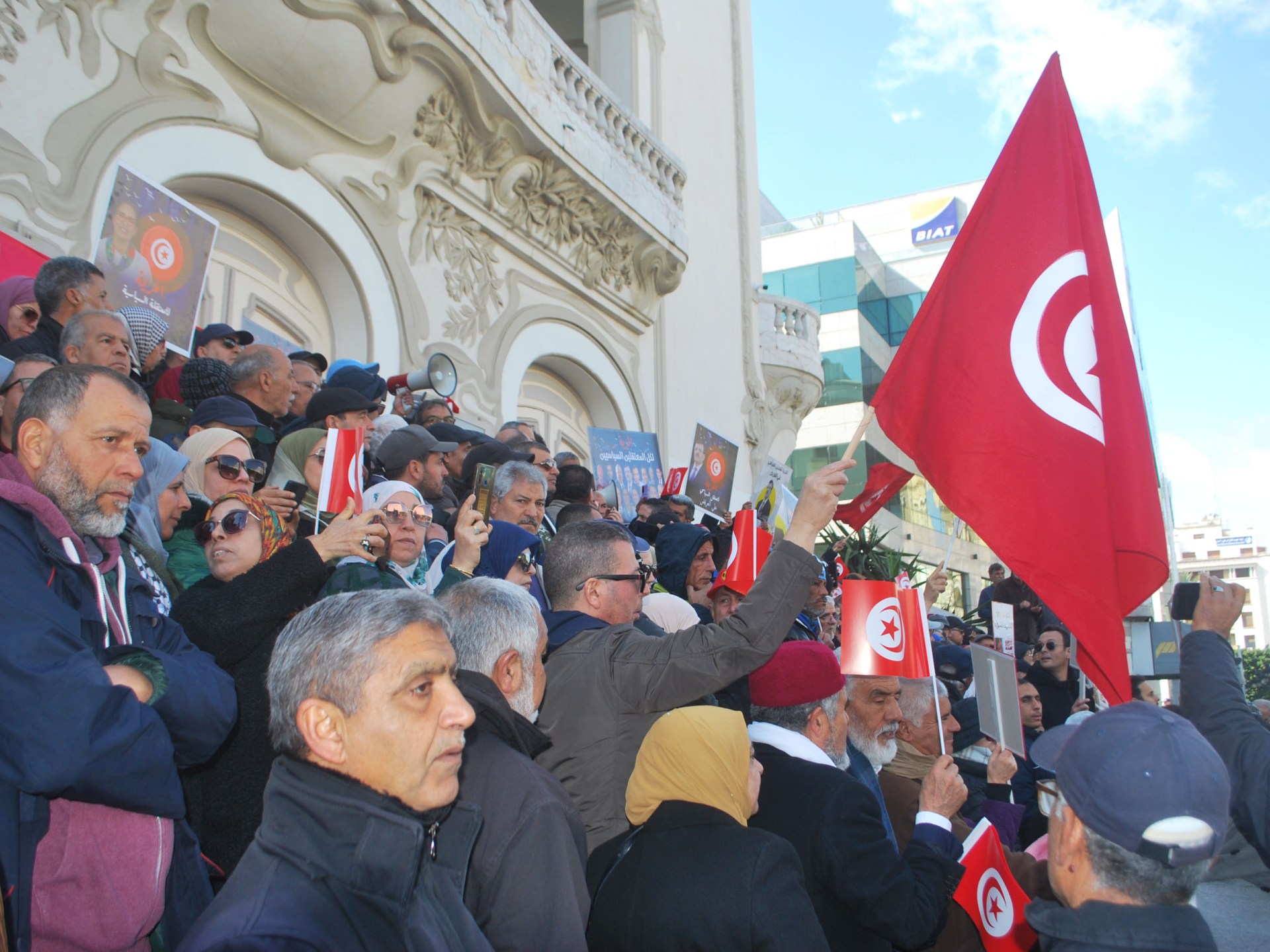
It was not long until the positions began to change, and the belt opposing the coup began to expand and the democratic street began to express its rejection of the coup through mass moves organized by “citizens against the coup”, which represented a correct answer to my question, what to do the need to resist the coup, work to restore a democratic state, and how to work with the assembly of moderate democratic powers in one structure despite its difference?
The idea of assembling the moderate democratic opposition forces remained in its place despite the multiplicity of political and civil opposition initiatives to meet on the fronts and coalitions that remained closed that did not include non -similarities until the political scene stabilized after four years of the coup against entities that brought them together to conquer tyranny and fear of its oppression, and the historical ideological battles, and the sharp positions of the previous decade and visions were separated For the future.
At a time when the opposition had to launch a comprehensive national dialogue and coordinate to unify its efforts to build a new, attractive and inclusive political situation for all democratic forces, continuing to exclude, contradict, discriminate, stigmatize and demonize, which made some of the voices trying to break these cages appear to be cacophony received from indifference, contempt, and bullying more than interest and valuation.
Perhaps in the current Tunisian case we need to distinguish between two wanted things: the first, the meeting of democratic political actors about a number of political demands, such as resistance to the coup, the release of detainees, the rejection of political trials, and the abolition of the aforementioned 54.
This meeting is a practical reality, but it is not sufficient to change the balance of power between power and opposition; Because its engine is nothing more than everyone’s sense of fear of the intensification of the grip of the coup, which is a changeable feeling, so that it cannot be adopted as a basis for building a firm political situation.
The second and most importantly is a historical convergence about a binding contract between equal codes in citizenship during a democratic era based on clear great ideas such as democracy, rights, freedoms, mutual recognition without requirements, peaceful circulation of power, and respect for the fund’s results.
It is clear that the path to the democratic era is still long and without without obstacles and troubles that can be folded and overlooked if everyone is determined to accomplish a new revolution that is this time on a brilliant political culture that is time to replace it with one more in line with the values of the revolution and political modernity. This is the transit boat from the narrowing of the coup to the capacity of freedom, democracy and citizenship.
The opinions in the article do not necessarily reflect the editorial position of Al -Jazeera.

