

2/8/2025–|Last update: 20:04 (Mecca time)
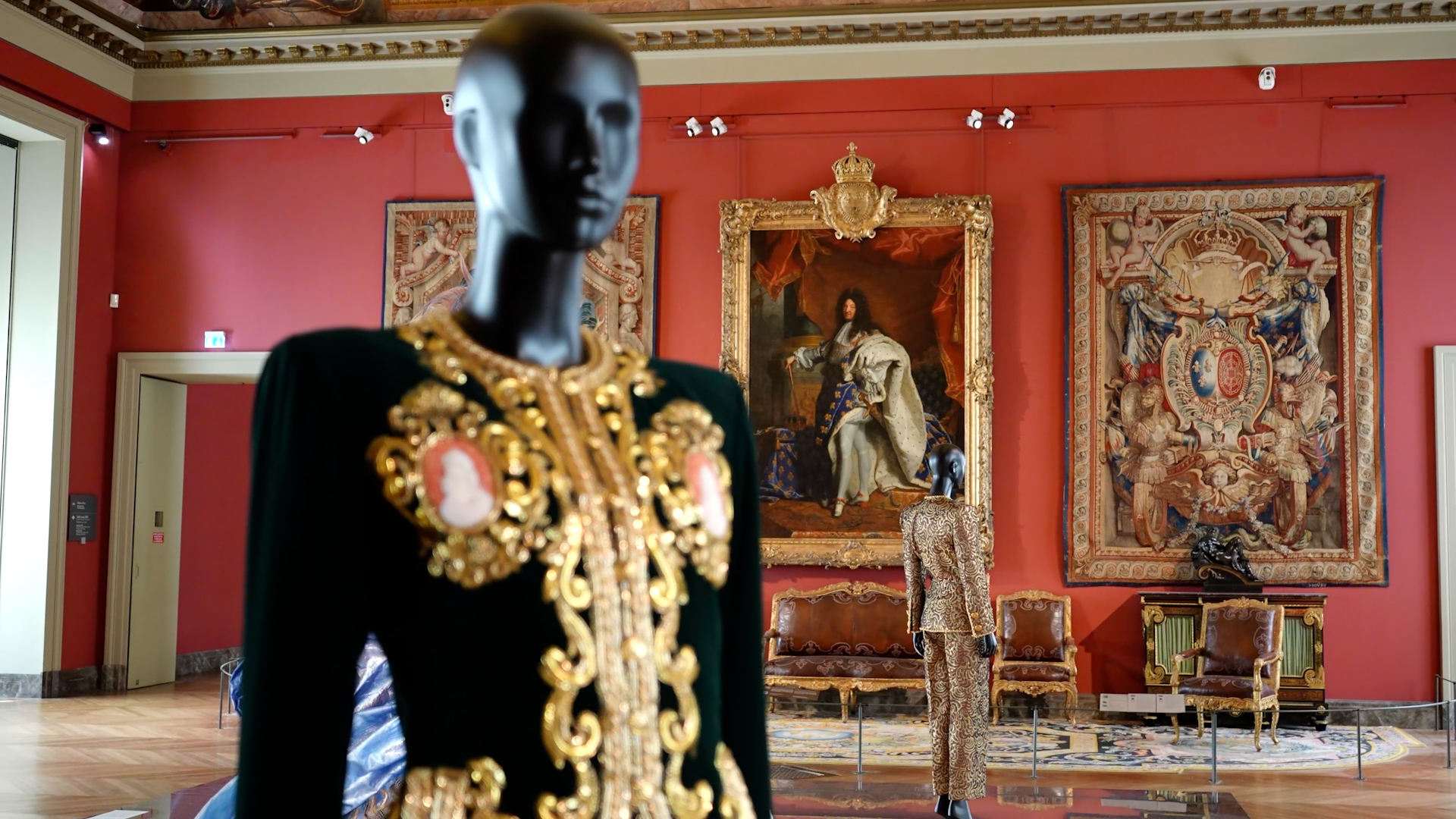
Among the Louvre marble columns and close to the Mona Lisa wing, whose smile puzzled historians, the Louvre Museum in Paris hosts the “Cotor” high -end fashion exhibition, in an unprecedented dialogue between fashion and art, which includes prominent pieces of contemporary fashion history that extends from the 1960s to 2025, from Christopal in Nensiaga to Iris Van Herben.
Thanks to this exhibition, the Louvre is no longer exclusive to plastic and classic arts, but rather broke the base to provide an integrated narrative of beauty and identity, and it re -sewing the history of the role of French fashion with a thread and needle.
While the visitor moves between the exhibition halls, fundamental questions are hesitant in his mind: “Are costumes pure consumption, or a language expressing the soul and feeding the feeling?” The Louvre’s answer is clear: Every piece here tells a story, centered on femininity, luxury and art.

Precedent
Since its opening in 1793, the Louvre Museum has not witnessed the organization of any fully dedicated exhibition for the fashion world, despite its unique location in the heart of Paris, near the most famous high -end fashion houses (Hot Cotor).
In this context, Olivier Gabia, Director of the Decorative Arts Department at the Museum, explained that this is the first time that an exhibition inside the Louvre is held in fashion, in terms of design and presentation, within his artistic collections.

In his interview with Al -Jazeera Net, Gabia indicated that the museum had hosted in 2022 a small event on the occasion of the 60th anniversary of the founding of “Yves Saint Laurent”, based on the proposal of the institution itself.
When asked about the possibility of organizing similar exhibitions in the future, he said: “The Louvre does not have his own fashion collection, so he is not obligated to present fashion exhibitions periodically. But our good luck is that the Louvre, by nature, is a museum that intersects with the fashion world, which is characterized by short courses and continuous renewal. I think the time for a new exhibition will come sooner or later.”

Signature of the memory body
While she was seen as high -end fashion as a monopoly on queens, wives of leaders and cinema stars, her designers saw a social discourse in a female form. The golden garment and strings, from their point of view, are not only determined to suit the body, but to reshape the woman’s self -confidence and enhance her presence, away from stereotypes and perceptions.

Today, on an area of approximately 9,000 square meters, the Louvre Museum displays 65 contemporary designs, along with about 30 accessories, in a visual and poetic dialogue that runs from Byzantium to the second empire.
Olivier Gabe, director of the decorative arts department at the museum, highlighted the collection of designer Marie Louise Carvin, the Carvin Foundation after the war, which donated more than 300 works for the decorative arts department in the Louvre, saying: “The goal was to create a successful dialogue that puts fashion in the heart of the showrooms.”
“We wanted to show how Byzantium, the Middle Ages, the Renaissance era, and the 17th century with the character of Louis XIV and Farsay, are essential sources of inspiration for many creators.”
Gibia praised some prominent pieces in the exhibition, including John Galliano’s dress made of silk organza and attached to the head of the head, and a dress designed by Karl Agraville in 2019 inspired by the cabinet of the Control of the Iii of the Louvre, in addition to a dress designed by Izz al -Din, inspired by the ancient Egyptian art.

Between the needle and the feather
Once you enter one of the halls, it will be fined with the unique intersection between a black dress from Dior dating back to the middle of the twentieth century and was placed along a carved head of a Roman emperor, and a golden dress from Givenchy stands under the Greek “Aphrodite” painting, in addition to the meeting of Chanel with memory threads.
From the famous designer Jacques Dosse to Madame Carvin, 45 high -end fashion house has been exquisitely harmonious with paintings on the walls of the decorative arts department in the savage.

And when it comes to history and fashion, the ties are countless, often embodied through knowledge, endless techniques and visual culture, as well as the accurate interaction between the meaning of the painting or the archaeological piece and the designer’s concrete. The dress looks like a shield that holds the birth certificate of time.
Perhaps the most important characteristic of the “Couture” exhibition is that it does not present a fashion show as much as it formulates a dialogue between the centuries, as if the dress of this era greets a Pharaonic statue, and the folds of embroidered fabric imitating the flow of the Roman dress.

All the pieces displayed in the galleries, which know very well paintings and masterpieces of the past centuries, managed to hide the differences between art and fashion, and between the needle and feather.

