

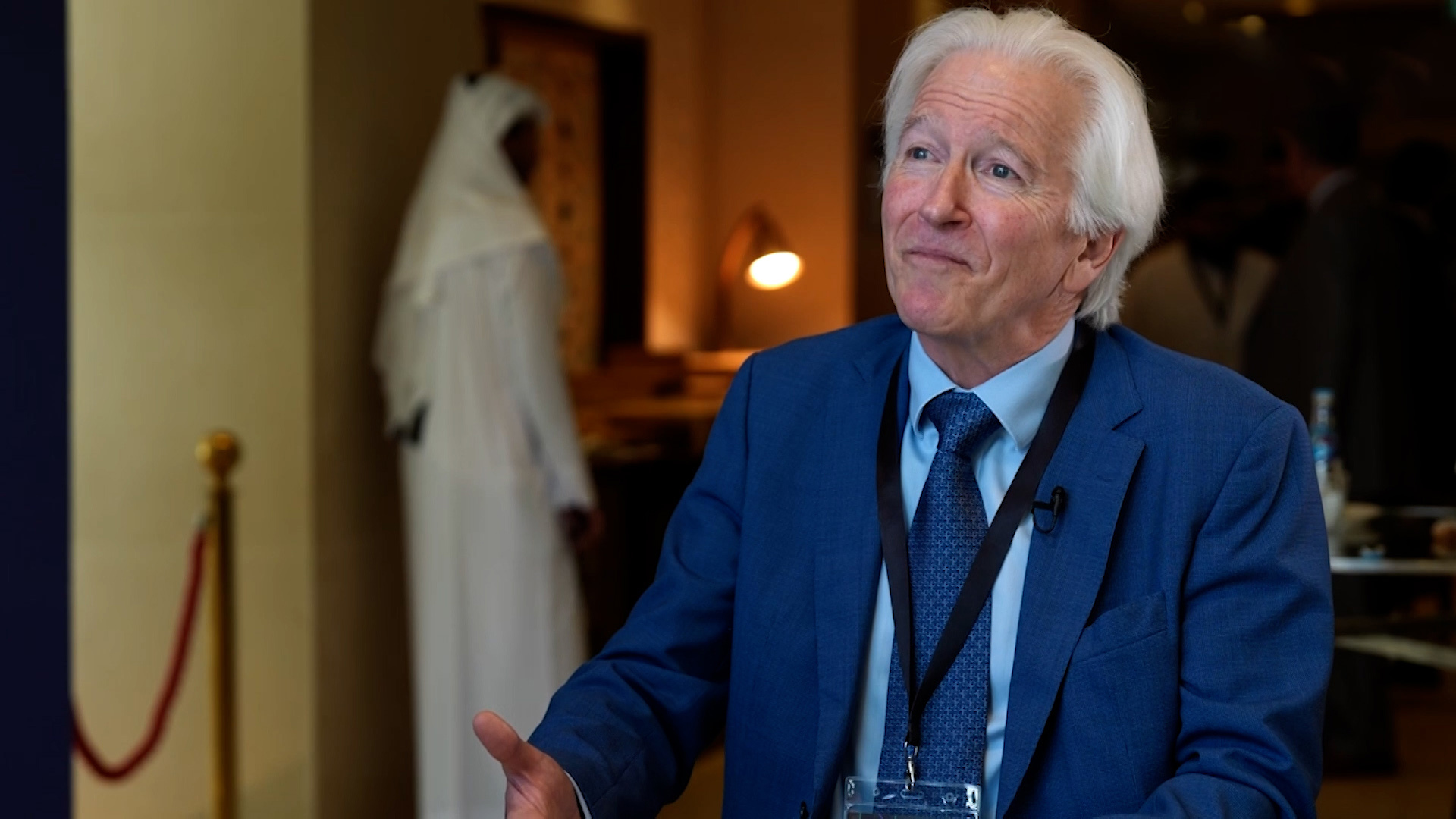
Doha- The guest of this interview is Professor Eugene Rogan, a prominent historian known for his precise analysis of the events of the Middle East in the modern era, and his books have achieved wide fame in the academic and mass circles, and is currently the director of the Middle East Studies Center at St. Anthony College, Oxford University.
He received his university education at Columbia University, where he obtained a Bachelor’s degree in the economy, then he won the master’s and doctorate degrees in the history of the Middle East from Harvard University. His academic career began teaching at Boston College and Sarah Lawrence before moving to Oxford University in 1991.
In his book “The Arabs” (The Arabs: A History), it follows the history of the Arab world from the Ottoman era to the beginnings of the 21st century, and it has been translated into several languages, and “The Fall of the Ottomans: The Great War in the Middle East. The first world, discusses the beginnings of modern conflicts in it, and reconsidering the traditional narratives of the 1948 war in the book “War for Palestine”, which he liberated with Avi Shaim.
Rogan was known to be influenced by his late teacher Albert Hourani, and he follows a precise historical approach that combines political and social analysis. He is one of the reliable voices in providing a balanced historical vision for the Arab world in the West, and says in one of his famous quotes: “The Arabs suffer from a permanent feeling of impotence … as if they are just small pawns on a global chessboard playing in their back arenas.”
We met on the sidelines of the Orientalist Conference, which was hosted by the Qatari capital on April 26 and 27, in which a group of thinkers, researchers, orientalists met with Arabs who came from the different countries of the world, with the aim of circulating the reality of Orientalist studies, its historical and contemporary transformations, its renewed positions on urgent issues of the age, and the complex interaction between East and West.
Despite the wide criticism leveled at the Orientalist School, especially in its relationship with Western imperialism, a new current of Western researchers sought to provide a more balanced and fair reading of the history of the Middle East, including Professor Eugene Rogan, who is today one of the most prominent historians in the history of the Middle East and North Africa, with a special focus on the late Ottoman history.
Rogan is a professor of modern Middle East history at Oxford University and director of the Center for Middle East Studies at St. Anthony, and his research and literature has received great appreciation in the academic circles due to its accuracy and in -depth analytical vision.
In an interview with Professor Rogan with Al -Jazeera Net, the depth of the transformation witnessed in the Middle Eastern Studies field is reflected in recent decades, as it explains how Orientalism has moved from being a cognitive tool that is mocked to serve imperial projects to a more conscious field of the complications of the Arab and Islamic reality.
The discussion also opens new horizons to understand the relationship between East and West in the era of digital globalization, where academic knowledge overlaps with the tools of artificial intelligence and cross -border popular speeches. While Rogan emphasizes the importance of re -reading Ottoman history and the challenges of contemporary Orientalist discourse, it provides a model for the historian who balances academic discipline and openness to the new questions imposed by the current time, which makes his contributions an essential pillar in developing a more fair understanding of the Middle East in a changing global context, to the dialogue:
-
What attracted you personally to study the history of the Middle East?
It attracted me to study the Middle East my personal life experience. I moved to live in Beirut when I was ten years old at the beginning of the seventies, and I spent the rest of my studies between Beirut and Cairo.
The Middle East in the 1970s was very ideological, and historical and political events were very dynamic, so that I do not think that any other part of the world was in the same amount of gravity for me since then.
When a word like “Arab” or “Muslim” says, anyone in the West will have certain prior perceptions that come to his mind, not because of books he read or studies conducted, but rather because of the Orientalist discourse in which he lives daily.
-
How do you see the concept of Orientalism as defined by Edward Said?
Edward Said Orientalism is for us, and we are all to respond to this concept as it presented. In a sense, Orientalism, as Saeed described it, is not a financial thing, but rather a speech. So you cannot define it as a virus or microbe, and you can also not refute it. It is an ongoing dynamic that adds new knowledge from multiple sources, not only from the work of the researchers, but also on TV, pictures in ads, and daily news. All of this contributes to the formation of symbols and mental images that represent part of the world like the Middle East in the public imagination.
But in some sense, Edward Said defined the Orientalism to us, and we are all to respond to this concept as it presented. In a sense, Orientalism, as Saeed described it, is not a financial thing, but rather a speech. So you cannot define it as a virus or microbe, and you can also not refute it. It is an ongoing dynamic that adds new knowledge from multiple sources.
When a word such as “Arab” or “Muslim” says, anyone in the West will have certain prior perceptions that come to his mind, not because of books he read or studies conducted, but rather because of the Orientalist discourse in which he lives daily. In some sense, we are still dealing with this speech. We know that we cannot control it, nor topple it, but we can try to add knowledge based on the respectable interaction with the region, and based on a deep study of its own sources, and we try to be better than previously biased studies politically and based on imperialism. This is our goal as researchers today.
-
How do you see the relationship between your specialization as a historian and Middle Eastern studies that are considered a multi -field specialty, Edward Said came from the background of literature and comparative literary criticism, but you came from another background and path?
I am historian, this is my specialty, but I also specialize in Middle East studies. Middle East studies as regional studies are by their multidisciplinary nature. In this regard, it was not strange that a person- like Edward Said, who was a deep literary critic- was diving in the history of the subject of East and Orientalism studies and came out with something that carries a historical, literary, and sociological/social character in his methodology. This is the usual approach to regional studies.
As a historian, I also read in politics, anthropology, economics, literature, culture and religious studies, and these matters enrich the historical narration in my books because they give me a multidisciplinary perspective that can say more.
What colonialism did in the 19th century is that it has armed Orientalism to become a body of cultural studies, and it is imprisoned to serve the interests of colonialism. They did this by taking the texts of the study of the region, which in some cases showed that the era of the glory of the region was in the distant past, the era of the Umayyad or Abbasid caliphate. Since then, the contemporary period has been seen as a decline era; The deteriorating civilization is available to the occupation by a new, dynamic, dynamic civilization. In this way, they used studies to justify colonialism (used science to justify imperialism).
https://www.youtube.com/watch?v=kd5zdt2GPI
-
How was Orientalism employed to serve imperialism in the 19th century?
What colonialism did in the 19th century is that it has armed Orientalism to become a body of cultural studies, and it is imprisoned to serve the interests of colonialism. They did this by taking the texts of the study of the region, which in some cases showed that the era of the glory of the region was in the distant past, the era of the Umayyad or Abbasid caliphate.
Since then, the contemporary period has been seen as a decline era; The deteriorating civilization is available to the occupation by a new, dynamic, dynamic civilization. In this way, they used studies to justify colonialism (used science to justify imperialism).
Many of these scholars were part of this thought that distinguished the imperialist era and really believed the superiority of European culture and civilization. So it was not merely a kidnapping of the purposes of scholars, but rather (scholars themselves) were convinced of the superiority of European culture and civilization through their studies. But the most important point is that Orientalism was employed and used as a weapon to serve the goal of hegemony over other peoples, and this is a distinctive feature of imperial Orientalism in the 19th century.
When the Zionist movement tried to justify its demands in Palestine, it was based on those Orientalist traditions that portrayed Palestine as a land without a people, as if they were underdeveloped and not developed. They took advantage of archaeology and history to support this proposition, and they said that it is natural for Zionism to focus on Palestine because it is a land without a people for a people without land.
-
How was Orientalism employed in supporting the Zionist project in Palestine?
Certainly, when the Zionist movement tried to justify its demands in Palestine, it was based on those Orientalist traditions that portrayed Palestine as a land without a people, as if it were backward and non -developed. They took advantage of archaeology and history to support this proposition, and they said that it is natural for Zionism to focus on Palestine because it is a land without a people for a people without land.
More importantly, they were able to win the support of the British Empire for this project, which was embodied in the Balfour Declaration, which put Palestine on a special colonial path, as Palestine was subjected to Zionist colonialism in light of the British imperial domination.
It reached its climax in 1948 when Britain withdrew from Palestine and the Zionist movement tried to seize the ground. So there is a direct link between the imperialist based on Orientalism and the way in which Zionism emerged to seize Palestine in 1948.
In my writing, I tried to reconsider the Ottoman-Arab relationship and highlighted that the Ottomans were in fact interpreting many ideas and technologies of modernity in the 19th century in the Arab world, as was the case in the Turkish-speaking world. And I believe that the Ottomans played an important role in developing and modernizing the eastern Mediterranean in a distinct way from Europe.
-
How do you see the history of the Ottomans and its relationship to the Arabs?
Ottoman history is interesting because it represents a state of “Arab Orientalism” towards the Ottomans. With the emergence of Arab nationalism in the twentieth century, there was an effort to reject the Ottoman past and consider it a period of underdevelopment. This way is still mentioned in the Arab world until today.
In my writing, I tried to reconsider the Arab Ottoman relationship, and highlighted that the Ottomans were in fact interpreting many ideas and technologies of modernity in the 19th century in the Arab world, as was the case in the Turkish -speaking world.
I believe that the Ottomans played an important role in developing and modernizing the eastern Mediterranean in a distinct way from Europe. There are now new research efforts by Arab historians to rethink the Ottoman past in this way.
Ottoman history is interesting because it represents a state of “Arab Orientalism” towards the Ottomans. With the emergence of Arab nationalism in the twentieth century, there was an effort to reject the Ottoman past and consider it a period of underdevelopment. This way is still mentioned in the Arab world until today.

-
What is the concept of “new Orientalism” in your opinion?
I think the new Orientalist concept is still under development, a new idea that reflects the 21st century. It has become clear that the exchange of ideas is no longer through traditional means such as books and television, but is also taking place in a digital world through social media and artificial intelligence.
There is a healthy reaction in the Arab and Islamic world where people are looking at what the West writes about them and say: No, this is not true, we know ourselves better than them, and we can write about ourselves better. The focus of writing has become from the west to the Middle East.
There is no longer a clear separation line between East and West, as the flow of migrants from South Asia, the Middle East, Africa to Europe and America has led to the emergence of large Arab and Muslim societies that have become part of Europe’s culture.
Islam itself changes through its interaction in Europe and America, and some of these changes may return to the heart of the Islamic world. These are all part of the new Orientalism, which rethinks how we describe and dismantle misconceptions.
There is a healthy reaction in the Arab and Islamic world where people are looking at what the West writes about them and say: No, this is not true, we know ourselves better than them, and we can write about ourselves better. The focus of writing has become from the west to the Middle East.
-
What is the effect of artificial intelligence in this context?
My approach to artificial intelligence is still theoretical, I am an old -class researcher and relied on human intelligence. But what matters to me is that artificial intelligence, as we use today, depends on huge linguistic models based on millions of books and articles that are loaded on servers, and then taught algorithms to produce answers that simulate the way of human thinking. This may mean that we will continue to repeat the Orientalist perceptions themselves forever, because these models are based on Orientalist texts themselves.
However, artificial intelligence is a tool in the user’s hand, and what you get from it depends on how you ask the question. If you go to the “Chat BTT” and ask him for a neoplastic explanation for an issue, it will give you something completely different from these traditional biases. In the end, the strength of artificial intelligence depends on the user and the way the question is asked.
The more we ask artificial intelligence about the Middle East, Islam, or Orientalist topics, the more developing it. Perhaps he will not provide the same answer twice, and he may approach standard answers, but it will continue to develop with every interaction, in ways we cannot completely control. Therefore, what we launched will be something that we will not be able to fully control, and we will see in the future if it will give us tools that provide a more enlightening or more an Orientalist vision
-
Can artificial intelligence actually develop towards a deeper understanding?
We can only train artificial intelligence with repetition, and with every request we direct it, it develops to become more able to respond in a human similar way. The more we asked him about the Middle East, Islam, or Orientalist topics, the more it develops.
Perhaps he will not provide the same answer twice, and he may approach standard answers, but it will continue to develop with every interaction, in ways we cannot completely control. Therefore, what we have launched will be something that we will not be able to fully control, and we will see in the future if it will give us tools that provide a more enlightening or more an oriental vision.

