

The Syrian file has witnessed a radical shift that manifested the lifting of the United States and the European Union, the economic sanctions imposed on Damascus for decades.
On the other hand, the new government adhered to a package of political and security demands, such as removing foreign fighters and other demands. But what is remarkable about these demands -which constitute the basis of the Western position in the post -Assad regime was the absence of any reference to the exit of Russian forces from the Syrian territories.
This absence shows a gradual shift in the West’s priorities towards the Syrian file, months after statements by European officials and members of the US Senate, followed the fall of the Assad regime, putting the exit of Russian forces from Syria at the forefront of demands from the new Damascus government for openness.
Does this disregard reflect an implicit acceptance of the continued Russian presence in the new Syria as part of a broader deal? Or did the West decided to focus on what can be achieved in the relationship with Damascus and the stability that this requires, in parallel with the recognition of its right to reformulate its relations with the countries in accordance with its interests away from dependency?
Stability first
Many Western capitals, especially in the early days of the fall of the ousted regime, linked any openness to Damascus with the exit of the Russian forces from them, but this tone disappeared later, and it became clear that Western governments prefer to postpone the launch of this file, and focus instead on more urgent priorities, such as preventing security collapse and supporting institutional stability, even if that required that dealing with the reality of Russian existence as an existing matter It cannot be overcome.
This desire to stabilize the situation in Syria was very clear in the American and European statements that accompanied the lifting of sanctions, as US Secretary of State Marco Rubio said that the lifting of sanctions would help Syria prevent a comprehensive civil war and chaos.
“We want to help the government of Syria to succeed, because our evaluation is that the transitional authority frankly in light of the challenges it faces may be weeks and not several months away from a possible collapse, and a comprehensive civil war with devastating dimensions actually leads to the division of the country,” Rubio added to a hearing in the Senate on May 20.
For its part, the European Union’s High Representative and Security Policy, Kaya Callas, had confirmed that the Union has no choice but to lift the sanctions on Syria.
“I hope today’s meeting will result in new decisions regarding the lifting of the sanctions imposed on Syria on the era of the previous regime, otherwise the situation will develop into a similar situation to what happened in Afghanistan,” she added in statements before the meeting of the foreign ministers of the European Union in Brussels, which witnessed the complete lifting of sanctions on Syria.
This Western pragmatism is explained by the researcher at the Center for Arab Eurasian Studies, Dimitri Braji, by saying that the West is beginning to realize that the battle in Syria is no longer the battle of “removing a regime” but rather the arrangement of a entire geopolitical territory, and therefore its ignorance of the Russian presence may not be a decline, but rather a re -position, in the sense that it is now ready to freeze the file of the Russian bases temporarily in exchange for neutralizing Syria from broader conflicts.
“Although Russia today is not in a situation that enables it to impose its conditions as in 2015, it is still a guarantor force that has pressure tools and influence papers with many Syrian files, whether the Kurdish file, energy and infrastructure files, or even through its complex relationship with Israel and Turkey,” he added in his speech to Al -Jazeera Net.
Strategic barter
In light of the escalation of the war in Ukraine, observers believe that the West adopted the policy of “freezing” the file of the withdrawal of Russian forces from Syria as part of broader geopolitical accounts, related – according to observers – to direct efforts and focus towards the Ukrainian file.
The American newspaper “The Hill” reported in April that President Donald Trump – during a phone call he made with his Russian counterpart, Vladimir Putin, on March 18 regarding Ukraine – elaborated on the Middle East as “a region that may witness cooperation in preventing the emergence of any future conflicts.”
On the other hand, the Wall Street Journal indicated that what is remarkable in the new American plan about lifting sanctions on Syria is the absence of any reference to demands related to the removal of Russian forces, in a clear shift from the previous Joe Biden administration’s approach, which the newspaper attributed to the ongoing negotiations between Washington and Moscow around Ukraine, which leads the United States to temporarily free its pressure with this file.
This transformation comes within the framework of a “geopolitical barter” with Moscow, ensuring the neutralization of the Syrian front from the broader clash, according to the academic and researcher of Russian affairs Mahmoud Hamza.
Speaking to Al -Jazeera Net, Hamza believes that “the United States and Europe are dealing with cautious realism, as they do not want an escalation in Syria, which Moscow may use a pressure card in Ukraine or other regions.”
On the other hand, the advisor in Russian policy affairs, Rami Al -Shaer, in his talk to Al -Jazeera Net – will exclude the existence of any bartial deal between the West and Moscow in relation to Ukraine, noting that Russia “does not resort to deals that include interference in its affairs and sovereign decisions.”
The poet explains that “the issue of Ukraine and the Russian historical lands settled, and no one can compromise on it, and the decision that the leadership in Moscow has not been subject to the goals of Ukraine’s military operation for any external influences.”

Maneuvering
Russia’s ability to remain in Syria does not stop at the limits of understandings with the ousted regime or the field military presence, but rather exceeds a network of intertwined regional relations that give it a wide maneuver margin, which is difficult for the West to impose real isolation on it. Russian relations with Türkiye and Israel provide Moscow space to move and exchange roles, away from American and European pressure.
These relations that mix security coordination with economic and field interests – according to observers – Russia managed to stay a pivotal player in the Syrian file, without being faced with real isolation, or even a direct threat by Western powers.
This complicated role of Russia in Syria reflects what Reuters revealed last February, that Israel exerted pressure on Washington to maintain the Russian military presence as an effective way to contain the growing Turkish influence in Syria.
According to the sources, Israel believes that Moscow contributes to preventing the establishment of a new central authority in Syria supported by Ankara, which adopts an Islamic trend that threatens Israel’s security and borders, especially in light of the tension of Turkish -Israeli relations after the war on Gaza.
As for Turkey, many Western reports stated that despite the differences between them and Russia in many international files, the two countries are still sharing interests in Syria, the most important of which is the prevention of the Islamic State from establishing a foothold in that country again, and to address the Washington’s agenda to serve the goals of the two countries, and for this it is likely to continue their cooperation in the Syrian file and other files.
In confirmation of the above, the researcher Hamza explains that the strategic relations – which link Russia to all of Israel and Turkey – are difficult for the West to impose its withdrawal.
On the side of Israel – according to the researcher – it communicates with security understandings despite the tension, most notably the understanding of a triple (Russian -Israeli Israeli) in 2019, delivered Moscow to manage the security file in Syria in exchange for ensuring Israel’s security.
On the Turkish front, Hamza says that the relationship between Ankara and Moscow is based on a complex partnership based on common interests in the fields of energy, trade and regional policy, which is reflected directly on the Syrian file and contributes to the consolidation of the Russian presence there.
The ball is in the Damascus stadium
Analysts indicate that the United States and Europe ignored the inclusion of Russian withdrawal from Syria within the conditions of lifting sanctions, not only explained by the Western pragmatism or the intertwining of Russia’s regional interests, but also seems a reflection of a profound transformation in the structure of the Syrian decision itself.
After the fall of the regime, Damascus is trying to draw features of a new relationship with Moscow, based on mutual interests, not dependency. This transformation made the Russian presence in Syria a matter subject to the will of Damascus, not to the dictates of the outside.
While Russian interests are linked to broader issues such as Hmeimim, Tartous and old debts, President Ahmed Al -Shara indicates on more than one occasion that the relationship with Russia will be restructured to serve the national interest.
Al -Shara said, in an interview with the British Broadcasting Corporation, that “there are unfair agreements against Syria between Russia and the former regime,” stressing the work to reconsider it.
In this context, Russian researcher Dmitry Braji believes that the coming years may witness a new Syrian model, in which the Russian bases are subject to legal supervision, and Moscow is participating in the reconstruction within joint projects, while Damascus negotiated a club, with the logic of partnership, not with the logic of demand.
With this logic – he continues with a return – to ignore the demand for the Russian withdrawal in Western negotiations is a concept within this new context, as Moscow is no longer the only party that dictates its conditions, nor the West, the authority capable of imposing paths on Damascus, which has today that it has for the first time since a rare opportunity to draw the map of its alliances and formed the presence of the allies on its soil.
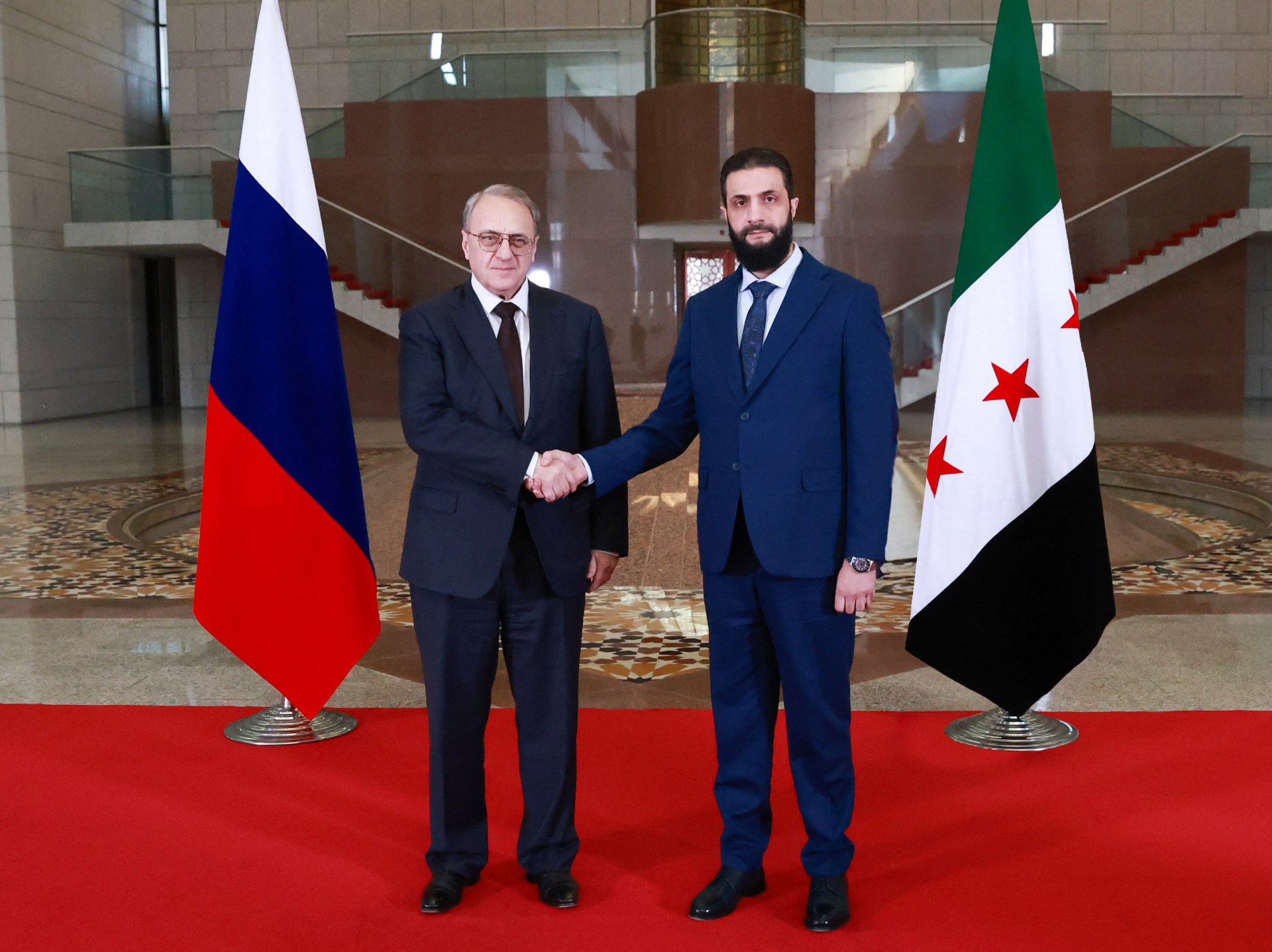
Russian statements towards the new administration in Damascus were characterized by positive, and the desire to build a strategic partnership relationship between the two countries.
The Russian envoy to Syria, Mikhail Bogdanov, confirmed on the first visit to Syria after the fall of the regime that “Russia is keen on the unity, independence and integrity of the Syrian territories,” adding that the visit comes in the context of “strengthening historical relations between Russia and Syria according to the base of common interests.”

