

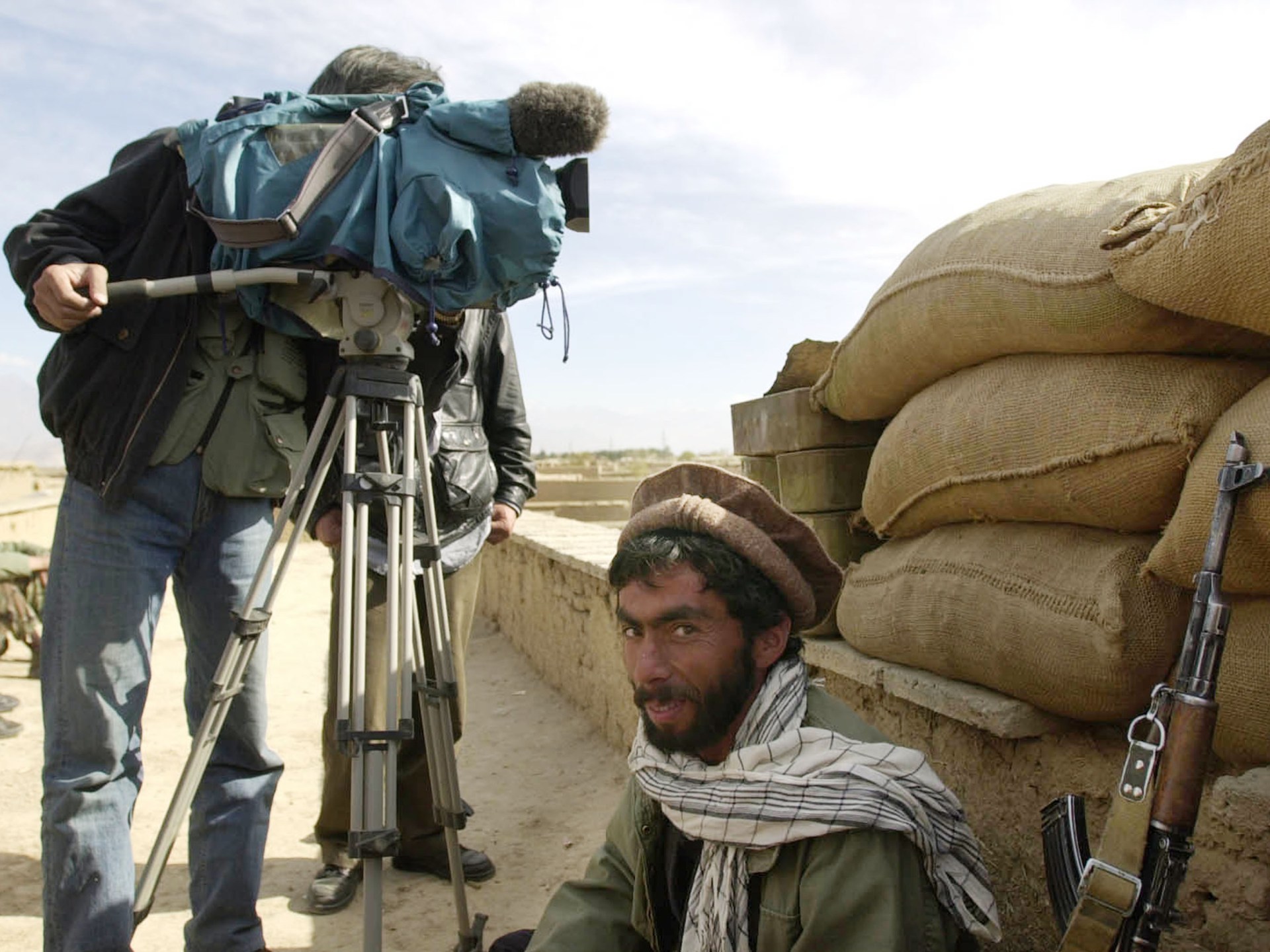
Afghanistan remained contracts, a fixed article in international and Arab news bulletins, but they were often evoked when the battles, bombings, or armies withdrawal.
A locked country, a stereotype almost change, a gun in the hands of a child, a veiled woman crying behind a destroyed wall, and fighters on the mountain peaks, but, is this the full picture? Did the media really transfer Afghanistan as it is?
Between amplification and blackout
The September 11, 2001 attacks constituted a fundamental turning point in the dealing of the international media, Afghanistan, where Western coverage, especially the American, adopted the “war on terror”, the country’s introduction as a dangerous area that houses the Taliban and Al Qaeda, with a clear ignorance of the complications of the political, social and historical reality that paved this situation.
The American media promoted its major networks, to a picture that linked Islam in Afghanistan and terrorism, ignoring decades of foreign occupation, developmental weakness, and regional and international interventions that increased the fragility of the state and society.
According to a study of a research team at the University of Kardan in Kabul, this coverage contributed to the formation of a bilateral perception of the world, dividing the people into “good” represented by the West, and “bad guys” represented in its opponents, which is a logic that was manifested in George Bush’s famous speech: “Either you are with us or with the terrorists.”
In his speech in Cleveland in 2006, President Bush used the word “terrorism” 54 times, according to American journalist Sydney Blumena, in an attempt to stir up feelings of fear and sympathy among the Americans.
In the midst of preparing for the American invasion, the media used images of veiled Afghan women in “dark” scenes under the rule of the Taliban, to feed a humanitarian speech that justifies military intervention.
The war was offered as a project to liberate women and build a modern state, while the voices of real women, especially from villages and remote areas, were absent in favor of models that speak the language of the West or adopt its vision.
In this, the Afghan researcher Abdel -Shahid Mayar believes that the Bush administration adopted two parallel narratives:
- Political raises the slogan “democracy and the liberation of the people.”
- Humanity focuses on saving women.
The aim of both accounts was to mobilize popular support for the war, adding that these narratives were adopted without criticism from the major American media, which gave the war a false moral cover.

Laura on her husband’s line
Even the wife of US President Laura Bush entered the campaign line with radio messages attacking the Taliban and defending the rights of women, but many researchers indicate that this was not a sincere commitment to women’s issues, but rather a political investment for their tragedy to serve the goals of the war.
The Afghan journalist Fatima Taherian from the city of Herat summarized the situation: “The West did not care about our rights, but rather was looking for moral legitimacy to intervene, they only highlighted those who spoke in their language.”
This media handling -as the late thinker Edward Said reflects an Orientalist view that sees the “other” Muslim who is a minor being unable to manage his affairs and needs an external guardianship.
Instead of the media being a bridge to transfer reality, in many cases it turned into a tool for a ready -made narrative that serves major policies, and excludes real sounds from the scene.
Thus, Afghanistan has turned from a country burdened with a long history of conflicts and occupation, into a reduced image in a Western discourse, which reduced the suffering of millions in the dualism of good and evil, without regard to local complexity or the truth of what its people live daily under the weight of war, poverty and division.

American invasion
Despite the continued American military presence in Afghanistan for nearly two decades, the majority of Western media coverage was distinguished in the period of the American invasion of Afghanistan, and adopted a functional speech subject to political priorities.
I will highlight the suffering of some groups with a broader ignorance of the complexities of Afghan reality and multiple sounds inside it.
Some specialists believe that the Western media did not pay serious attention to the transfer of the suffering of the Afghan people under occupation, and the deep structural challenges that faced the emerging Afghan state have not emerged.
Western media coverage focused on stories that serve the official novel, such as building schools, promoting women’s rights and development projects, in exchange for deliberate ignorance of the issues of rampant corruption, political exclusion, and the grave violations committed by foreign forces.
The Western media often adopted a justification narrative of the war, promoting official data, overlooking the heavy human cost.
In the coverage of the battle of Kunduz in 2009, for example, major American and Western newspapers drained to celebrate “the success of air strikes in eliminating the Taliban”, while the massacres that claimed the lives of civilians, including children, did not enjoy marginal signals in internal pages and hesitantly.
The investigative press office estimates that the United States carried out more than 13,000 drone attacks in Afghanistan between 2015 and 2020, killing up to 10,000 people, and September 2019 was the highest in terms of raid density, by about 1110 air strikes during it.
The file of the Secret CIA prisons in Afghanistan, and the systematic torture practices in it, remained absent from the American and British media coverage for a long time, and was only open under the pressure of human rights organizations reports, and after years of silence.
https://www.youtube.com/watch?v=uxw7zx3a8Ri
American withdrawal coverage
With the chaotic withdrawal of the American forces in August 2021, the international media focused on chaos scenes at Kabul Airport, and the state of panic that prevailed in the country.
The deep analyzes that are looking for the reasons for the failure of the Western project in Afghanistan were absent, and the international powers are responsible for the political and military collapse, and many media were satisfied with depicting the situation as an internal Afghan failure, without referring to the strategic failure of Western policies.
In this context, a professor in political psychology, Richard Lesman, believes that “media coverage is very narrow and focuses only on the scenes of Afghans who are trying to leave and chaos at the airport.” He adds that this “does not give the true picture of what happened in the last 20 years.”

Traditional Arab media echo international novels
After the events of September 11 and the subsequent developments in Afghanistan, in addition to some objective coverage that reflect the Afghan reality, most Arab media coverage was characterized by the repetition of Western narratives without scrutiny or critical reading.
The majority of Arab channels – with the exception of some media channels and platforms – lacked independent field investigations, and absent cultural, linguistic and religious diversity in the country, as well as the civil and educational initiatives that local communities beats.
It is noteworthy that the Arab media discourse, in its entirety, adopted the novel “War on Terror” as it was formulated by Western institutions, without taking into account the complexities of Afghan society or verifying the field.
This led to the transmission of a distorted and unbalanced image of reality, as the Afghan writer Abdullah Qadi Zadeh, who confirms that “the Arab media with rare exceptions, including Al -Jazeera, was not independent in its coverage of Afghanistan, but rather was either affiliated with the Western discourse or was a tool of regional agendas seeking to settle political accounts.”
This politicization was evident in the way of eating the Afghan file, as some Arab media platforms used it as a propaganda tool. While some channels sought to hold regional countries responsible for the deterioration of the situation in Afghanistan, others made from Afghanistan a model for the failure of the American project.
Some Arab media have presented members of the Taliban and Afghan Mujahideen in some cases as a threat representing the “danger of political Islam”, while other platforms went to polish the image of the Taliban as a moderate movement “that changed from what it was in its first reign 1996-2001”.
Between the demonization and polishing, the balanced narration and professional analysis were absent, and the Afghan file turned into a mirror on which regional conflicts have nothing to do with the local reality.
In both cases, the real journalist was absent and attended the propaganda speech, which made the suffering of the Afghan people a substance for political investment, not a subject of media research and fairness.

Reducing the narrative in the “victim and the executioner” dualism
One of the most prominent problems of media coverage of Afghan affairs is excessive reduction, as society was often divided into only two parties: the executioner, represented by the Taliban, armed groups, and the victim, represented by women, children and refugees.
This simplicity ignored the rich diversity in Afghan society from intellectual elites and civil, youth and women’s initiatives, and contributed to distorting the image of the country and devoting stereotypes.
Among the factors that strengthened this stereotype is the weak local representation within the international editing rooms. In major media institutions, Afghan journalists are rarely given an opportunity to formulate the novel or editing, but rather in turn as translators or field assistants.
“We know the reality, but the last word of the editor in London or Washington,” says veteran journalist Nour Allah Safi – a pseudonym – who worked with the BBC in Kabul.
This marginalization is in line with the phenomenon of “paratroopers” who are temporarily sent to cover events without sufficient knowledge of the country, which leads to superficial and terrifying reports that reflect prior perceptions instead of the complex reality.
The researcher, Sayed Sorour Hashemi, describes these coverage as “deeper and accurate, and offends the Afghan context.”

Media without balance
Although about 4 years have passed since the Taliban control, the majority of Western and Arab coverage are still swinging between full demonization and absolute justification, without a balanced professional approach.
Some Western and Arab media institutions ignore field transformations in Afghanistan under the rule of the Taliban, such as improved security, low violence rates, a significant reduction in drug trafficking, the cohesion of central administration, and a relative improvement in some economic indicators, such as the stability of Afghan currency and low inflation.
The researcher Abdullah Aref believes, “Equity requires reference to these facts, even with fundamental criticism of the Taliban’s performance in the files of politics and rights.”
On the other hand, some media outlets in Arab and Islamic countries adopt an exaggerated speech in sympathy for the Taliban, in which they ignore a number of fundamental violations, most notably the absence of any constitution for the country, the monopoly of power of one category, prevent active political participation and reject the principle of elections.
The Afghan human rights activist, Maryam Mahmoudi, describes this media handling as “adoption of the official account at the expense of field facts.”

The absence of the voice of the silent majority
What the majority of media coverage, whether in the West or the Arab world, is the existence of the “third vote” in Afghanistan, the wide popular current that does not belong to the Taliban or the previous regime, but demands radical reforms and build a fair and comprehensive system of government for all components of the Afghan people.
This current consists of large segments of Sharia scholars, intellectuals, academics, journalists, and civil activists, who reject violence, civil war, exclusion, corruption and tyranny, and they call for a gradual peaceful transition towards a rule that reflects the popular will and guarantees rights and freedoms within the framework of the constitution and the law.
The writer and journalist, Shams Rahmani, says, “We are the silent majority, we carry the country’s concern and aspire to build a future that goes beyond polarization and fragmentation,” and the absence of these voices deepens from the blurring of the scene and prevents the international community from realizing the Afghan reality in its multiplicity and complexity.
Ethical and professional challenges
The international and Arab media coverage of the Afghan affairs was not immune to ideological and political biases, as many of them dominated the absence of balance, weak local representation in news rooms, and resorting to easy stereotypes.
These factors combined contributed to the production of a surface and simplified novel of a complex reality that a whole society suffers.
In this context, observers believe that the responsibility of press institutions is not limited to the transmission of the news, but rather to it to the necessity of representing different views, providing space for local journalists, and holding the prevailing narratives with a serious critical analysis.
“He collides with serious field challenges,” said Basir Ahmed Danchear, a former professor of media at Herat University and Vice President of the Organization for Afghan Journalists, to Al -Jazeera Net.
The media palaces in providing a comprehensive image of Afghanistan not only a professional failure, but part of a continuous cognitive injustice, and the transgression of this defect requires rebuilding confidence, expanding the margin of freedom for local journalists, and listening to the voices that have long been marginalized.

