

1/8/2025–|Last update: 07:47 (Mecca time)
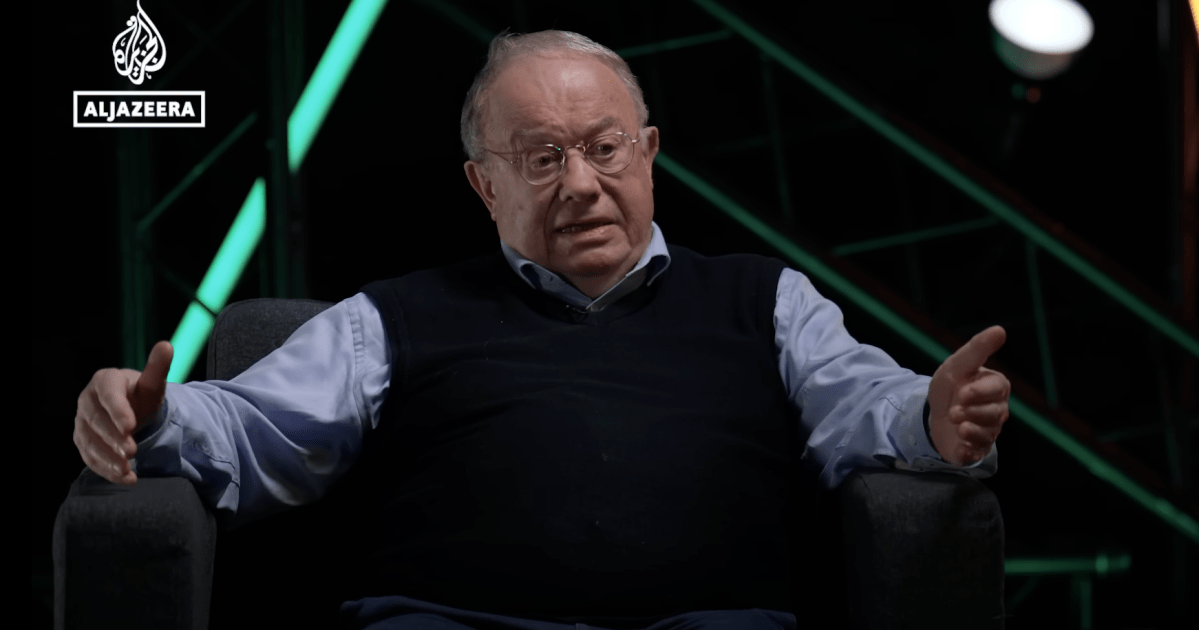
In an in -depth dialogue with the thinker and professor of oriental studies, Olivier Roa (born in 1949), the French academic presented a radical critical reading of the course of the relationship between the West and the Islamic world, focusing on the development of the concept of Orientalism and its transformations, and the role of Western discourse in producing negative perceptions of Islam and Muslims, and its use of concepts such as progress and human rights as colonial tools covered with a moral mule.
This came in the dialogue of the director of “Al -Jazeera 360”, Jamal Al -Shayal, with Roa, Director of the Research Center for Scientific Research and the Director of the former French Social Sciences Studies, within the center of the English island, which hosts personalities from influential thought leaders and explores their views on urgent global issues.
Roa began his work in Afghanistan, to which a boy went in 1969 when he had barely finished his secondary school (Lycee) and went to be brought up and wandered in the streets of Kabul and exploring life in the cities of the East, and later the Central Asia studied in the cities of Uzbekistan and the ancient Tajikistan, before returning to Paris and obtaining the PhD of Philosophy, and studying in several French universities and institutes.
He presented important books in the sociology of Islam and religions, most of which were translated into Arabic, including “Islam and secularism, sacred ignorance … a time of religion without culture, jihad and death, globalization of Islam, the failure of political Islam” and others, and Al -Jazeera Net hosted Roa to talk about the future of religions, identity and secularism, and the following is the most prominent of his ideas during the interview:
From admiration to hegemony
Roa confirms that Orientalism was not only the product of the colonial era, but rather preceded it. The late 18th century has arisen as an academic cognitive field centered on the study of the “East” as a distinguished civilization. The first orientalist in Europe was a fan of Islamic civilization, but they looked at it as a glorious flood, as it was related to the present.
He believes that this view penetrated into the Western discourse, as it was considered that the Islamic world “missed progress and secularism” and that he must start again, and to learn from the West the path of “modernity”. Roa notes that this trend was not limited to the West, but was adopted by a number of political leaders in the Islamic world, such as Mustafa Kemal Ataturk, who saw the necessity of erasing traditional educational and cultural institutions and building “modern” institutions on the Western model.
Secularism as a means of control
Roa criticizes the Western hypothesis that “progress is achieved only through secularism” and considers that it has been circulated to become a civilized condition for belonging to the modern era.
He adds that this vision was not innocent, but rather a politician in the context of colonialism. It is set for example in France, which was not initially concerned with the culture of Algeria, but later established institutions such as Islamic Sharia colleges with a French administration, not with the aim of recognizing local culture but rather with the aim of controlling it and reproducing it to serve the dominance of the colonizer.
Universal
Roa criticizes sharply the Western use of human rights discourse, and confirms that the Universal Declaration of Human Rights in 1947 was with a semi -exclusive Western representation, which made the supposed “global” tend to be “a source of western privacy”.
It indicates that this discourse has turned into a way to impose a specific cultural model, which ignores or classifies local contexts as an opposition to cosmic concepts, such as religion or non -Western societal values.
It is set, for example, with varying Western positions on global issues, such as the war in Ukraine and the massacres in Gaza, to explain that what is supposed to be an initial position is “adapted according to the geopolitical interest.”
From civilization to “the problem of Islam”
Roa shows that the most dangerous shift in modern Orientalist discourse is to remove from the vision of “Islamic East as a civilization” to seeing it as a “religious problem”. Since the 1970s, Islam has not been seen as a cultural component, but rather a direct threat to the West, and turned into a “pretext for criminalizing Islamic societies.” Religious symbols such as the veil or abstinence from alcohol have become automatically connected to authoritarianism and the absence of freedoms.
He adds that Islam is no longer treated as part of the diversity of cultures, but rather as an initial enemy of human rights, in a vision that is reduced to the title “Islam against modernity.”
Contemporary West Crisis: Identity instead of principles
Roa says that the West is witnessing a decline today from the “cosmic value discourse” to “the discourse of identity and exclusion”, specifically with the escalation of populist discourse. It is set for example in France, where Islamic religious manifestations are treated as a threat to the unity of the nation, although its constitutions stipulate freedom of belief. It indicates that the paradox is that those countries that claim to spread pluralism abroad seek to obscure diversity internally.
He adds that Western democracies are suffering from a structural crisis, and not “exposed to the threat of Islam” as they are promoted, but are lying from the inside by populist movements, while Muslims of the first and second generations in Europe often believe in democracy and want to integrate, but with respect for their religious freedom.
Roa notes that Muslims in the West are calling for guaranteed rights to constitutions, such as the right to religious manifestations or halal food, but they are being rejected. He says that Muslims are not against democracy, but they are also depicted in Western political discourse, and this discourse is being invested for internal political purposes.
It indicates that the difference in dealing with Islamic political parties, compared to the emerging extremist nationalist parties in Europe, such as “National Rally” in France and “Alternative for Germany” shows the same as standards, as Islamists are forbidden to practice politics, while the extremist right is allowed to expand in power.
The Orientalist crisis and the dilemma of the West
Roa concludes that the Western world today lives an internal struggle between the principles of cosmic, identity tendencies and exclusion. He says that the conflict is no longer between two civilizations, as Samuel Huntington went, but rather between identity and principle, in light of the transformation of Islam in the Western imagination to a fundamental threat, not just a cultural or religious difference.
The French thinker and academic concludes that the dilemma of the West lies in its failure to achieve equality at home, the duplication of his standards abroad, and his belief in the values of the institution itself, on top of which is democracy.

